
History and Development of the mysteries of Mithras, and the scholarship about it
In antiquity, texts refer to "the mysteries of Mithras", and to its adherents, as "the mysteries of the Persians."1 But there is great dispute about whether there is really any link with Persia, and its origins are quite obscure.2
The mysteries of Mithras were not practiced until the 1st century AD.3 The unique underground temples or Mithraea appear suddenly in the archaeology in the last quarter of the 1st century AD.4
1. Early archaeology
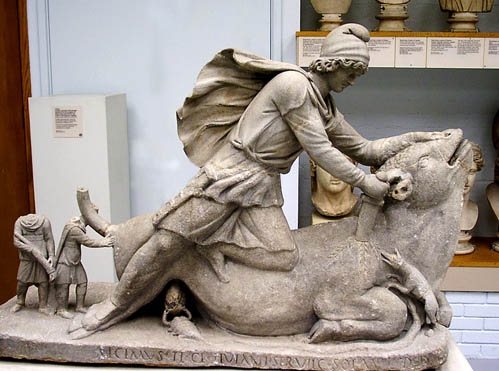
No monument which is certainly Mithraic can be securely dated earlier than the end of the 1st century AD.5
The earliest Mithraic monument is thought to be CIMRM 593. This is a depiction of Mithras killing the bull, found in Rome. There is no date, but the inscription tells us that it was dedicated by a certain Alcimus, steward of T. Claudius Livianus. Vermaseren and Gordon believe that this Livianus is a certain Livianus who was commander of the Praetorian guard in 101 AD, which would give an earliest date of 98-99 AD.6
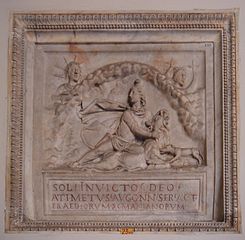
CIMRM 362, an altar or block from near SS. Pietro e Marcellino on the Esquiline in Rome was inscribed with a bilingual inscription by an Imperial freedman named T. Flavius Hyginus, probably between 80-100 AD. It is dedicated to Sol Invictus Mithras.7
CIMRM 2268-2269 is either an altar, or the broken base of a statue, and comes from Novae/Steklen in Moesia Inferior. It has an inscription which refers to an individual who held office ca. 100 AD.8
Other early archaeology includes the Greek inscription from Venosia by Sagaris actor probably from 100-150 AD; the Sidon cippus dedicated by Theodotus priest of Mithras to Asclepius, 140-141 AD; and the earliest military inscription, by C. Sacidius Barbarus, centurion of XV Apollinaris, from the bank of the Danube at Carnuntum, probably before 114 AD.9
The last is the earliest archaeological evidence outside Rome for the Roman worship of Mithras, a record of Roman soldiers who came from the military garrison at Carnuntum.10 The earliest dateable Mithraeum outside Rome dates from 148 AD.11 The Mithraeum at Caesarea Maritima is the only one in Palestine and the date is inferred.12
1.1. Earliest dateable archaeology
The attested locations of the cult in the earliest phase (c. 80-120 AD) are as follows:13
Mithraea datable from pottery:
- Nida/Heddernheim III (Germania Sup.)
- Mogontiacum (Germania Sup.)
- Pons Aeni (Noricum)
- Caesarea (Judaea)
Datable dedications:
- Nida/Heddernheim I (Germania Sup.) (CIMRM 1091/2, 1098)
- Carnuntum III (Pannonia Sup.) (CIMRM 1718)
- Novae (Moesia Inf.) (CIMRM 2268-2269)14
- Oescus(Moesia Inf.)(CIMRM 2250)
- Rome(CIMRM 362, 593-594)
Datable literary reference:
- Rome (Statius, Thebaid, 1.719-20)
1.2. The Kerch plaques
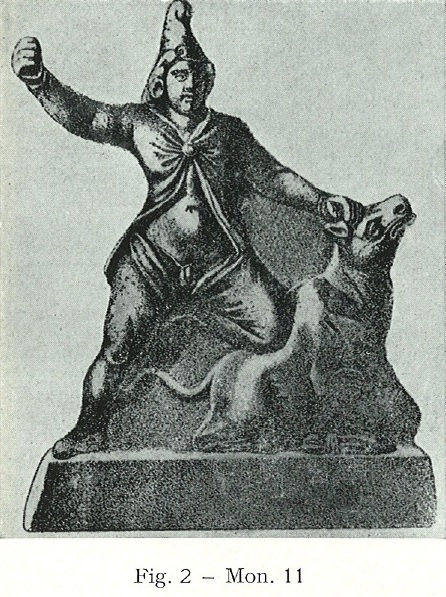
Five small terracotta plaques of a figure holding a knife over a bull have been excavated near Kerch in the Crimea. Two have been included in the CIMRM as CIMRM 11 and CIMRM 12. The bull-slaying figure wears a Phrygian cap, but is otherwise unlike standard depictions of the tauroctony.15
There are differences of opinion over the date. Beskow, who believes that the cult of Mithras originated here and diffused from here, dates them to the second half of the 1st century BC,16, Clauss in Gordon's translation dates them to 50 BC,17 and Beck dates them to between 50 BC-50 AD.18
2. Earliest literary references
The earliest surviving ancient literary text that can be associated with the Mysteries of Mithras is in Statius c. 80 AD, who makes an enigmatic reference, possibly to the tauroctony.19 Dio Cassius, describing the visit of Tiridates to the emperor Nero in 63 AD, refers to his worshipping Mithras; but the context suggests that the Persian Mitra is intended.20
3. Ancient statements about the origins of the mysteries
There are a couple of statements in the literary sources which give an account of how the cult came into existence. These have tantalised scholars, particularly since the archaeological evidence tells a different story.
3.1. Plutarch
The Greek biographer Plutarch (46 - 127) says that the pirates of Cilicia, the coastal province in the southeast of Anatolia, were the origin of the Mithraic rituals that were being practiced in Rome in his day: "They likewise offered strange sacrifices; those of Olympus I mean; and they celebrated certain secret mysteries, among which those of Mithras continue to this day, being originally instituted by them." (Life of Pompey 24, referring to events c. 68 BC). The 4th century commentary on Vergil by Servius says that Pompey settled some of these pirates in Calabria.21 But whether any of this relates to the origins of the mysteries is unclear.22
3.2. Porphyry
According to 3-4th century AD philosopher Porphyry, the myth of Mithras said that their cult was founded by Zoroaster.23 But Porphyry is writing at a late period, close to the demise of the cult, and modern scholar Robert Turcan has challenged the idea that Porphyry's statements about Mithraism are accurate. His case is that far from representing what Mithraists believed, they are merely representations by the neo-platonists of what it suited them in the late 4th century to read into the mysteries.24 Merkelbach and Beck believe that Porphyry's work "is in fact thoroughly coloured with the doctrines of the Mysteries."25
4. Scholarly opinions about origins
4.1. Cumont's hypothesis: possible origins in Persian Zoroastrianism
Scholarship on Mithras begins with Franz Cumont, who published a two volume collection of source texts and images of monuments in French in 1894-1900. Cumont's hypothesis, as the author summarizes it in the first 32 pages of his book, was that the Roman religion was "the Roman form of Mazdaism",26 the Persian state religion, disseminated from the East.
Cumont's theories were examined and largely rejected at the First International Congress of Mithraic Studies held in 1971. Two papers, by John Hinnells, and by Richard Gordon, in the published collection of papers reflect this but the consensus was general. Roger Beck has stated Cumont's view is "rightly gone" and that "we shall probably never see it again."27 John Hinnells was unwilling to reject entirely the idea of Iranian origin,28 but wrote: "we must now conclude that his reconstruction simply will not stand. It receives no support from the Iranian material and is in fact in conflict with the ideas of that tradition as they are represented in the extant texts. Above all, it is a theoretical reconstruction which does not accord with the actual Roman iconography."29 He discussed Cumont's reconstruction of the bull-slaying scene and stated "that the portrayal of Mithras given by Cumont is not merely unsupported by Iranian texts but is actually in serious conflict with known Iranian theology."30 Another paper by R. L. Gordon argued that Cumont severely distorted the available evidence by forcing the material to conform to his predetermined model of Zoroastrian origins. Gordon suggested that the theory of Persian origins was completely invalid and that the Mithraic mysteries in the West was an entirely new creation.31
Mary Boyce states that "no satisfactory evidence has yet been adduced to show that, before Zoroaster, the concept of a supreme god existed among the Iranians, or that among them Mithra - or any other divinity - ever enjoyed a separate cult of his or her own outside either their ancient or their Zoroastrian pantheons."32
Cumont's pupil, Maarten Vermaseren, likewise rejected Cumont's theory in 1975, stating that the idea of an Iranian substrate was not true for the mysteries.33 The hymns of Santa Prisca show no relationship to Parseeism, the modern version of Zoroastrianism, he stated; and we cannot reasonable place the origin of Mithras in Turkey, after so much archaeological work has been done. Instead it must be seen as a western product of the Graeco-Roman world.34
Beck tells us that since the 1970s scholars have generally rejected Cumont, but adds that recent theories about how Zoroastrianism was during the period BC now makes some new form of Cumont's east-west transfer possible.35 "Apart from the name of the god himself, in other words, Mithraism seems to have developed largely in and is, therefore, best understood from the context of Roman culture."36
4.2. Modern theories
Beck believes that the cult was created in Rome, by a single founder who had some knowledge of both Greek and Oriental religion, but suggests that some of the ideas used may have passed through the Hellenistic kingdoms: "Mithras - moreover, a Mithras who was identified with the Greek Sun god, Helios, ... was one of the deities of the syncretic Graeco-Iranian royal cult founded by Antiochus I, king of the small, but prosperous "buffer" state of Commagene, in the mid first century BC.37
Merkelbach suggests that its mysteries were essentially created by a particular person or persons38 and created in a specific place, the city of Rome, by someone from an eastern province or border state who knew the Iranian myths in detail, which he wove into his new grades of initiation; but that he must have been Greek and Greek-speaking because he incorporated elements of Greek platonism into it. The myths, he suggests, were probably created in the milieu of the imperial bureaucracy, and for its members.39 Clauss tends to agree. Beck calls this "the most likely scenario" and states "Till now, Mithraism has generally been treated as if it somehow evolved Topsy-like from its Iranian precursor -- a most implausible scenario once it is stated explicitly."40
Archaeologist Lewis M. Hopfe notes that there are only three Mithraea in Roman Syria, in contrast to further west. He writes: "archaeology indicates that Roman Mithraism had its epicenter in Rome... the fully developed religion known as Mithraism seems to have begun in Rome and been carried to Syria by soldiers and merchants."41
Taking a different view from most modern scholars, Ulansey argues that the Mithraic mysteries began in the Greco-Roman world as a religious response to the discovery by the Greek astronomer Hipparchus of the astronomical phenomenon of the precession of the equinoxes - a discovery that amounted to discovering that the entire cosmos was moving in a hitherto unknown way. This new cosmic motion, he suggests, was seen by the founders of Mithraism as indicating the existence of a powerful new god capable of shifting the cosmic spheres and thereby controlling the universe.42
Ware asserted that the Romans who founded the cult borrowed the name "Mithras" from Avestan Mithra.43
5. Mithras in the 2nd and 3rd centuries
The first important expansion of the mysteries in the Empire seems to have happened quite quickly, late in the reign of Antoninus Pius and under Marcus Aurelius. By this time all the key elements of the mysteries were in place.44
Mithraism reached the apogee of its popularity during the 2nd and 3rd centuries, spreading at an "astonishing" rate at the same period when Sol Invictus became part of the state religion.45
At this period a certain Pallas devoted a monograph to Mithras, and a little later Euboulus wrote a History of Mithras, although both works are now lost.46
According to the possibly spurious 4th century Historia Augusta, the emperor Commodus participated in its mysteries.47 But it never became one of the state cults.48
6. The end of the Mithras cult
It is difficult to trace when the cult of Mithras came to an end. Beck states that "Quite early in the [fourth] century the religion was as good as dead throughout the empire."49 Inscriptions from the 4th century are few. Clauss states that inscriptions show Mithras as one of the cults listed on inscriptions by pagan senators in Rome as part of the "pagan revival" among the elite.50
There is virtually no evidence for the continuance of the cult of Mithras into the 5th century. In particular large numbers of votive coins deposited by worshippers have been recovered at the Mithraeum at Pons Sarravi (Sarrebourg) in Gallia Belgica, in a series that runs from Gallienus (253-68) to Theodosius I (379-395). These were scattered over the floor when the Mithraeum was destroyed, as Christians apparently regarded the coins as polluted; and they therefore provide reliable dates for the functioning of the Mithraeum.51 It cannot be shown that any Mithraeum continued in use in the 5th century. The coin series in all Mithraea end at the end of the 4th century at the latest. The cult disappeared earlier than that of Isis. Isis was still remembered in the middle ages as a pagan deity, but Mithras was already forgotten in late antiquity.52
Cumont stated in the English edition of his book that Mithraism may have survived in certain remote cantons of the Alps and Vosges into the 5th century, but the reference was only given in the French text, and was to the date of the coins in the Mithraeum at Pons Sarravi, none of which are in fact 5th century.53
7. Late archaeology
These seem to be the latest monuments of Mithras.54
- CIMRM 420, is an inscription on a base from Rome, dated to 387 AD, giving the titles of Vettius Agorius Praetextatus, who is listed as Pater Patrorum on his tomb.
- CIMRM 76, from Sidon has an inscription with a local date of "500", which may be equivalent to 389 AD.
- The Hawarti mithraeum contained a coin of Arcadius, and perhaps was in use at the very end of the 4th century AD.55
| 1 | Roger Beck, Mithraism article in Encyclopaedia Iranica website, 2002. |
| 2 | See detailed discussion of possible origins below. |
| 3 | Manfred Clauss, The Roman cult of Mithras, tr. Richard Gordon, Edinburgh, 2000. |
| 4 | Roger Beck, "The Mysteries of Mithras: A New Account of their Genesis", Journal of Roman Studies, 1998, 115-128. p. 118. |
| 5 | Vermaseren, M.J., Mithras: the Secret God, p. 29: "One other point of note is that no Mithraic monument can be dated earlier than the end of the first century AD, and even the more extensive investigations at Pompeii, buried beneath the ashes of Vesuvius in AD 79, have not produced a single image of the god." |
| 6 | Richard Gordon, "The date and significance of CIMRM 593 (British Museum, Townley Collection)", Journal of Mithraic Studies 2, 1978, p.148-174. Online here. |
| 7 | Richard Gordon, "The date and significance of CIMRM 593 (British Museum, Townley Collection)", Journal of Mithraic Studies 2, 1978, p.148-174. Online here. On p.151 this states that CIMRM 362 a , b = CIL VI 732 = Moretti, lGUR I 179 contains the following: "Soli | Invicto Mithrae | T . Flavius Aug. lib. Hyginus | Ephebianus | d . d." The inscription is bilingual, and the title in the Greek side is just "`Hliwi Mithrai". On p.152 the author writes that the name "Flavius" for an imperial freedman dates it between 70-136 AD. The Greek section refers to a pater of the cult named Lollius Rufus, evidence of the existence of the rank system at this early date. |
| 8 | Richard Gordon, "The date and significance of CIMRM 593 (British Museum, Townley Collection)", Journal of Mithraic Studies 2, 1978, p.148-174. Online here. p. 153. |
| 9 | Richard Gordon, "The date and significance of CIMRM 593 (British Museum, Townley Collection)", Journal of Mithraic Studies 2, 1978, p.148-174. Online here. p. 150. |
| 10 | C. M. Daniels, "The Roman army and the spread of Mithraism" in John R. Hinnells, Mithraic Studies: Proceedings of the First International Congress of Mithraic Studies, vol. 2, 1975, Manchester UP, pp.249-274. "The considerable movement [of civil servants and military] throughout the empire was of great importance to Mithraism, and even with the very fragmentary and inadequate evidence that we have it is clear that the movement of troops was a major factor in the spread of the cult. Traditionally there are two geographical regions where Mithraism first struck root: Italy and the Danube. Italy I propose to omit, as the subject needs considerable discussion, and the introduction of the cult there, as witnessed by its early dedicators, seems not to have been military. Before we turn to the Danube, however, there is one early event (rather than geographical location) which should perhaps be mentioned briefly in passing. This is the supposed arrival of the cult in Italy as a result of Pompey the Great's defeat of Cicilian pirates, who practiced 'strange sacrifices of their own... and celebrated certain secret rites, amongst which those of Mithras continue to the present time, have been first instituted by them'. (ref Plutarch, "Pompey" 24-25) Suffice it to say that there is neither archaelogical nor allied evidence for the arrival of Mithraism in the west at that time, nor is there any ancient literary reference, either contemporary or later. If anything, Plutarch's mention carefully omits making the point that the cult was introduced into Italy at that time or by the pirates. Turning to the Danube, the earliest dedication from that region is an altar to Mitrhe (sic) set up by C. Sacidus Barbarus, a centurion of XV Appolinaris, stationed at the time at Carnuntum in Pannonia (Deutsch-Altenburg, Austria). The movements of this legion are particularly informative." The article then goes on to say that XV Appolinaris was originally based at Carnuntum, but between 62-71 transferred to the east, first in the Armenian campaign, and then to put down the Jewish uprising. Then 71- 86 back in Carnuntum, then 86-105 intermittently in the Dacian wars, then 105-114 back in Carnuntum, and finally moved to Cappadocia in 114. |
| 11 | C. M. Daniels, "The Roman army and the spread of Mithraism" in John R. Hinnels, Mithraic Studies: Proceedings of the First International Congress of Mithraic Studies, vol. 2, 1975, Manchester UP, p. 263. The first dateable Mithraeum outside italy is from Böckingen on the Neckar, where a centurion of the legion VIII Augustus dedicated two altars, one to Mithras and the other (dated 148) to Apollo. |
| 12 | Lewis M. Hopfe, "Archaeological indications on the origins of Roman Mithraism", in Lewis M. Hopfe (ed). Uncovering ancient stones: essays in memory of H. Neil Richardson, Eisenbrauns (1994), pp. 147-158. p.153: "At present this is the only Mithraeum known in Roman Palestine." p. 154: "It is difficult to assign an exact date to the founding of the Caesarea Maritima Mithraeum. No dedicatory plaques have been discovered that might aid in the dating. The lamps found with the taurectone medallion are from the end of the first century to the late third century A.D. Other pottery and coins from the vault are also from this era. Therefore it is speculated that this Mithraeum developed toward the end of the first century and remained active until the late third century. This matches the dates assigned to the Dura-Europos and the Sidon Mithraea." |
| 13 | "Beck on Mithraism", pp. 34-35. Online here. |
| 14 | Richard Gordon, "The date and significance of CIMRM 593 (British Museum, Townley Collection)", Journal of Mithraic Studies 2, 1978, p.148-174. Online here. p. 153. |
| 15 | Per Beskow, The routes of early Mithraism, in Études mithriaques Ed.Jacques Duchesne-Guillemin. p.14: "The plaques are typical Bosporan terracottas... At the same time it must be admitted that the plaques have some strange features which make it debateable if this is really Mithra(s). Most striking is the fact that his genitals are visible as they are in the iconography of Attis, which is accentuated by a high anaxyrides. Instead of the tunic and flowing cloak he wears a kind of jacket, buttoned over the breast with only one button, perhaps the attempt of a not so skillful artist to depict a cloak. The bull is small and has a hump and the tauroctone does not plunge his knife into the flank of the bull but holds it lifted. The nudity gives it the character of a fertility god and if we want to connect it directly with the Mithraic mysteries it is indeed embarrassing that the first one of these plaques was found in a woman's tomb." Roger Beck, Mithraism since Franz Cumont, Aufsteig und Niedergang der romischen Welt II 17.4 (1984), p. 2019: "Their iconography is significantly different from that of the standard tauroctony (e.g. in the Attis-like exposure of the god's genitals)." Clauss, p.156: "He is grasping one of the bull's horns with his left hand, and wrenching back its head; the right arm is raised to deliver the death-blow. So far, this god must be Mithras. But in sharp contrast with the usual representations, he is dressed in a jacket-like garment, fastened at the chest with a brooch, which leaves his genitals exposed - the iconography typical of Attis." |
| 16 | Per Beskow, The routes of early Mithraism, in Études mithriaques Ed.Jacques Duchesne-Guillemin. p.14: "Another possible piece of evidence is offered by five terracotta plaques with a tauroctone, found in Crimea and taken into the records of Mithraic monuments by Cumont and Vermaseren. If they are Mithraic, they are certainly the oldest known representations of Mithras tauroctone; the somewhat varying dates given by Russian archaeologists will set the beginning of the first century C.E. as a terminus ad quem, which is also said to have been confirmed by the stratigraphic conditions." Note 20 gives the publication as W. Blawatsky / G. Kolchelenko, Le culte de Mithra sur la côte spetentrionale de la Mer Noire, Leiden 1966, p.14f. |
| 17 | Clauss, The Roman cult of Mithras, p.156-7 merely mentions the date and presumes that the deity is Mithras-Attis; but the date is not mentioned in Clauss' original text in German. |
| 18 | Roger Beck, Mithraism since Franz Cumont, Aufsteig und Niedergang der romischen Welt II 17.4 (1984), p. 2019: "...the area [the Crimea] is of interest mainly because of the terracotta plaques from Kerch (five, of which two are in CIMRM as nos 11 and 12). These show a bull-killing figure and their probable date (second half of first-century BC to first half of first AD) would make them the earliest tauroctonies - if it is Mithras that they portray. Their iconography is significantly different from that of the standard tauroctony (e.g. in the Attis-like exposure of the god's genitals). Beskow (1978) has proposed the Crimea as the early centre from which the cult was disseminated via Moesia into the Roman world.[25]" |
| 19 | Statius, Thebaid (Book i. 719,720): "Mithras twists the unruly horns beneath the rocks of a Persian cave." |
| 20 | Dio, Cassius, Epitome of Book 63, 5:2. |
| 21 | The sources and references may be found here. |
| 22 | C.M.Daniels, "The role of the Roman army in the spread and practice of Mithraism" in John R. Hinnells (ed) Mithraic Studies: proceedings of the first International congress of Mithraic Studies, Manchester University Press (1975), vol. 2, p. 250: "Traditionally there are two geographical regions where Mithraism first struck root in the Roman empire: Italy and the Danube. Italy I propose to omit, as the subject needs considerable discussion, and the introduction of the cult there, as witnessed by its early dedicators, seems not to have been military. Before we turn to the Danube, however, there is one early event (rather than geographical location) which should perhaps be mentioned briefly in passing. This is the supposed arrival of the cult in Italy as a result of Pompey the Great's defeat of the Cilician pirates, who practised 'strange sacrifices of their own ... and celebrated certain secret rites, amongst which those of Mithra continue to the present time, having been first instituted by them'. Suffice it to say that there is neither archaeological nor allied evidence for the arrival of Mithraism in the West at that time, nor is there any ancient literary reference, either contemporary or later. If anything, Plutarch's mention carefully omits making the point that the cult was introduced into Italy at that time or by the pirates." |
| 23 | Porphyry, On the Cave of the Nymphs, 6: "For according to Eubulus, Zoroaster first of all among the neighbouring mountains of Persia, consecrated a natural cave, florid and watered with fountains, in honour of Mithras the father of all things: a cave in the opinion of Zoroaster bearing a resemblance of the world fabricated by Mithras. But the things contained in the cavern, being disposed by certain intervals, according to symmetry and order, were symbols of the elements and climates of the world." |
| 24 | Robert Turcan, Mithras Platonicus, Leiden, 1975, via Roger Beck Merkelbach's Mithras p. 301-2. |
| 25 | Roger Beck, Merkelbach's Mithras, p. 308 n. 37. |
| 26 | Roger Beck, "Merkelbach's Mithras" in Phoenix 41.3 (1987) p. 298. |
| 27 | Roger Beck, "Merkelbach's Mithras", in: Phoenix 41 (1987) p.298. JSTOR. |
| 28 | John R. Hinnells, "Reflections on the bull-slaying scene" in Mithraic Studies, vol. 2, p. 303-4: "Nevertheless we would not be justified in swinging to the opposite extreme from Cumont and Campbell and denying all connection between Mithraism and Iran." |
| 29 | John R. Hinnells, "Reflections on the bull-slaying scene" in Mithraic studies, vol. 2, p. 303-4: "Since Cumont's reconstruction of the theology underlying the reliefs in terms of the Zoroastrian myth of creation depends upon the symbolic expression of the conflict of good and evil, we must now conclude that his reconstruction simply will not stand. It receives no support from the Iranian material and is in fact in conflict with the ideas of that tradition as they are represented in the extant texts. Above all, it is a theoretical reconstruction which does not accord with the actual Roman iconography. What, then, do the reliefs depict? And how can we proceed in any study of Mithraism? I would accept with R. Gordon that Mithraic scholars must in future start with the Roman evidence, not by outlining Zoroastrian myths and then making the Roman iconography fit that scheme. ... Unless we discover Euboulus' history of Mithraism we are never likely to have conclusive proof for any theory. Perhaps all that can be hoped for is a theory which is in accordance with the evidence and commends itself by (mere) plausibility." |
| 30 | John R. Hinnells, "Reflections on the bull-slaying scene" in Mithraic studies, vol. 2, p. 292: "Indeed, one can go further and say that the portrayal of Mithras given by Cumont is not merely unsupported by Iranian texts but is actually in serious conflict with known Iranian theology. Cumont reconstructs a primordial life of the god on earth, but such a concept is unthinkable in terms of known, specifically Zoroastrian, Iranian thought where the gods never, and apparently never could, live on earth. To interpret Roman Mithraism in terms of Zoroastrian thought and to argue for an earthly life of the god is to combine irreconcilables. If it is believed that Mithras had a primordial life on earth, then the concept of the god has changed so fundamentally that the Iranian background has become virtually irrelevant." |
| 31 | R.L.Gordon, "Franz Cumont and the doctrines of Mithraism" in John R. Hinnells, Mithraic Studies, vol. 1, p. 215 f |
| 32 | Mary Boyce, "Mithra the King and Varuna the Master", in: Festschrift für Helmut Humbach zum 80, Trier, 2001, pp. 239-257; p.243,n.18 |
| 33 | M.J. Vermaseren, "Nuove indagini nell'area della basilica di S. Prisca in Roma", in Mededelingen van het Nederlands Instituut te Rome. Antiquity, n.s., 37, 2 (1975), pp. 87-96, p.93: "E per quanto riguardali mitraismo vorrei aggiungere subito che secondo la mia modesta opinione questo culto si basa più su concezioni ellenistiche che su un sostrato iranico, come credeva una volta il geniale Franz Cumont.(27) Il famoso studioso belga era dell'opinione che tutti i tratti caratteristici del Mitraismo occidentale derivavano dalla religione iranica e che così anche il pantheon iranico era rappresentato nelle divinità che riscontriamo nei Mitrei. Questa supposizione vale parzialmente per le iscrizioni di Mithradates Kallinikos e di suo figlio Antioco di Commagene,(28) dove però il contenuto e ellenistico, ma non è vera per il Mitraismo come culto sviluppato con misteri." (As regards Mithraism, I would like to add now that in my humble opinion this cult is based more on hellenistic concepts than on an Iranian substrate, as once believed the brilliant Franz Cumont. (27) The famous Belgian scholar was of the opinion that all the characteristic features of Mithraism derived from the western Iranian religion, and so that the Iranian pantheon was represented in the divinity that we find in Mithraea. This assumption is true in part for inscriptions of Mithradates Kallinikos and his son Antiochus of Commagene,(28) where, however, the content is Hellenistic, but it is not true for Mithraism as a developed cult with mysteries.) |
| 34 | Vermaseren, "Nuovo", l.c.: "Gli inni di Santa Prisca non contengono alcuna allusione al parsismo. ... Non dimentichiamo che gli inni di Santa Prisca non offrono una sola riga identica al Yasht X dell’Avesta; d’altra parte non possiamo più, dopo tanti anni di ricerche archeologiche nell’Asia Minore, sperare ancora di trovare il Mitraismo nascente in Turchia. Credo piuttosto che dobbiamo abituarci a credere ad un Mitraismo occidentale cioè fondato in un mondo ellenistico-romano." (The hymns of Santa Prisca contain no allusion to Parseeism. ... Do not forget that the hymns of Santa Prisca not offer a single line identical to Yasht X of the Avesta; on the other hand we cannot, after so many years of archaeological research in Asia Minor, still expect to find that Mithraism arose in Turkey. I rather think that we have to get used to believing in a western Mithraism that was founded in the Greco-Roman world.) |
| 35 | Roger Beck, "Beck on Mithraism: Collected Works With New Essays", Ashgate, 2004, p. 28: "Since the 1970s scholars of western Mithraism have generally agreed that Cumont's master narrative of east-west transfer is unsustainable;" although he adds that "recent trends in the scholarship on Iranian religion, by modifying the picture of that religion prior to the birth of the western mysteries, now render a revised Cumontian scenario of east-west transfer and continuities now viable." |
| 36 | Luther H. Martin, foreword in: Roger Beck, "Beck on Mithraism: Collected Works With New Essays", Ashgate, 2004, p.xiv. |
| 37 | Roger Beck, "Mithraism", Encyclopaedia Iranica, 2002, Costa Mesa:Mazda Pub. |
| 38 | Roger Beck, 2002: "Discontinuity's weaker form of argument postulates re-invention among and for the denizens of the Roman empire (or certain sections thereof), but re-invention by a person or persons of some familiarity with Iranian religion in a form current on its western margins in the first century AD. Merkelbach (1984: pp. 75-7), expanding on a suggestion of M.P. Nilsson, proposes such a founder from eastern Anatolia, working in court circles in Rome. So does Beck 1998, with special focus on the dynasty of Commagene (see above). Jakobs 1999 proposes a similar scenario." |
| 39 | Reinhold Merkelbach, Mithras, Konigstein, 1984, ch. 75-7 |
| 40 | Roger Beck, "Merkelbach's Mithras", p. 304, 306. |
| 41 | Lewis M. Hopfe, "Archaeological indications on the origins of Roman Mithraism", in Lewis M. Hopfe (ed). Uncovering ancient stones: essays in memory of H. Neil Richardson, Eisenbrauns (1994), pp. 147-158. p.156:"Beyond these three Mithraea [in Syria and Palestine], there are only a handful of objects from Syria that may be identified with Mithraism. Archaeological evidence of Mithraism in Syria is therefore in marked contrast to the abundance of Mithraea and materials that have been located in the rest of the Roman Empire. Both the frequency and the quality of Mithraic materials is greater in the rest of the empire. Even on the western frontier in Britain, archaeology has produced rich Mithraic materials, such as those found at Walbrook. If one accepts Cumont's theory that Mithraism began in Iran, moved west through Babylon to Asia Minor, and then to Rome, one would expect that the religion left its traces in those locations. Instead, archaeology indicates that Roman Mithraism had its epicenter in Rome. Wherever its ultimate place of origin may have been, the fully developed religion known as Mithraism seems to have begun in Rome and been carried to Syria by soldiers and merchants. None of the Mithraic materials or temples in Roman Syria except the Commagene sculpture bears any date earlier than the late first or early second century. [30. Mithras, identified with a Phrygian cap and the nimbus about his head, is depicted in colossal statuary erected by King Antiochus I of Commagene, 69-34 B.C.. (see Vermaseren, CIMRM vol.1, 53-56). However, there are no other literary or archaeological evidences to indicate that the cult of Mithras as it was known among the Romans in the second to fourth centuries A.D. was practiced in Commagene]. While little can be proved from silence, it seems that the relative lack of archaeological evidence from Roman Syria would argue against the traditional theories for the origins of Mithraism." |
| 42 | Ulansey, D., The origins of the Mithraic mysteries, p. 77f. |
| 43 | Ware, James R.; Kent, Roland G., "The Old Persian Cuneiform Inscriptions of Artaxerxes II and Artaxerxes III" in "Transactions and Proceedings of the American Philological Association" vol. 55 (1924), pp. 52-61; p.52. |
| 44 | Richard L. Gordon, The date and significance of CIMRM 593 (British Museum, Townley Collection), Journal of Mithraic Studies vol. 2, 1978, p.148-174. pp.150-151: "The first important expansion of the mysteries in the Empire seems to have occurred relatively rapidly late in the reign of Antoninus Pius and under Marcus Aurelius (9). By that date, it is clear, the mysteries were fully institutionalised and capable of relatively stereotyped self-reproduction through the medium of an agreed, and highly complex, symbolic system reduced in iconography and architecture to a readable set of 'signs'. Yet we have good reason to believe that the establishment of at least some of those signs is to be dated at least as early as the Flavian period or in the very earliest years of the second century. Beyond that we cannot go..." |
| 45 | Beck, R., ''Merkelbach's Mithras'', p.299; Clauss, R., The Roman cult of Mithras, p. 25: "... the astonishing spread of the cult in the later second and early third centuries AD ... This extraordinary expansion, documented by the archaeological monuments..." |
| 46 | Clauss, R., The Roman cult of Mithras, p. 25, referring to Porphyry, De Abstinentia, 2.56 and 4.16.3 (for Pallas) and De antro nympharum 6 (for Euboulus and his history). |
| 47 | D. Magie, Scriptores Historiae Augustae: Commodus, Loeb edition, 1932, Book IX c.6: Sacra Mithriaca homicidio vero polluit, cum illic aliquid ad speciem timoris vel dici vel fingi soleat: "He desecrated the rites of Mithras with actual murder, although it was customary in them merely to say or pretend something that would produce an impression of terror". |
| 48 | Clauss, M., The Roman cult of Mithras, p. 24: "The cult of Mithras never became one of those supported by the state with public funds, and was never admitted to the official list of festivals celebrated by the state and army - at any rate as far as the latter is known to us from the Feriale Duranum, the religious calendar of the units at Dura-Europos in Coele Syria;" [where there was a Mithraeum] "the same is true of all the other mystery cults too." He adds that at the individual level, various individuals did hold roles both in the state cults and the priesthood of Mithras. |
| 49 | Beck, R., Merkelbach's Mithras, p. 299. |
| 50 | Clauss, M., The Roman cult of Mithras, p. 29-30: "Mithras also found a place in the 'pagan revival' that occurred, particularly in the western empire, in the latter half of the fourth century AD. For a brief period, especially in Rome, the cult enjoyed, along with others, a last efflorescence, for which we have evidence from among the highest circles of the senatorial order. One of these senators was Rufius Caeionius Sabinus, who in 377 dedicated an altar" to a long list of gods including Mithras. |
| 51 | Clauss, M., The Roman cult of Mithras, pp. 31-32. |
| 52 | Clauss, M., The Roman cult of Mithras, p.171. |
| 53 | Franz Cumont, The Mysteries of Mithra, tr. Thomas J. McCormack, 1903, pp. 206: "A few clandestine conventicles may, with stubborn persistence, have been held in the subterranean retreats of the palaces. The cult of the Persian god possibly existed as late as the fifth century in certain remote cantons of the Alps and the Vosges. For example, devotion to the Mithraic rites long persisted in the tribe of the Anauni, masters of a flourishing valley, of which a narrow defile closed the mouth." This is unreferenced; but the French text in Textes et monuments figurés relatifs aux mystères de Mithra, tom. 1, p. 348 has a footnote. The French text is referenced and discussed here. |
| 54 | M. Gawlikowski, "Hawarti: Preliminary Report", Polish Archaeology in the Mediterranean 10 (Reports 1998), 1999, 197-204 (online here). |
| 55 | M. Gawlikowski, "Hawarti: Preliminary Report", Polish Archaeology in the Mediterranean 10 (Reports 1998), 1999, 197-204 (online here). |
| Tweet |