 |
THE MAKING OF A FRONTIER FIVE YEARS' EXPERIENCES AND ADVENTURES IN GILGIT, HUNZA NAGAR, CHITRAL, AND THE EASTERN HINDU-KUSH
BY
COLONEL ALGERNON DURAND, C.B., C.I.E.
THOMAS NELSON & SONS |
A. DURAND, The Making of a Frontier (1899)
|
THE MAKING OF A FRONTIER FIVE YEARS' EXPERIENCES AND ADVENTURES IN GILGIT, HUNZA NAGAR, CHITRAL, AND THE EASTERN HINDU-KUSH
BY
COLONEL ALGERNON DURAND, C.B., C.I.E.
THOMAS NELSON & SONS |
DEDICATED
TO
THE OFFICERS AND MEN
BRITISH AND NATIVE
WHO SERVED AT GILGIT
1889-1893
SOME word of explanation seems due when an unknown writer obtrudes a personal narrative on the public. My reason for writing this book was, that as the story of the development of the Gilgit Frontier, told in my letters and diaries, was read with interest by some who saw those papers, it seemed probable that its publication might give to those who have no chance of seeing the sort of life their countrymen lead on an uncivilised frontier, a faithful idea of what such an existence means. The book is a plain and unvarnished tale of the experiences of a frontier officer in times of peace as well as in those of war.
It was written under adverse circumstances, in the scanty hours of leisure snatched from official work in India, and it could not, for obvious reasons, have been published while I was Military Secretary to the Viceroy of India. The events it describes |8 began ten years and ended five years ago. It contains no information which has not been at the disposal of the man in the street, but it has this advantage: that, having been behind the scenes, it has been possible for me to avoid including the inaccuracies of the mere looker-on.
The book contains no dissertations on Frontier policy, no criticisms or attacks on those who direct that of the Government of India. I have no wish to join the bands who ride out to do battle with the windmills of the forward or backward policy, and it is, in my old-fashioned opinion, disloyal for an officer still in the service to criticise his superiors, even should he consider that he has grounds for his views, which is not my case. Moreover, such criticism is generally foolish; for the man on the Frontier sees but his own square on the chess-board, and can know but little of the whole game in which he is a pawn. It has been my aim merely to give a faithful account of the policy pursued on the Gilgit Frontier, of the steps taken to give it effect, and of the result attained. The reader who expects to find cut-and-dried dogmatic opinions as to the management of our relations with Frontier tribes will be disappointed. These, as a rule, can only be given, with their full effect, by men who know nothing about the question. |9
The reader also who expects to find a book on the Frontier stuffed with "tales of wild adventure ----mostly lies"----will not find them here. A certain amount of exciting incident there could not help being in five years' work in a wild country, but much of the book is a record of peaceful service. It tells of a constant struggle to raise a stretch of Frontier 300 miles in length from a condition of incessant war, anarchy, and oppression into a state of fairly established peace, prosperity, and good government.
For much of the ethnological information in the book I am indebted to The Tribes of the Hindu-Kush by Colonel Biddulph, who was for some time in Gilgit.
Owing to the courtesy of the Editors of the Fortnightly and Contemporary, I have been enabled to make use of articles published in their reviews, portions of which are incorporated in the book.
ALGERNON DURAND.
1900.
I. A MISSION OF ENQUIRY . . . . 15
II. FIRST VISIT TO CHITRAL . . . . 69
III. A MONTH IN CHITRAL . . . . 107
IV. ESTABLISHMENT OF THE GILGIT AGENCY ..... 160
V. VISIT TO HUNZA NAGAR . . . 199
VI. SECOND VISIT TO CHITRAL. . . . 234
VII. DARDISTAN ..... 264
VIII. FOLK-LORE AND SPORT . . . . 278
IX. ADMINISTRATION AND WAR . . . 300
X. THE HUNZA-NAGAR EXPEDITION. . 335
XI. THE INDUS VALLEY RISING . . . 356
COLONEL DURAND, C.B., C.I.E. Frontispiece
CROSSING A ROPE BRIDGE . . .112
CHITRAL FORT AND VALLEY . . .160
MAP OF THE GILGIT VALLEY AND SURROUNDING COUNTRY . . .192
ABOVE NAGAR, END OF THE GREAT GLACIER ..... 256
THE BRITISH AGENT'S HOUSE, GILGIT 288
THE CHAPROT VALLEY, FROM THE WALLS OF THE FORT . . . 320
IMPERIAL SERVICE TROOPS: DETACHMENT OF THE KASHMIR BODYGUARD REGIMENT . . . 352
[These face the pages above in the printed text -- in the online text, I have placed them near the same places.]
A MISSION OF ENQUIRY
THE interest which attaches to the work of Englishmen on the borderlands of our great Empire has prompted me to write the following plain record of work and travel in the Hindu-Kush. For four years Warden of the Marches on the northernmost point of our Indian frontier, it was my good fortune, in peace and war, to deal with the most primitive races, to penetrate mountain fastnesses where the foot of a European had never trod, and to wander through the most magnificent scenery that the eye of man has ever looked upon. I trust, therefore, that the following pages may give some idea of what life on the frontier really means.
The stretch of frontier to which I refer lies south of that portion of the Himalayan range which divides |16 Chinese and Russian Turkestan and Eastern Afghanistan from the Indian Empire. Officially it is known as the region of the Eastern Hindu-Kush. From east to west its length is some five hundred miles; from north to south its depth is about a hundred and fifty. It comprises the districts and States of Baltistan or Little Thibet, Gilgit, Hunza and Nagar, Chitral, and the Indus Valley from Bunji to Sazin.
The whole of these are either directly under the rule of, or tributary to, Kashmir, which State again is one of the most important of the Native States of India acknowledging the suzerainty of the Queen.
The importance of this portion of the frontier lies mainly in the proximity of the Russian outposts.
It is difficult of access. Gilgit, which is roughly its centre, lies four hundred miles from the line of railway at Rawal Pindi in the Punjab, and the only road leading to it, over which we have permanent control, runs over high passes closed for six months of the year by snow. From a military point of view, therefore, it is a bad position in which to lock up troops. But military considerations alone cannot decide the actions of a Government.
The Sikhs, during the time they ruled Kashmir, had been drawn into crossing the Indus at Bunji, |17 owing to the persistent aggression of their Gilgit neighbours. The Dogras, the present rulers of Kashmir, had inherited their responsibilities, and had added to them by contracting agreements with the neighbouring States. As the suzerain power the responsibilities of Kashmir became ours, and it was recognised that the Hindu-Kush for these hundreds of miles must be our natural frontier.
If I have mentioned Russia, it is not to enter into dissertations as to the feasibility of her attacking India. The Great Empire----the coming shadow of which Napoleon saw with prophetic eye----is expanding in many directions. Central Asia is now hers. That her soldiers, and the ablest of them, consequently believe in the possibility of conquering India, no one who has had the chance of studying the question can doubt. Her diplomats may not consider the task one to be undertaken----they are fairly busy elsewhere. None the less do her tentacles creep cautiously forward towards our Indian frontier. To-day it is the Pamirs, to-morrow it will be Chinese Turkestan or part of Persia, which is quietly swallowed. For every point of possible attack gained is to her advantage, and every man of ours who can be kept locked up in India, or guarding its frontier, when the Battle of Armageddon does come, must be |18 withdrawn from the real chessboard, wherever that may be. That, to my mind, is the crucial point.
If this is no place to discuss "the Russian menace," still less is it to raise the vexed question of frontier policy. I am no believer in catch-words, though they are useful as terms of abuse. The "forward policy," and that of "masterly inactivity," have been wrangled over quite sufficiently. No sensible man nails either colour to his mast. Circumstances, and the races you have to do with, decide cases. Successive Cabinets in England, Conservative and Radical, agreed with the Government of India, that in the case of the Gilgit frontier certain steps were necessary, and the steps were taken. The following pages tell the tale of what was done.
In the summer of 1888 an officer of the Quarter-Master-GeneraPs Department being required by Lord Dufferin's Government to visit Gilgit to enquire on the spot into the causes which had led to the outbreak of hostilities between Kashmir and two of its tributary States, Hunza and Nagar, I was fortunate enough to be selected for the duty.
Once or twice before the name of Gilgit had appeared for a moment, to be forgotten again immediately. The adventurous traveller, Hayward, had been murdered in the neighbouring valley of Yasin |19 under circumstances of the blackest treachery, and his bones had been laid to rest in Gilgit. An English officer, Major Biddulph, had, in Lord Lytton's Vice-royalty, spent some years there, and had been recalled from the too isolated position after a stormy experience. A mission under Colonel Lockhart, now Sir William Lockhart, Commander-in-Chief in India, had wintered at Gilgit, and from it, as a base, had traversed Hunza, crossed the Hindu-Kush, passed through Wakhan down the Ab-i-Panja, the southernmost branch of the Oxus, and had traversed Chitral territory from end to end. A few adventurous travellers and sportsmen had visited Gilgit, but to most men in India it was a name and nothing more. My satisfaction, therefore, at the thought of penetrating to this little known country was great.
My brother was at the time Foreign Secretary to the Government of India, and from him at Simla I received all the information available on the subject, and my instructions. These preliminaries completed, I started for Gilgit.
At Rawal Pindi, the railway terminus for Kashmir, I found my companion, George Robertson, now Sir George Robertson, K.C.S.I., it having been decided that a doctor should form one of the little party of two. Nothing can, it is said, be such a test |20 of compatibility of temper as travelling with only one companion for a length of time. For four months we lived alone together, sharing the pleasures and troubles of hard travelling, and we emerged from the trial the fastest friends. With such a companion, delighting in the people, the scenery, and the novelty of the life, the four months of marching was a continual pleasure.
From Rawal Pindi, where the rail is left, the road into Kashmir runs for forty miles uphill to Murree, the summer headquarters of the Punjab Military Command, and from there descends twenty-eight miles to Kohala, in the valley of the Jhelum, which river is here the boundary between British India and Kashmir. The Jhelum is crossed by a suspension bridge at Kohala, and from this point the road runs for over ninety miles along the left bank of the river till it debouches at Baramulla into the main valley of Kashmir, within a few miles of the spot where the river leaves the Woollar Lake. The road is a very fine one, admirably aligned, but at the time I write of it was only partially completed, and we had to march about half the distance between Kohala and Baramulla, at which place the traveller into Kashmir usually enters the boats that convey him to Srinagar, the capital of the Kashmir State. |21
In the summer the heat in the Jhelum valley is very great, and though the scenery is fine, the river in a constantly recurring series of rapids cutting its way through the gorges of the impeding hills, there is not anything as a rule of remarkable beauty, and one's only object is to get through the journey as quickly as possible. The last few marches, however, are striking. The road runs below great cliffs clothed with forest, at one time through the terraced fields of rich rice cultivation, at another through thickets of lilac, barberry, and hazel, and at another through the forest itself, here composed of magnificent deodars. Ruins of Buddhist temples by the roadside----some of them of great interest, and in a fair state of preservation----bear witness here, as do other remains on every well-known natural line of communication throughout the Hindu-Kush and Northern India, to the widespread power of the creed once ruling from Kandahar and Kabul to Bengal, of which now throughout the continent of India, scarcely a trace remains, except in time-worn stones.
The valley of Kashmir, which is about eighty miles long by twenty broad, contains and leads to some of the most beautiful scenery in the world. Shut in by a great circle of snowy mountains, |22 traversed by a fine river running through richly cultivated lands, adorned by a chain of lovely lakes, watered by a thousand streams, covered with numerous villages embowered in every species of fruit-tree, with lake and stream bordered by plane-trees, the magnificent "chenar," dear to the Mogul Emperors, and planted by them wherever they loved to dwell, the vale of Kashmir is, outwardly at least, the earthly paradise of the East.
The traveller generally leaves Baramulla in the evening, and his barge is paddled and towed up by sunset to a spot where boats tie up for the night. From this point, at early dawn, a start is made to cross the Woollar Lake. This great stretch of water has an evil name among the boatmen, for it is subject to swift and terrible storms, against which the keel-less boats, with their heavy top hamper of mat roofs, cannot possibly make head. It is an unpleasant experience to be caught in a storm on the lake. All that is feasible in this case is to drift with the wind, paddling as rapidly as possible towards the nearest reed bed, and to tie up there till the storm is past; but many a boat caught in the open lake has been swamped, and the boatmen are full of tales of shipwreck. By starting before sunrise it is possible, however, to cross by mid-day to the other side of the lake, |23 where the river flows into it, and storms as a rule do not come down till after-noon.
The scene as your boat steals out into the lake an hour or more before sunrise is one never to be forgotten; many a time did I get up to enjoy it, and each time new beauties revealed themselves. It always reminded me of a picture of the Dutch School in varying gradations of pearly greys. The night has passed, and the cold, clear light of dawn steals over every feature of the scenery. The great snow mountains stand out white and pure against the cloudless sky, in which the morning star still burns; not a touch of pink has yet warmed their silent summits. Reed beds, swathed in gently-moving mist, and long grassy promontories, on which stand motionless cattle, project into the lake in ever-varying outline as the boat glides on, all showing grey in the yet sunless light. The weird call of the water-pheasant sounds on all sides, as the black and white birds, disturbed by the sound of the paddles, wheel over the marshes; and for miles around you stretches the great expanse of water, cool and grey, swept here and there with washes of pale blue, or dark-blue greys where the lake shallows.
The journey up the river, though it offers many beautiful views, is monotonous, and it is a relief to |24 get out of your boat occasionally, and to walk along the bank ahead of the men towing, or to cut off bends of the river by striking across country. In the spring the banks of the Jhelum are bordered for miles by broad bands of purple iris, with an occasional mass of the white iris showing the village graveyard; the air is delightful, and breathes new life into any one who has come up from the burning plains of India. When tired of walking there is nearly always a clump of the great plane-trees, or a single one growing on the river bank, to give the wayfarer pleasant shade, where he can sit and wait for his boat, sung into day-dreams of home in the far West by a chorus of sky-larks.
Srinagar itself is picturesque as approached by boat. The town, a huddled mass of lightly-built houses, in the construction of which timber takes a prominent part, lines both banks of the river. It is dominated by two isolated hills, one crowned with the battlements of the State prison and fortress called Hari Parbet, the other the Takht-i-Suleiman,or Throne of Solomon, topped by an ancient temple which has looked down on the crowded life below for many centuries, for it was built before the secret of the true arch was known. Behind these hills rise the rugged outlines of the mountains which form the boundary |25 of the valley. As your boat ascends the stream it passes under bridge after bridge of wood built out from massive wooden piers on timber cantilevers, and the bank is lined with temples, whose roofs, covered with tin, shine like silver. Ruined quays, retaining walls of masonry, in which can be traced the spoils of many a temple; ill-kept flights of stairs leading to filthy gullies, or here and there to broader roads; houses leaning at all angles, telling of the passing of the last earthquake; one wooden Mahomedan mosque, with a roof recalling Chinese architecture; the great mass of the Maharaja's palace, broken by the golden dome of the princely temple----all these combine to make a picture unique in the East. Passing under the last bridge your boat floats into a long reach, bordered on the left with stately planes and long lines of poplars, amongst which you land at the gate leading to the Residency, where lives the officer belonging to the Political Department of the Government of India, who holds the post of Resident in Kashmir. The house is a charming one, the most English house in India, but it is very badly situated, and lies below the bank of the river scarcely above the ordinary high-water level, and it has more than once been in imminent danger of being flooded out. A few words as to the position of a Resident in a |26 Native State may not be amiss. There are in India, surrounded by districts entirely under British rule, or lying, as in the case with Kashmir, on the borders of the Empire, some hundreds of Native States, great and small, having a total population of over eighty millions. These States, for want of a better word, may be described as feudatories of the Suzerain Power. Their relations with the latter pass through a thousand gradations, from quasi-independence to complete subservience. Hundreds of treaties, engagements, and grants ratified during the past hundred and fifty years, define their position and the duties of the contracting powers. In no case has a Native State the power of waging war, and no external relations can be entered into. The powers of the ruling chiefs, the forms of internal administration, vary in innumerable ways; at one end of the scale you may find the constitutional government of a State like Mysore, with its elaborate systems of revenue and education, its assemblies and councils; at the other the rude patriarchal rule of a border chief; but in all cases in the background, ready to further schemes of improvement, or to step in should mismanagement lead to oppression and danger, stands the, paramount power of the British Crown. The greater Native States have all a resident political |27 agent living in the State, the smaller, as a rule, have a political officer in charge of a collection of three or four of them. The whole of the work in connection with Native States which needs to be referred to the Government of India passes up to the Secretary in the Foreign Department, under whose orders, with exceptions which do not affect the general question, are the officers employed in the most important of the Native States. The head of this great department works directly under the Viceroy.
The department is recruited at the bottom from the ranks of the Indian Civil Service, and from officers of the Indian Army. Promotion in the higher grades is not necessarily by seniority, Government reserving itself the right to bring in suitable officers from other departments whenever advisable. Many of the highest offices are often thus filled, distinguished officers of the civil or military service being brought in at the top of the tree.
Mr Chichele-Plowden, then Resident in Kashmir, very kindly put us up in Srinagar. The first thing to be done was to pay my respects to the Maharaja, which I did in company with the Resident. My reception was exceedingly warm and cordial; an old-established friendship of many years' standing had existed between the Maharaja's father and mine, and |28 this was extended at once to the next generation. I found the Maharaja's brothers, Raja Ram Singh, the Commander-in-Chief of the Kashmir State, and Raja Amar Singh, who shortly after became Prime Minister and President of the State Council, equally disposed to be friendly. The acquaintance so auspiciously begun, ripened, I am glad to think, into warm regard and friendship, and during the five years I was connected with the affairs of Kashmir I received, however inconvenient my demands may have sometimes been, the heartiest assistance.
I found the Maharaja quite satisfied with the idea of my going to Gilgit, and, if necessary, on to Chitral, but he was very averse to my going to Chaprot. This was the frontier fort out of which the Kashmir garrison had been turned by the Hunza-Nagar combination during the preceding winter, and the Maharaja had not yet heard of its having been re-occupied by his forces. He was very averse, therefore, to my adventuring myself north of Gilgit, and as I, on my part, had not the least anxiety to have my throat cut, or to fall a prisoner into the hands of the tribesmen and to bring difficulties on Government, it was agreed that my movements, after my arrival at Gilgit, should depend on the position of the Maharaja's |29 troops and the advice of His Highness's local authorities.
The occupation of the Gilgit district had never paid. The Dogras had suffered heavy loss in it again and again, but the honour of the Kashmir Durbar (the title usually applied to the government of a native state), would not for a moment permit of withdrawal. Moreover, withdrawal would not have answered the purpose of securing peace; it would merely have opened, by uncovering the right bank of the Indus, a road constantly used in former days for raiding into Baltistan or Little Thibet, the next province on the north-east belonging to Kashmir. The remedy would have been worse than the disease; a State which begins retiring is in the East the natural and lawful prey of its adventurous neighbours. I found no question of withdrawal being discussed; the attention of the Durbar was entirely turned to securing its position on the frontier, and to retaking the Fort of Chaprot. Throughout the winter nothing could be done, the passes leading to Gilgit were closed by snow, but with the return of spring every nerve had been strained to accomplish this object.
The Durbar was immensely proud of its army, which at this time was very numerous and costly. |30 It was quite ignorant of the fact that the army was without the very rudiments of organisation, that it was merely an unwieldy agglomeration of units, and that its leaders, men for the most part of good family and of fighting instincts, were one and all as innocent as the babe unborn of the art of war. Trusting to the numbers of their troops and to the well-known gallantry of the Dogra race, the rulers in Kashmir seemed determined to restore order on the frontier, and to wipe out the disgrace which had been inflicted on their arms.
Ignoring the enormous natural difficulties of the country, the villainous state of the existing tracks ----roads there were practically none, when once the valley of Kashmir was left----and the conditions under which an expedition on its frontier must be carried on, the Durbar all through the spring and summer of 1888 poured thousands of men towards Gilgit. The army was without a trained general, had no staff, no proper transport, commissariat, medical, or ordnance departments, and was in short a mass of armed men without the semblance of organisation. The operations at Gilgit against the Hunza-Nagar tribesmen were to be directed by a committee of generals and sirdars, assisted by the Governor of Gilgit. Such an arrangement would elsewhere have |31 been recognised as ensuring the failure of any military operations. As a matter of fact there was in the end no fighting, which was a mercy, considering the condition of the Kashmir army. The Durbar built a golden bridge for its revolted vassals, peace on the frontier was temporarily patched up, and the Kashmir troops, with the exception of the usual garrison, were withdrawn from Gilgit by the autumn. After paying a farewell visit to the Maharaja, we started in one of His Highness's house-boats for Ban-dipur, the place on the Woollar Lake from which the road to Gilgit starts. The distance between Bandi-pur and Gilgit is about a hundred and ninety miles.
At Bandipur we were met by two officials of the Kashmir State, who had been deputed to accompany me----the one with strict injunctions never to lose sight of me for a moment wherever I might go, the other with orders to see me as far as Gilgit. A guard of twenty Kashmir sepoys, Dogras of one of the best regiments, had also been told off as my escort. I had, in addition, four Pathan orderlies belonging to my regiment, the Central India Horse. They were picked men of tried gallantry, true as steel, worthy of the implicit trust I placed in them. The baggage of the party was carried by coolies, the roads not being suitable for animal transport. |32
The second of the Kashmir officers was a charming companion, a Hindoo gentleman of the old school, who had passed much of his life at the Kashmir Court. Bright, always cheerful, with a supreme contempt for the savage people among whom we were to spend our time, and also it must be allowed for the beauties of their wild country, he invariably saw the amusing side of life, and was ready to extract some fun out of the difficulties and mishaps of frontier travel. We became the greatest friends, and spent hours in endless talk. The last time I saw him his humour was a trifle gruesome. He came to take leave of me, and told me with much glee how the Brahmin astrologer whom he had consulted about his return to Kashmir had fixed the lucky day for his start, but had not been able to foresee his own departure on a longer journey. The unfortunate man had died of cholera that morning.
From Bandipur the road runs straight out of the valley over the Tragbal pass, the highest point of which is about twelve thousand feet. Our first camp was at an altitude of over nine thousand feet in a glade in the pine forest, the turf covered with blue forget-me-nots. The march up was lovely, through one succession of copses of jasmine and scented wild rose, the latter of all colours from white to dark red. |33 Close to the camp we came on the first signs of the army which had preceded us----a line of graves of men who had died of cholera. The troops and coolies were said to have suffered much from this scourge, and we arranged to avoid their camping grounds in future. The following morning we continued our march, the road winding up through pine forest till the rounded tops of the watershed were reached. We halted for an hour at the top, surrounded by a wilderness of flowers, blue gentian, anemones, acres of white and yellow blossoms bordering the wreaths of snow, masses of small pink alpine flowers, wild rhubarb and sorrel in profusion, and patches of dwarf juniper, for we were well above the pine and birches. The views from here are lovely----to the left, steep pine-clad slopes descend into the famed Lolab valley, behind, stretched out thousands of feet below, lie the valley of Kashmir and the blue sheet of the Woollar Lake, backed by the snowy range of the Pir Panjal; to the right stand the great square peak and snowfields of Haramukh; in front, a hundred miles away, towers Nanga Parbat, from which on both hands as far as the eye can reach tossed ranges patched with snow fill up the picture.
I had an example on reaching camp this day of the extraordinary carrying power of the Kashmiri |34 coolie; my tent was late coming up, and when it arrived I found one man carrying it, a large solid leather kit bag, and his own rations. The weight was at the least a hundred and fifty pounds. I was extremely angry, and made it very unpleasant all round, as plenty of coolies had been arranged for. Nothing of the sort ever occurred again, but my orderlies told me, and I saw enough to show that the report was true, that the sepoys treated the coolies like dogs, and beat them as they would a beast of burden. The fact is, the Kashmiri villager proper, to which class our carriers belonged, comes of a race that has been mercilessly oppressed for centuries by foreign Mahomedan rulers from India. Being a Mahomedan, he has been specially ill-used since Kashmir passed under Hindu rule. The sepoys and officials of all classes are almost to a man Dogras and other Hindus who have absolutely no sympathy with the Kashmiri. The race is physically fine, great, strong men and well fed, but morally they are, what their oppression has made them, liars and pitiful cowards, who cringe to the stick of the sepoy like spaniels. My coolies said they were never paid when employed on Government work, and that they generally had to supply their own rations. They certainly expected no pay on this occasion, and were delighted |35 and astonished beyond measure when I saw them paid myself. The Durbar made nothing by the transaction when coolies were impressed, it was duly charged for their hire, but the money stuck in the hands of those drawing it. A new era has now opened, owing to the revenue settlement carried out by my friend, Mr. Walter Lawrence, a distinguished member of the Indian Civil Service, whose services were lent to the Durbar for this purpose by Government. The villagers are no longer liable to be dragged out for forced labour if they do not satisfy the extortionate demands of tax collectors and plundering officials. But it will take many a long year before the Kashmiri becomes a man.
The next few marches are up the valley of the Kishengunga, one of the most beautiful in Kashmir. The road runs for the most part near the river, through fir forest and thickets of deciduous trees and bushes, amongst which the white Persian lilac and wild roses show in great profusion. At the lower end of the valley is a splendid grove of branching poplars, beyond which, near Gurais, are a few miles of open cultivation and stretches of meadow land. The steep hill sides for the most part, however, close in on the river; the slopes facing north covered with forest, those facing south bare of trees but grass grown, as is |36 usual in the Himalayas, where the summer sun burns up the southern exposed slopes too much to permit of young woods growing. The mountains rise in grand peaks, broken into precipices hung with fir and birch, and interspersed with alpine meadows.
The height of the Gurais valley is about eight thousand feet, and the climate as near perfection in spring, summer, and autumn as can be found on earth. We habitually marched early for the sake of the coolies, starting any time after four or five, stopping to breakfast at some tempting spot, where we would spend most of the day reading or wandering off the road in search of views and game, and finally reaching camp some time in the afternoon. It was the existence of the nomad, the charm of which once tasted works like madness in the blood, and suddenly fills the sufferer, when mewed up within the four walls of a house, with a wild longing to be away, wandering, it matters not where. I had my fill of it for five years, and nothing comes up to it for pure enjoyment.
The road out of the Gurais valley is either by the Kamri Pass or the Burzil. We chose the former, as by it the distance to Astor is about a march shorter. The road over the Kamri leaves the valley at the village of Bangla, goes straight up the side of the hill, |37 and crosses the ridge at an altitude of over thirteen thousand feet. The ascent is very severe, but on the other side the descent is gentle. We camped on both sides of the pass just below snow level in most delicious air, like Northumberland in clear autumn, and again our marches were through miles of flowers, acres of spirea, and thickets of roses in full bloom.
The road requires but little description. Across open downs or grassy slopes it was simply the footpath worn by men and animals. In narrow valleys it wound in and out, now at the level of the stream, again a hundred feet up, over boulders, stone staircases, and along shelves of rock, anywhere and everywhere, so long as man and beast could find a foothold. Perhaps a quarter of the length of the road may be said to have been made, the rest had evidently "growed."
As we dropped down towards Astor the valley we were in deepened, and was crowned by perpendicular cliffs broken into the most fantastic shapes. We began now to get occasional glimpses of Nanga Parbat, 26,620 feet high, which dominates this part of the country, and close under whose shadow we were marching,----magnificent views, giving an overpowering impression of towering height. Locally it is called Deomir, "the mountain of the gods," a fitting name. |38
The last few marches showed miles of terraced land out of cultivation, the result of the incursions of the murderous Chilasis who raided from the Indus valley. In a country where every foot of cultivation has to be won with heavy toil from nature, nothing appeals so to your heart as the sight of deserted land and ruined homesteads.
Finally, after thirteen days' marching, we reached Astor, which used to be the capital of a kingdom important enough in a small way in the Hindu-Kush. The Sikhs absorbed it, all that remains of its former glories being a fort now held by the Dogras.
Astor boasts of a bazaar, the first met with since leaving Kashmir; beyond it there are only two, at Gilgit and Chitral. Most of the trade was at this time done by itinerant traders from Koli and Palas in the Indus valley, who brought goods from India, taking back gold-dust and products of Central Asia, and who penetrated into the remotest glens. The more peaceful state of things which we introduced has given a start to Gilgit, which is now becoming the emporium of this portion of the Hindu-Kush.
I here made the acquaintance of Bahadur Khan, Raja of Astor, the representative of the old ruling race, an old gentleman whose honesty, intimate knowledge of the country, and connection with all the |39 local rajas were to be of the greatest value to me on more than one occasion. Deprived of his kingdom and very poor, living on a small grant of land given to him by the Durbar, treated with contempt by the Kashmiri Governor of Gilgit, under whom is the valley of Astor, he had the loyalty and respect of his former subjects, who reserved for their Kashmiri rulers the hatred, fear, and contempt begotten of oppression.
We saw at Astor for the first time polo as it is played in what is either the home of its birth or the land of its earliest adoption. In very few places does flat open ground exist; consequently the polo grounds are merely terraces annexed from the cultivation, through which, as a rule, the main road into the village runs. The Astor ground is about a hundred and fifty yards long by twenty yards wide, and it is one of the best. Any number of men play, the usual limit is ten-a-side, and at the beginning of the game both sides assemble at one of the goals. When all is ready the captain of one side, usually the local raja or the most important guest, dashes down the ground at full speed, carrying the ball and followed by the whole mob of players, all shouting madly; the band, which is seated outside the boundary wall at the centre of the ground, plays its loudest, the lookers-on |40 yell and whistle in a way a London street boy might be proud of, and, without checking his speed for a moment, the holder of the ball throws it into the air and hits it as it falls. The hit should be made from the centre of the ground, and a good man will often hit a goal. A man who is inclined to be a bit too sharp will gallop well beyond the centre before hitting, and gain an unfair advantage. One of my worst enemies, who murdered his brother because he was a friend of ours, who gave me endless trouble, and finally made war on us, but on whom the hand of Fate at last descended with crushing power, always cheated in this way. I used to think it was very typical of his brutal, overbearing, treacherous nature.
The game is very rough and ready, and each goal hit produces a wild mêlée, as the striker or his side must be able to pick up the ball for the goal to count. The man who has hit the goal will throw himself off his pony and try and pick up the ball, while the other side, with fine impartiality, hit him or the ball, or ride over him, in their endeavours to save the goal. Why each game does not end in sudden death and a general free fight I could never imagine, but a serious accident is rare. In most parts the losing side has to dance before the winners when the game is over. As all the men |41 love dancing, this is no great hardship. With the advent of the British Subaltern the polo rules of the Hindu-Kush have undergone revision and improvement.
A day at Astor enabled us to rest our camp and attend to letters. Then we started again, double marching ourselves to Doian, the last stage before the descent into the Indus valley is made, where I proposed to shoot for a few days in the Lechur, one of the nullahs leading into the Indus, and good for markhor. Our camp was to go on by single marches to Bunji, where the Indus is crossed.
The character of the mountains now began to change completely. Below eight thousand feet hardly a tree is to be seen, except where irrigation fertilises the lands of a village. Steep bare hillsides, streaked with reds and ochres, but generally grey and pale sandy yellow, covered where anything will grow with wormwood scrub, plunge down thousands of feet into the valleys, which are only wide enough at the bottom to admit the passage of the chafing stream. If you happen fortunately to be about the altitude of eight to twelve thousand feet, where the rain falls, you will march through forest and grass lands. Above that, again, run bare rock-strewn hillsides, the last vegetation being |42 always the dwarf juniper, and from thirteen to fourteen thousand feet is the line of eternal snow. As a rule your road runs in a valley as near the bottom as possible; for days at a time you see no forest; when you do see it, it is a green patch thousands of feet above you, and you only get an occasional peep at a snow peak. Mile after mile of arid sand and rock is passed, unrelieved by a single tree, except where a stream has cut its way from the higher hills and piled up an alluvial fan at right angles to the main valley. Then you find a lovely little oasis of green terraced fields running hundreds of feet up the hillside, a village embowered in fruit-trees and vines, and you sit down and thank God for the shade.
The march to Doian was severe; the road ran first through scattered forest of edible pine and pencil cedar, then dropped into the river-bed to climb, by laborious zigzags, a thousand feet to avoid a cliff. This was repeated again and again, the road running occasionally for miles in sand full of loose stones, the debris of the hills above. The last ten miles of the march is, however, lovely: much of it through one of the finest pine forests in the world, which fills an enormous bay in the hills. The moon had risen before we reached camp, and the view, as |43 we topped the last spur and saw below us the twinkle of the torches carried by the men coming to meet us, was one I shall never forget. A veil of mist, flooded by brilliant moonlight, stretched across the great abyss which yawned a thousand fathoms deep at our feet, and turned the peaks of the Hindu-Kush, which lay before us, into visionary delectable mountains of Beulah, barred with silvery grey.
Whatever dreams the beautiful scene evolved were rudely dispelled. We had only the inside fly of one tent, and were sleeping on the ground, having come as light as possible. It began to rain steadily directly we got to bed, and poured all night. I managed to keep perfectly dry, sleeping in an explorer's bag, but the unfortunate Robertson, with nothing but waterproof sheets, spent the night in pools of water. We stayed at Doian a few days, and I was lucky enough to get a fine markhor with a forty-seven-inch head.
We moved up to a camp about eleven thousand feet high, from which we had the most superb views. We were on a spur of Nanga Parbat, the watershed between the Indus and Astor river, and surrounded by a complete ring of snow-peaks, the average height of which is about twenty thousand feet. The view from the crest, a couple of thousand feet above our |44 camp, is one of the finest I should think in the world, certainly one of the finest in the Hindu-Kush. In a gorge nine thousand feet below, at your very feet, runs the Indus, giving that depth and proportion which is so often lacking in a mountain view; to the south, solitary, sublime, rises in one sweep from the spot on which you stand the mighty mass of Nanga Parbat, thirteen thousand feet of snow-field and glacier; to the east, magnificent peaks succeed each other till they join the main chain of the Hindu-Kush, which stretches in an unbroken line before you; while to the west the Hindu Raj towers over the Indus, backed by the snows of Chitral and of the Pathan Kohistan.
It is very rare to get a view which gives you a range in height of twenty-two thousand feet, but when you are fortunate enough to obtain it the effect is overpowering. The Hindu-Kush once seen in its most majestic aspects crushes all comparison.
We spent several days in this shooting camp, and then moved down again to Doian and started for Bunji, where the Indus is crossed. The march was the worst on the whole road. Running along the last spur between the Indus and the Astor river the path struck the watershed at the height of ten thousand feet, and then dropped down the Hattu |45 Pir six thousand feet in about five miles to Ramghat, or Shaitan Nara, the "devil's bridge," as it was more appropriately called, until the Maharaja piously renamed it. It is impossible to exaggerate the vileness of this portion of the road; it plunged down over a thousand feet of tumbled rock, in steps from six inches to two feet deep; then for a mile it ran ankle-deep in loose sand filled with sharp-edged stones; it crossed shingle slopes which gave at every step; it passed by a shelf six inches wide across the face of a precipice; in fact it concentrated into those five miles every horror which it would be possible to conceive of a road in the worst nightmare, The culminating point was that, for the whole way from top to bottom, there was not a drop of water to be found on it, not an atom of shade. With coolies in the hot weather the only way to tackle the ascent was by marching at night and sending on water half way for them; the descent we managed fairly comfortably by starting at from two to four in the morning. The road was so execrable that ponies which had made the trip once from Astor to Bunji were always considered unfit for further work without a fortnight's rest and good grazing. The Hattu Pir was a Golgotha; the, whole six thousand feet was strewn with the carcasses of expended baggage animals, and in |46 more than one place did we find a heap of human bones.
Ramghat was a place of the greatest importance, as the only line of communication between Gilgit, Astor, and Kashmir crossed the Astor river here. It is a weird spot; the river about a hundred to a hundred and fifty feet wide dashes through a gorge, making two turns at almost complete right angles, so that, standing on the bridge, you cannot see more than a couple of hundred yards in all. The force of the water is terrific, the noise deafening, and the heat in summer awful. The river was bridged by a rope bridge, and also by a wooden cantilever bridge of great length and doubtful strength, which rocked and swayed in a way to try bad nerves. This bridge had no hand-rail, was about five feet wide, and fifty feet above the water; it was not safe to ride over, though my engineer friend, Colonel Aylmer, V.C., when up with me, used habitually to ride over it and every other similar bridge in the country. But then his nerves were not those of the ordinary mortal. Once, when leading my horse over it, the bridge swayed so much that the sensible beast stuck out all four feet, and stood still till it stopped swinging.
On this occasion we elected to try the rope bridge for the first time. It was not nearly so alarming as it |47 looked. The bridge is made of ropes of twisted birch twigs, each rope being about the thickness of a man's arm. Three of these make the footway, bound together here and there by withes; the hand-rails are similar ropes, the footway and hand-rails being fastened together by light one-inch ropes at every six feet or so. All three sets of ropes pass over one piece of timber set across uprights on each bank, and they are anchored as a rule to another baulk of timber buried in loose stone masonry. Advantage is taken of a high rock or bit of cliff for a take-off; the nearer both ends of the bridge are to being at the same level the better, but this is not essential, and one end may be twenty feet higher than the other. Even with the take-off at each end on a level, the bridge sags very much in the centre; if there is much variation in the level the pitch at one end is necessarily much steeper than at the other, and at either end there is a very decided slope. This is trying for a tall man, for the nearer to the anchorages the shallower the V made by the ropes, and in order to get hold of the side-ropes you must stoop forward very much, which is apt to be unpleasant when you necessarily look down and see, sixty feet below you, hard rocks. Once you get above the water all feeling of discomfort passes off, and in the hot weather it is |48 pleasant to stand leaning your back against the side-rope, swaying in the wind, and facing the cold air which rushes down above the centre of these ice-fed torrents. In order to prevent the side-ropes getting close together they are kept apart by sticks inserted at every few yards, over which you have to step. This is rather an acrobatic performance, as in the middle of the bridge the side ropes are two-and-a-half to three feet above the foot rope, but you soon get used to it. Every one crosses these bridges, old women, children, men carrying any loads, alive or dead. Some dogs negotiate them quite easily, but many get frightened and lie down, half way and have to be picked up. We had one pariah, who followed us from Kashmir, drowned, alas! three years afterwards in the Indus, who always tried to walk over the rope bridge, and invariably fell into the water when half way over. He did not try the Shaitan Nara: nothing that fell into that boiling torrent could come out alive.
From Ramghat the road runs for eight miles over an open sloping plain bordering the Indus to Bunji. This plain extends north for another ten miles, and is reported to have been richly cultivated, to have been partially ruined during the numerous wars at the beginning of the century, and to have had its |49 devastation completed by the great flood in 1841. This was caused by a gigantic landslip, probably following an earthquake. The whole hillside facing the Indus, just above the Lechur nullah, from a height of about four thousand feet above the river, was precipitated into the valley below, impinging on the opposite bank, and bringing down on that side a secondary hill-fall. The course of the river was completely arrested by a huge dam thousands of feet thick and some hundreds high; the water must have risen at the dam to fully a thousand feet above its present level. Whatever may have been the ordinary level then, the Bunji plain was converted into a lake, and the Gilgit river, which runs into the Indus six miles above Bunji, was dammed up for thirty miles to just below the present fort of Gilgit. The tradition is that the dam held for months, and that, when it began to cut, the river completed its work in one day, and swept down in a solid wall of water carrying all before it. All down the Indus valley to the plains the people were of course prepared for the rush, and though miles of cultivated land were ruined, one does not hear of much loss of life. But where the river begins to open out into the plains of India near Attock, a great disaster occurred. A portion of the Sikh army was encamped practically in the river-bed, |50 and the flood caught it and swept it away. In the picturesque native description it is said: "As an old woman with a wet cloth sweeps away an army of ants, so the river swept away the army of the Maharaja." All down the Indus valley ruined village lands covered with sand still attest the violence of the flood. You pass through a mile or more of the great dam, a mass of crumpled and distorted hillocks, on the road by the left bank of the Indus to Chilas; and the remains of a great pile of drift-wood left by the flood, which had for fifty years formed an inexhaustible supply of firewood for every traveller, shepherd, shikari, or raider who had passed that way, was still to be seen a year or two ago.
The Bunji plain now holds but a small fort, commanding the ferry six hundred feet below, and a patch of cultivation. It only wants water brought on to it to make it blossom like the rose. But the climate is not pleasant; the heat in summer all down the Indus valley is very great; 125° in tents is not uncommon in May. We found our camp very hot, as our tents were little double-fly tents, seven or eight feet square, just high enough for a tall man to stand up in with a few inches to spare. Our servants, orderlies, and guard were in single-fly sepoys' tents, and we were all |51 thankful for the shade of a few trees. We visited the fort, which stood on the edge of a great ravine leading into the Indus, surrounded on two sides up to the very walls by fruit-trees, under which some hundreds of Kashmiri irregular troops were now camped. All the arrangements for water-supply, magazines, and commissariat were of the vaguest.
At Astor we had begun to hear rumours of the heavy losses the Kashmir troops and coolies who had preceded us had suffered crossing the passes, pushed through as they had been in the early spring. Here we heard more details of losses by snow, and now the losses from cholera, dysentery, and other diseases incidental to bad food, over-work, and no sanitary or medical arrangements, began to be evident.
We crossed the river next day. It was running three hundred yards wide, a very mill race, with huge waves boiling over deep hidden rocks in the centre of its course. We crossed on a large raft, about eight feet by ten, made of a light framework of wood and bamboo, floated on half-a-dozen inflated bullock skins. It was a most exhilarating performance; once you had pushed out from the shore and began rowing, the raft was caught in the stream, and went dancing madly down, tossed in all directions by the waves, the men pulling for their lives so as to avoid being |52 swept past the landing-place and through the heavy rapids below. A few minutes of racing down-stream, and you pulled into quieter water on the opposite side, some hundreds of yards lower down than you started. All our kit, guard, etc., crossed in the boats, a much more dangerous performance, unless most carefully watched, for the Kashmir officials had never realised that the flat-bottomed boats, suitable to the navigation of the Woollar Lake, and of the quiet upper reaches of the Jhelum, were not fitted to the roaring stream of the Indus in flood. Consequently, year by year, they continued to build slab-sided flat-bottomed boats, and to man them with unfortunate impressed Kashmiri boatmen, accustomed to use a futile heart-shaped paddle instead of an oar; the natural result was that every year, as a rule, there was a disaster, and twenty to thirty men drowned The local officials did not even trouble to select the best place for a ferry; there were far better places a little up the stream. A Kashmir officer, while the arrangements for crossing were being made, explained to us the advantages of the rafts, and thoughtfully remarked: "The boat is very dangerous; we will not go in it ourselves, but send the coolies and guard." I crossed often afterwards by boat, but it was most unpleasant, and with a lot of men and horses in it, really unsafe |53 There were the usual casualties this year, a couple of boat-loads of men being lost Two years afterwards Robertson lost the whole of his kit, especially got together for his exploration of Kafiristan, a couple of horses and about twenty men going down at the same time, owing to the officer in charge having allowed the boat to be overloaded. Luckily for Robertson he was not there, having gone up-stream to look at a bridge site for me, but it was an expensive way of having the lesson rubbed in that you should never in wild countries permit other people, however well-meaning, to take charge of your baggage.
The road led up from the Indus through a bare plain to the Sai valley and passed through thousands of acres of once cultivated land, now almost entirely abandoned. We halted to breakfast and to pass the heat of the day at Damot, a village at the mouth of the Damot nullah, famous for its markhor ground, in an orchard which was a great natural arbour bound together by countless vines. Amongst these, making at a distance a lovely picture, little naked boys played and swung on loops of vine; close at hand they were too dirty to be even picturesque.
We passed on the road a group of Balti coolies, who threw themselves at my horse's feet in a body, and prayed for help. There was nothing I could do |54 for them at the moment, though the mere fact that I enquired into their grievances had, as I afterwards heard, a good effect, and got them dismissed to their homes, but Robertson stopped behind to see what a little doctoring could do. It was not much; the men, fifty-three in number, were the remains of a body of a hundred coolies who had left Baltistan six months before, impressed by the Kashmir authorities as transport for the army assembling at Gilgit; they were, to a man almost, suffering from diarrhoea and dysentery brought on by overwork and bad food, and several were dying, the worst cases being placed by the runnel of an irrigation channel, close enough to reach the water with their hands. This was all the help their companions could give them. Forty men of the original band were said to have died, the remainder were being slowly worked to death, and were then being taken to Bunji to bring up grain to Gilgit for the troops. One poor wretch had a hole in his back where his load had worn away the flesh. The whole thing was sickening; war is bad enough at any time, but mismanaged war is hell.
In the evening we moved further up the Sai stream to Chakarkot, another pretty little camp in the village orchards.
The next three marches to Gilgit were at that time |55 horrible, through a howling wilderness; for nearly twenty miles there was not a drop of water, except when the road dipped right down to the bank of the Gilgit river, and that was running thick and slab like gritty cocoa. Up and down over spurs of hills, into gaping ravines, now at the level of the river, now a thousand feet up, along cliffs glaring and blazing in the sun, the miserable path ran on. Going free and comfortable as we were, it was easy to realise what such a road meant to laden coolies or troops. Once we had some rain at night, and were treated on a small scale to one of the most curious phenomena to be met with in this weird country, namely, the mud flow, which forms the alluvial fan.
If you stand high up on a mountain side, in any part of the Hindu-Kush, and look up or down the valley, you will always see projecting into it, at varying intervals, usually making an angle of from ten to fifteen degrees with the river level, and invariably at an entirely different slope to that of the main hillsides, a series of fan-shaped spurs, poured out as it were from the mountains behind. These are the alluvial fans on which in almost all cases the first cultivation in a valley commences, and from which, if there is flat ground round their bases and enough water is available, the cultivation extends. The fans |56 are formed by streams draining the inner mountains which have cut their way through the hills forming the main valleys. They are composed of boulder clay, and show very often distinct traces of stratification. Rain rarely falls below an altitude of eight thousand feet in these parts, and the streams as a rule can cope with the drainage from the hills. But in the spring, when the heavy melt of snow commences, and when consequently the hills above that level are for days together clothed in mist and drenched with rain; or in summer when, after ten days of brilliant weather, a three days' storm rages and the fountains of heaven are opened on the higher hills, the streams cannot drain the hillsides sufficiently quickly. They become heavy with mud, loosened boulders crash into them and are swept down, the main ravine becomes more and more choked as the tributary streams pour in, and at last in a solid mass forty, fifty, sixty feet deep, it pours its stream of mud, out of the hills into the river valley, the stream at once expanding as it leaves the embrace of the enclosing cliffs. In this way every fan has been formed, the stream which made it cutting its way through its own fan to reach the river. The mud flow of which we saw the traces was a mere baby; it had only covered rocks ten feet high in the stream bed, and made a miniature fan where it |57 debouched, but its force was attested by the huge boulders it had moved. These mud flows come down with terrible rapidity and irresistible force, and with no further warning than a tremble of the ground like an earthquake and a grinding roar, followed immediately by the wall of mud and rock: man or beast caught in a ravine by them is lost. The peculiar formation so common in the Hindu-Kush by which a stream, with a catchment area "perhaps thirty to fifty miles round, cuts its way into the main river through a gorge fifty feet wide, with walls several hundred feet in height, is what makes these mud flows possible and so dangerous. No one who had not had his attention drawn to them would believe in their action. When making the road down to Chilas in 1893 I found a bridge being built over a ravine apparently in a perfectly safe situation about thirty feet above the bed. The engineer in charge would not believe that it could be unsafe till I showed him on the cliffs not fifty yards from the bridge traces of a mud flow, which I knew was only a year or so old, some thirty feet higher than his bridge site.
About twelve miles from Gilgit we passed lines of sungahs, stone breast-works, following the edge of the cliff above the river, and blocking the ravine heads leading into it, and asked their meaning. The |58 road at this point dropped into the river bed, and led for a few hundred yards along a flat sandy bank by the water's edge. We were told that the place was called "the fort of Bhoop Singh," from a Kashmir general of that name who, some forty years before, had marched up to the relief of Gilgit. Instead of pushing on to the high ground beyond, he had halted his men here, and had neglected to hold the heights. Immediately taking advantage of his folly, the insurgents who were beleaguering Gilgit came down during the night, seized both the paths leading up from the river bed, and built the sungahs we saw, while the Hunza-Nagar men came down and took up a position on the opposite bank. After some days of hopeless fighting, the force, which numbered twelve hundred, was wiped out, every single man killed or carried off into slavery.
One could see the tragedy; the wretched men under a plunging fire, with inaccessible cliffs above them, and a raging torrent in front of them, badly equipped, badly led, and with nothing but death or worse staring them in the face. It was a useful reminder to all soldiers passing by. I never rode through the place without feeling the horror of the long past days of agony, and without having the difficulties and dangers of campaigning in such a country |59 forcibly brought in on me. It would have saved us many a life before some years were over had all ranks, British and native, taken the lesson to heart. But it was not to be: each generation must apparently make the same mistakes, men will be reckless, and some apparently can only buy experience with the wasted blood of their men, and gain common-sense for themselves when it comes to them hand-in-hand with death.
The approach to Gilgit is rather fine. The road runs up the flank of a huge alluvial fan several hundred feet in depth, where it bursts out of the hillside, and which stretches a mile into the valley. From the east as you approached you saw then no trace of cultivation, only line after line of ruined terraced fields bare and brown. High up on the main hillside, visible for miles, stands a Buddhist tower, the land-mark which must for centuries have welcomed the traveller to Gilgit. The extraordinary dryness of the climate, with its average rainfall of under a couple of inches a year, has kept it, ancient as it is, in a state of almost perfect preservation.
From the. highest point where the road crosses the fan there is a splendid view of the triple peaks of Rakapushi, the great mountain above Nagar to the north, and the Gilgit oasis bursts into view. This is |60 a mass of cultivation five or six miles long by a mile wide at the widest, studded with villages and covered with fruit-trees, the whole irrigated and depending for its water on one stream which enters the valley at the western end.
I was met on the road at intervals by all the important men in Gilgit; the lower the status of the official the further he came out, according to Eastern custom, to receive me. The rajas of Punyal, the country tributary to Kashmir, which is the continuation of the valley of the Gilgit river towards Chitral, refugee princes from Yasin, driven out by the Mehtar of Chitral, local wazirs and Kashmir officials met me one after the other, the culminating point being my reception by the Governor of Gilgit and the officers of the Committee directing the operations on the frontier. It was a motley crowd and picturesque, but I was glad when, after passing the fort, we were conducted to the house built in Major Biddulph's day, and left there in peace.
The next few days were spent in making acquaintance with the Governor and the members of the Committee, which consisted of the General commanding at Gilgit, the General commanding the regular reinforcements, the Sunadés or officer commanding the irregular troops, and of a couple of high |61 civil officials, the most important of all being Mehta Sher Singh, an old gentleman of high family and position in Kashmir. The ablest among these gentlemen was, perhaps, the Governor, who had held his post for eight years, was heartily sick of it, and was most anxious to settle matters with Hunza and Nagar somehow, and to be permitted to return to Kashmir. He was an adept at intrigue, the threads of all the frontier affairs were in his hand, and the puppets on both sides of the border generally danced at his bidding.
My position was difficult; I had distinct orders not to give advice, but I could see very well that, if the negotiations going on failed, the Committee would come to me for it, and that whatever decision they came to, the onus would be thrown on me. Every endeavour was of course made to throw dust in my eyes, and to prevent my getting information as to what had really happened, why the tribes had broken out, what was going on at the moment, and as to the condition of the troops. I was told, however, and I knew the information was true, that between Astor and Nomal, the fort eighteen miles north of Gilgit, then the last Kashmir outpost towards Hunza and Nagar, the Durbar had a force of eight thousand men. I knew, what I was not |62 intended to know, that the men were half starved, fed on the worst form of grain, the food-grain which ought to have been in the granaries having been fraudulently made away with, and that there was only a month's food for the troops on the Gilgit side of the Indus, and no carriage to bring on any more. The Durbar had poured hundreds of tons of grain into Astor, which was easy enough to do, but had left it to the local authorities to forward this to Gilgit, a task, with their then resources, impossible of accomplishment.
I have before described the want of system which existed, so I was not surprised at what I saw en route and at Gilgit. Here I found the Kashmir regiments scattered all about the valley in orchards, a sensible enough measure, as they had suffered considerably from cholera, but without a semblance of military precautions being taken. The senior officers never visited their men, not once were the troops under arms during my stay, and I do not think they had ever been properly fallen in since they had left Kashmir. Some days after my arrival at Gilgit nine hundred men were despatched unarmed, without an escort even, and without one single superior officer, four marches back, to fetch up for themselves a month's grain. The day before I arrived the |63 troops were issued a day's supply of good flour to disarm enquiry on my part, but, as a rule, their food was vile, and the men received nothing but two pounds of unground grain, absolutely no extras, not even salt. What could be done with troops so treated? The men were well enough, and, poor wretches, looked eagerly to my coming to relieve them of their misery. Some of the officers were keen, but peculation and corruption were rampant; the honest men, if they existed, had no chance, and the condition of the force was deplorable.
If from the military point of view things were bad, from the civil they were no better. The Durbar was robbed by every official from the highest to the lowest; granaries that should have been full of good grain were empty, or full of rubbish substituted for a consideration, bribery and corruption ruled the land, disloyalty and treachery were in its high places. The man to send warning to the Hunza-Nagar forces, when after the capture of Chaprot they had advanced south and were besieging Nomal, the last Kashmir fort between them and Gilgit, of the advance of the Kashmir troops to its relief, was the Governor of Gilgit's right-hand man, Wazir Ghulam Haidar. Every one knew this, yet he was still employed and passed backwards and forwards between both |64 sides, apparently the trusted servant of the Governor. A more villainous-looking scoundrel I never saw. He came one day, bringing the sons of the Raja of Nagar, who had come as ambassadors from their father, to see me. One of them had some years before been made Rá or Chief of Gilgit by the Durbar, the old line of chiefs having died out, and he having married the last surviving girl belonging to it. He had distinguished himself by bolting from Gilgit and leading the attack of the Nagar forces on Chaprot some months before. I thought this rather ungrateful at the time, till I found that, with the Governor's connivance, Wazir Ghulam Haidar had previously seized his best house and lands. It was double-dealing of this kind which had brought on the troubles for the Durbar, a mixture of weakness and bullying, fear and swagger, which had half-frightened and half-exasperated the tribesmen into attack. There was also a Helen in the case.
A fortnight at Gilgit put me in full possession of the leading facts bearing on the existing difficulties, which may be summarised as follows:----Hunza was extremely difficult of attack, and practically could have but little pressure brought to bear on it, having exits to the north on to the Pamirs. It could get |65 all its luxuries from Kashgar and Yarkand, and had some connection with China; an Amban being at the time I was in Gil'git, or shortly before, in Hunza, to enquire as to the cause of the trouble. He was plundered and practically sent naked away, but that is another story. Nagar being a cul-de-sac, and depending for its salt and other luxuries on Gilgit, could be squeezed, and was, moreover, supposed to be easier of access. The Durbar, while jealous of its military reputation, and ostensibly making great preparations for war, really wished to avoid fighting, and was anxious to arrive at peace by any means in its power. The Committee at Gilgit fully recognised the difficulties of supply and carriage, and were also most anxious to come to some modus vivendi. The Hunza-Nagar people were sick of the game, and wanted to make peace, so that the men might look after the crops instead of spending the best part of their time sitting like vultures on the tops of cliffs on the look-out for the Kashmir army of invasion. With things in this condition, and nothing much more to be learnt, there was no use in my staying longer, and I welcomed the invitation I now received from the Mehtar of Chitral, and prepared to start for that country.
And here, perhaps, will be a fitting place to |66 point out more clearly the importance of Gilgit It is a poor valley, separated from India by snow passes, situated on the far side of the Indus at the extreme verge of Kashmir territory. Why, it has been asked should it be worth our while to interfere there whatever happened ? The answer is, of course, Russia. She had advanced practically to the Hindu-Kush; it was necessary to see that she did not cross it. No man in his senses ever believed that a Russian army would cross the Pamirs and attack India by the passes of Hunza and Chitral, but we could not overlook the fact that in 1885, when war hung in the balance, some thousands of her troops were moved down towards the Pamirs. What was this for?----hardly for change of air or to shoot big game, as the British public were asked to believe later, when similar moves were made. The object was to get a footing on the south side of the Hindu-Kush, and to paralyse numbers of our troops who would have to be kept in observation of possible Russian lines of advance. Further, I have no hesitation in saying, and I know every inch of the country, and every important man in it, that at the time of which I am now writing, had war broken out between us and Russia, there was absolutely nothing to prevent a Russian officer, with |67 a thousand Cossacks, from reaching Astor in ten days after crossing the passes of the Hindu-Kush, and from watering his horses in the Woollar Lake four days later. The Kashmir troops usually kept on the frontier would have gone like chaff before the wind, and there would have been no local opposition; far from it, an invader promising the loot of Kashmir would have been welcomed. We should have been treated in India to a bolt from the blue.
That a thousand Cossacks could not hold Kashmir is very true, but think what the effect in India would have been when the Maharaja and his Court, the Resident, and any Europeans in the country, came tumbling out of Kashmir, flying from a Russian force, the strength of which no one could tell. There would have been no British troops within two hundred miles of Kashmir, all eyes would have been turned to the Peshawar and Bolan fronts where our troops would have been massing, and the word would suddenly have gone forth----"The Russians have turned our flank, they are in Kashmir, and will be in the Punjab and on our line of communications in a week." The consideration that though the main fact might be correct the deduction from it was unsound, would have carried but little weight. |68 Public opinion, both in India and England, could not fail to be seriously stirred by the invasion of Kashmir, the wildest rumours would have been credited, the most dismal prophecies believed. The alarmist within the country is a worse enemy than the foe at the gates. For the moment the effect would have been stunning, and though in the end we should have recovered from the blow, it would have been a terribly effective move with which to open a campaign. Let people consider for a moment what a born leader like Skobelef would have made of a chance like this, and they will, I think, agree, that expensive as the Gilgit game may have been, it was worth the candle. |69
FIRST VISIT TO CHITRAL
AFZUL-UL-MULK, second son of the Mehtar or King of Chitral, who had passed the winter in a visit to India, and had been in Kashmir as I passed through, now arrived in Gilgit, and came to see me. He was generally known in Chitral as the Tsik Mehtar, or little Mehtar, his elder brother Nizam-ul-Mulk, in consideration of being heir-apparent, having the title of Sirdar. He was a good-looking young man with beautiful eyes and well-shaped face, the mouth being the bad part, the lower lip of which was heavy. It was the family feature, borne by every Katúr, as the clan of the ruling family was called. Colonel Lockhart had taken a great fancy to Afzul-ul-Mulk, and he had certainly a taking personality. Bright, cheery, of an enquiring turn of mind, talking Persian fluently, as does every gentleman in the Hindu-Kush, interested in everything he had seen in India, realising what the British power meant better |70 than his father, who had never left Chitral, and extravagantly loyal, open-handed, courteous to all, young, handsome, hospitable, a good shot, and, for a Chitrali, a fine rider, it would have been curious if he had failed to be popular. But there was a different side to his character, as I very soon learnt. At heart he was a pure savage, a mixture of the monkey and the tiger. Loyal from calculation, and from hopes of being recognised by Government as the heir-apparent, he was, under his cloak of open bonhomie, generosity, and transparent honesty, the most persistent plotter, and the most treacherous and ruthless foe. At his father's death, he very naturally seized the throne, and his elder brother fled the country, defeated by superior powers of intrigue. But with all his cunning Afzul-ul-Mulk was a fool. He tried to strike terror by cutting down the leading men; he cut down too many or too few. The cold-blooded and treacherous murder of three brothers would have passed with little comment, the death of leading adherents of his brother was natural, but the announcement that a list of head men existed, who were to be killed, and the uncertainty as to whose turn was to come next, were too much. A carefully prepared plot, hatched in Afghanistan, overthrew him; his trusted adherents betrayed him, his most confidential servant opened |71 the gates of his fort and let in the enemy, and he fell as he had risen, by treachery and murder.
However, at the moment, everything was rosy. No shadows of coming events chilled us, and I gladly arranged to accept the Mehtar's invitation to visit his country, so courteously delivered by Afzul. It was decided that he should move on ahead of me, as he took up a great deal of carriage, and that he should await me at Mastuj, the headquarters of the district he governed. I wanted a few days to arrange about my carriage, and to take farewell of my Kashmiri friends, to each one of whom I had to make a present of more or less value on the part of Government.
We were not sorry to start; the valley was horribly hot and unhealthy, the rice cultivation in full swing, the fields a sea of putrid water, cholera was more or less all round us, and. we had both been rather out of sorts. The measures taken to stop the cholera were curious. No attention was paid to such trifles as water-supply or sanitation, but morning and evening the Brahmins used to march round the camps of the troops, blowing conch-shells and invoking their gods, a plan which, however effective against the walls of Jericho, left something to be desired during a cholera epidemic. |72
We found the country we marched through to Gakuch, the last fort in Punyal, and for many marches beyond, wilder than anything we had yet seen. For the most part the road runs through a narrow valley just wide enough to give room for a roaring torrent sixty to eighty yards across, with an average fall of forty feet to the mile, the valley here and there opening out and showing alluvial fans and patches of cultivation. The two most marked features of the road for a hundred miles from Gilgit, and practically throughout the Hindu-Kush, are shingle slopes and the "parris." Thousands of feet above you are the mountain tops, shattered by frost and sun into the most fantastic outlines, from whose rugged summits fall masses of rock. Below any precipice you consequently see the shingle slope in existence; these slopes sometimes running up thousands of feet at a steep unbroken angle, almost universally of thirty degrees. The sizes of the stones forming the slope vary with the character of the rock and the length of the fall. You may pass through the foot of a slope by a path running over and amongst a heap of gigantic fragments weighing many tons each, or you may ride across a slope of fine slatey shingle which gives at every step, but wherever you cross a slope you |73 generally find all the stones at that point very much the same size. Whenever there is heavy rain, or snow begins to melt in the spring, rock avalanches come down, and I have lain at nights for hours listening to the thundering roar of great fragments plunging down from thousands of feet above one's camp. In the day-time you have to keep a sharp look-out when marching. There are many places well-known as extremely dangerous, in crossing which it is prudent not to loiter. I have never seen a man killed, but I have seen a man's leg broken a few yards in front of me by a falling stone, and have witnessed very narrow escapes. There was one particularly nasty stone shoot at Shaitan Nara, where stones fell all day long, the smaller whizzing by like a bullet, and the larger cannonading down in flying leaps, the last of which frequently carried them nearly across the Astor River. Starting stone avalanches on to an enemy below is a well understood and thoroughly appreciated form of warfare in these parts, and a very effectual means of offence it is.
A "parri" is a cliff, across the face of which the road is carried. These cliffs constantly occur, either where the hills close in on the river, or where a long alluvial fan projects into its bed. Rising sheer from |74 the water in such cases you find generally a precipice of conglomerate. One path is carried across the face of the cliff, a second rises over it. The former, or lower path, is never more than a foot or so wide. Taking advantage of a ledge in the rock here, supported on pegs driven into its face there, carried across a bad place on a single shaky plank or light bundle of tamarisk, ascending fifty feet up a cleft in the rock by a series of small tree-trunks notched to give a foothold, and polished by years of use, the lower path is impossible for animals, and is exclusively used by men on foot, whether carrying loads or not. There is often a sheer drop of a hundred feet from the path on to the rocks below, but I never saw a really dangerous place. Our coolies and servants habitually used the lower paths, and I have had mountain guns carried over some of the worst, in order to give the men confidence in bad ground. The upper path toils laboriously up in endless zigzags till it surmounts the cliff, and drops in the same way to meet the lower path on the far side. This is the riding road, and that by which laden animals go; but though you can, and do, ride over these paths, there are very few marches where you can take laden animals along without constant unloading. Many of these "parris" make capital defensive positions, and have been |75 fought on scores of times: the lower path can be entirely destroyed in a couple of minutes by knocking away a few pegs, and the upper path is commanded at a dozen places by carefully placed sungahs.
I had to halt several days at Gakuch, forty miles from Gilgit, to wait for my Balti coolies, who were to follow me, and I spent the time in cultivating the acquaintance of Raja Akbar Khan, the Chief of Punyal, and his brothers and cousins. Fine fellows, magnificent mountaineers, who were later, under us, to prove "tall men of their hands."
The climate was perfect after Gilgit. We were camped in an apricot orchard, at an altitude of seven thousand feet and over, and the delicious air soon set us up.
Gakuch fort and its cultivation stand high, seven hundred feet or so above the river bed. The formation is curious; the hills, in one fine slope from the snows, sweep out till they finish in an almost sheer cliff into the river, the last few hundred yards before the cliff is reached being comparatively flat. Through this level portion project great rounded masses of rock, water-worn and full of "pot-holes," the remains of glacial action. It looks as if, at some remote period, a huge glacier had flowed down the Ishkuman, and had swept to its left down the Gilgit valley. These |76 rounded hillocks were full of chikor, the mountain partridge, which gave us good sport. In one of them is a cave reputed to be fathomless----really, I suppose, about twenty feet deep----heaped up with human bones. It was said to have been filled by a former ruler of Yasin, and a terror to his neighbours, whose bloodthirsty nature gained him the title of Adam khor, "the man-eater."
During my halt at Gakuch, Sirdar Nizam-ul-Mulk, the Mehtar's eldest son, who ruled Yasin, and who was to meet me just across the border, bombarded me with letters, and a curious incident occurred with one of his letter carriers. When I handed this man my answer to Nizam's letter, I gave him, as usual, a present, in this case a small round looking-glass in a brass cover, a thing much prized in these parts. He declined to receive it, and said the last man had got five rupees and a knife, and that he would not take less. It would have been impossible to carry on if I allowed myself to be rushed for presents in this way, so I dismissed him, and sending for the Mehtar's half-brother, who was accompanying me, explained the man's impertinence to him. The result was startling; the old gentleman was furious, said that, had we been in Chitral territory, he would have cut the man to pieces at |77 once, and that the Mehtar would certainly, if he heard of it, kill the man and sell his wife and children for slaves. I interceded for him, and he got off without punishment, but it gave one an idea of how the Mehtar ruled, and why he was obeyed as he was.
Nizam-ul-Mulk met us the first march across the border, and was with us a couple of days. He was a handsomer man than his brother, but had the same heavy under-lip. His manners were charming, but his morals, like those of almost every leading man in the country, excepting the Mehtar, Afzul, and one or two others, left much to be desired. He was a worse governor than Afzul, a mixture of cruelty, indolence, and good-nature, but he was popular too in his way, being a fine shikari. He was always accompanied by his dancing and singing boys, without whom he would move nowhere, and he was consequently an intolerable nuisance on the march, as they kept up their music right through the night. During his first interview with me he rather embarrassed us by asking, after a pause in the conversation, during which he had been fixedly staring at Robertson, whether the latter was a really good doctor. You had to be prepared to receive any question or statement with an impassive face, |78 a feat at first a little difficult, for Chitrali views of life were quaint.
Nizam mentioned casually that he had sold forty of his people into slavery this year, and explained that he had selected them from houses in which there were several men, so that it would make no difference in cultivating the land, an arrangement which he seemed to think showed a good deal of consideration. Afzul, when discussing the slavery question later with me, pointed out that in India we could afford to keep up jails, but that in a poor country like Chitral this was impossible, and that selling into slavery answered to our penal servitude; it was the only way of punishing a man who was too much of a scoundrel to be allowed at large. If selling into slavery had been ruled by these conditions, there might not have been so much to say against it in a country in the condition of Chitral, but this was not the case. The Mehtar and his sons looked upon selling men into slavery as a natural source of revenue, and they took every opportunity they could of making money in this way. The market value of an able-bodied man was about a hundred rupees, a good-looking young woman ran up to two hundred or two hundred and fifty, a boy or a girl was usually worth a horse, and |79 could be got for from forty to eighty-five rupees, an old man was worth a good sporting dog or a donkey, but I never heard the value of an old woman quoted. I lived in perpetual terror of being presented with a slave, and was prevented by this and other obvious considerations----one being that I did not want spies in my household----from attempting to start Chitrali servants, which was a loss when later I wanted to learn something of the language.
Throughout Chitral on this occasion I was not allowed to pay for any supplies. As my camp was very small, this was no great tax, and I tried to make up for it by giving presents. I found that the ruler and his guests were always supplied with food and firewood, and that this levy really took the place of part of the land tax, and that in some places it was the sole cess on land. In theory, it is a perfectly natural and harmless tax in a wild country like Chitral, but in practice it is bad, as the strong man in a village does not produce his own milk or sheep when the king's camp comes along and has to be fed, but takes those of his poorer neighbour, and presents them, with protestations of joy and loyalty. When I visited Chitral again, or officers under my orders did so in after years, it was always the rule that all supplies and carriage |80 should be paid for by a British officer in person. In the case of coolies this ensured the right man getting the money, but with supplies one was never certain of paying the rightful owner, and, in any case, the strong man armed took his share. That we could not help, you cannot alter the immemorial East; all that we could do was to make it evident to the people that we wanted to pay honestly for whatever we took, and that we were not on the side of oppression. The result was natural----the slaves and labouring classes liked us; the Adamzadas or nobles, who thought all the money should go to them, hated the sight of us.
The next point in our journey was Mastuj, a hundred and twenty miles from Gakuch, and the capital of Afzul's government. Afzul met me a march from it, and it was a pleasure, after passing some days in marching through Nizam's country, where such luxuries were unheeded, to get into his territory, and to find roads improved and cleared of stones so far as possible, and bridges repaired.
There was plenty of interest on the road: the first five or six marches from Gakuch were much as usual, over the most dreadful ground, but after that the valley opened a little. An extract from my diary for one day will give an idea of the road:---- |81 "The road very stony, in many places passing over the rocky débris slopes from the cliffs above, and going for some distance over nothing but broken rocks of all sizes: in fact, yesterday and to-day we have been riding gaily over places I should be afraid to lead an English horse over, but my 'Badakshani,' given me by Nizam, with his unshod feet goes over them as smoothly as a cat. We came by the lower road, along a small 'parri,' about three miles back, which is, I think, the most dangerous bit of road we have seen. For twenty yards or so you go along a sort of ledge of polished rock, with inequalities here and there where you can put your feet, and there is a clean drop below you of a hundred feet. All the coolies with loads use it, so that no one without a load ought to mind it."
Still, however bad the track, so long as a man stuck to the riding road he stuck to his horse; nowhere in the world, I should think, do men habitually ride over such awful ground, and yet the Chitrali is no horseman, but then he has no nerves. I used to get off the first few days after leaving Gilgit at particularly vile places, but when I found that this entailed every one doing the same, and that the men of the country would not have thought of dismounting, I saw this would never do, and |82 I put a horseman in front to show the way, and followed till he got off. It was a liberal education, and my heart used to be in my mouth when my inner leg would be brushing the cliff and the outer hanging over eternity. The only time a native ever got off was to use the short cut of a "parri" himself, if it were really a very short distance to walk, and so preferable to the longer riding road, to ascend or descend some obviously impossible rock staircase---- they counted about half a dozen of these between Gilgit and Chitral, ordinary mortals would have counted as many hundreds----or to get round some corner where the road ran over polished rock, and where it was considered advisable to hang on to the horse's tail to prevent his quarters going over the edge. I always hated riding over these roads, but it is wonderful what you can do if you make up your mind, and we gave them a most exhaustive and impartial trial.
At Chashi the valley opens out, three streams meeting here----one from Yasin to the north, and one from the mountains above Tangir to the south, joining the main valley. Riding up you seemed to be coming to a cul-de-sac, a broad low hill, the terminal moraine of a glacier, which must have filled the valley to the west, completely barring it from |83 side to side. Above this lay the Pandur lake. Below this hill the valley stretches away well cultivated, the foreground filled with low masses of rock and small hills, whose rounded tops and smooth and polished rocks tell of a glacier action. Here and during the next march I saw splendid crops of bearded wheat, the finest we had yet come across.
We were met at Chashi by Rahim-ut-Ullah Khan, the Mehtar's Governor of the Ghizr district, a fine-looking, tall man, with dignified manners. He was one of the Mehtar's most trusted adherents, but he had a deservedly evil reputation. He was the man said to have been employed in the murder of poor Hayward. The tradition as to the latter's death is, that finding he was in danger he sat up all night armed, with his rifle on the table before him, and that, overcome with sleep, he dozed about dawn, with his head on his arms. His enemies at once rushed in and overpowered him; he asked for a few moments, walked to the top of a mound by his tent, took his last look at the rising sun, and then quietly faced his murderers, who despatched him. One object in his murder was plunder; there were others, but it is unnecessary to enquire who prompted the deed, one of the foulest which stains the annals of the frontier. I always hated the sight of |84 Rahim-ut-Ullah, and found it difficult to be civil to him, but on the frontier you must deal with men as you find them: half my most intimate friends were murderers, and the standard to judge them by is not ours. Amongst an avaricious race, one and all from the highest to the lowest shameless beggars, Rahim-ut-Ullah was about the most barefaced in his attempts to wheedle money out of the passing stranger.
The Pandur lake when we passed it was very beautiful, a sheet of water about six miles in length by a mile in width. The shores are quite bare, the mountain to the north coming sheer down into the lake, while the southern shore, along which runs the road, is formed by very steep-sided flat-topped spurs jutting out from the mountains which lie some way back. The view was lovely, the water, which was of a peculiar opal tint, taking the most beautiful colouring from sky and cloud, and giving perfect reflections of the hills and islands. The wild duck on it floated double, duck and shadow, and kept carefully out of shot. Above the Pandur lake, and close to Ghizr, the road was prettier than anything since Kashmir; the river was here the picture of a small salmon river, and occasionally you rode over excellent turf. Again, at Ghizr has the valley been blocked by a |85 moraine, through which the river has cut a gorge some hundreds of feet deep. The road runs out of the Ghizr cultivation up a narrow gully, possibly the original outlet of the lake above, or the grip between the end of the moraine and the mountain side, over a confused mass of rock of all sizes constantly being added to from the crags above. The whole of this part of the country shows unmistakable signs of ice action. Polished and ice-marked rocks, roches moutonnées, the remains of dead and gone glaciers, glacial lakes like the Pandur and stretches of flat land of lacustrine formation meet you at every turn. There is a good deal of red and other coloured rock in the mountains at the head of the Ghizr valley, which makes a pleasant change after the monotony of the everlasting grey of the mountains and shingle slopes.
One thing disappointed me very much in the country, and that was the paucity of remains of archaeological interest. Here and there you see an undoubted Buddhist tope, though, curiously enough, I do not think that a single piece of Buddhist masonry, such as you would find in any other portion of the frontier, exists in any fort or road embankment. There is not one single inscription in the whole country, except one found by Colonel Lockhart |86 between Mastuj and Chitral commemorating the invasion of a Chinese army. I hunted the country high and low, promised rewards, did all I knew to get information, and the Chitralis would have shown us anything, for they are no bigots, but I never found the trace of an inscription. There are no buildings of historical interest, there were no written records, but there is a wonderful folk-lore which, I am sure, will repay research. It is rapidly being ruined by Mahomedanism, and in a few years, I am afraid, many of the old beliefs and legends will have passed away, but it was a mine of wealth which I had no time to explore.
Throughout the country are traces of past inhabitants, the remains of rock-built villages, attributed to the Kafirs, perched on some almost inaccessible crag, great circular enclosures, looking like gigantic sheepfolds, the reputed halting-places of Moghul armies, but so far from water that they cannot have been fortifications, and circles of stones pointing to dead worships. But all these are of the rudest type and construction, and in no case, search however closely, did I find trace of an inscription or of carving. In one place cup markings on a rock built into a wall caught my eye, but I was at the moment being swept along in the centre of a |87 cavalcade of Chitralis who had come to receive me, and I could not stop. I hunted for this stone again many times, but never found it, and, in any case, cup markings are an enigma. The only attempt I ever saw at sculpture was the production, in outline, chipped through the glazed weather surface of rocks, of the figures of animals, generally markhor and ibex. I examined a great many of these carefully, but it was extremely difficult to arrive at any satisfactory conclusion as to their age. Some were evidently very ancient, others may have been quite modern, though I must say I never found one fresh cut. The curious thing to me was that I never found the figure of a man or horse. I never got any satisfactory explanation about them, but they are probably the outcome of a desire to pass the time on the part of shepherd, sentry, or mere idler.
We crossed over to Mastuj by the Shandur pass, at an altitude of over twelve thousand feet, camping on the top of the pass, which is a flat plateau with lakes on it The line of mountains over which the pass leads is the connecting link, the only one, between the Hindu-Kush and the Hindu Raj ranges. The march from Ghizr to the top of the Shandur is easy, through a broad valley filled with willow and with scattered birch. We passed the road to Mastuj |88 by the Chamarkand, which we were to use later. The cold on the Shandur was felt a good deal by our men, and this was not to be wondered at, for when we got to our camp, at about four in the afternoon, an icy wind was blowing, and the thermometer was at forty----a few days before at the same time it had stood at a hundred and fifteen in the shade! In the winter the pass is very cold, but generally practicable. We found black-currant bushes on one side of the pass but no fruit.
Afzul-ul-Mulk's Deputy Governor, Abdulla Khan, met us on the Shandur. He was one of the most picturesque of all the Chitrali nobles, and on this occasion was dressed in a loose "choga," a garment cut like a dressing-gown, of gold brocade, covered with a pattern of large tea roses and bouquets of smaller flowers. The Chitrali always wears a small turban; he was no exception, but his was almost entirely gold. His under coat was of the brightest Bokhara silk; his loose bright green velvet breeches were stuffed into long Turkestan riding boots with extravagantly high heels and square toes. He was a great sportsman, and I never saw him without a hawk on his wrist, sometimes the beautiful grey falcon, often a smaller one to kill little birds. He rode a very fast walking horse with |89 brilliantly-decorated saddlery, bits, headstall, stirrups, all heavily plated with silver, and was altogether a pleasure to look upon.
Between the foot of the pass and Mastuj the ground was much the same as before, and I noted a formidable position which Afzul said was always held against an enemy coming from the south. A few years later it was held by the Chitralis against Kelly's force, which was advancing to the relief of Robertson, who was besieged in Chitral.
Mastuj we found a horrible place. The valley is much broader than usual, and at one time probably held much cultivation; there is but little now. The fort is close to the junction of the Laspur valley, down which we had come, and the main valley, and we camped a mile beyond it, at the far end of the polo ground. Mastuj is about the windiest place I know; being at the junction of three large valleys there is always a wind, generally a gale.
In Afzul's territory we first saw the Chitralis show off on the "janáli," the exercise ground, which belongs to every fair-sized village. We used to be taken to this before reaching our camp, and had to sit for some time, either on our horses or on the ground, watching various feats of arms. A high pole is set up, on the top of which are fixed gourds, |90 sometimes silver globes full of dust, and man after man dashes by at full gallop and fires at these marks. They load their guns as a rule with a cylinder of wood instead of a bullet, though a handful of fine pebbles, or a charge of shot if they can get it, does not come amiss. The latter practice is not regarded as quite fair. The mark is occasionally hit, the prize going to the lucky marksman. Sometimes you are treated to an exhibition of archery, the riders flying by and shooting at a mark on a mound of earth. The bows are very strong, being made of markhor horn, but the shooting is, as a rule, of the poorest. This sort of thing, though interesting when you first see it, becomes very wearisome when you are constantly called on to sit in a hot sun for an hour or more after a long march to watch it. But the humours of the scene were various. Afzul fairly took my breath away one day during the performance by calling to one of his attendant courtiers, and by blowing his nose on the end of the latter's turban. Here we first got the splendid white grape, reserved for the royal family. It almost equals the finest muscatel grown in an English hothouse. Properly cultivated, it would be about the best grape in the world. It is said to have been imported from Central Asia. |91
Our reception at Mastuj was very striking. Afzul had joined us the day before, and had with him some hundred and fifty mounted men, who formed an irregular bodyguard. They were ablaze with colour; their chogas of gold kinkob, green and blue velvets, gorgeous silks of Bokhara, or brilliant broadcloths, floated loose over bright silk or coloured cotton undercoats; their voluminous breeches were tucked into high brown or black boots, or merely into the gay-patterned knitted woollen stockings which all Chitralis wear. Every man was armed to the teeth. All had a rifle or gun slung over the shoulder; most had a polished metal or leather shield on the back; nearly all, in addition to a sword, carried a dagger and pistol stuck in the belt. On narrow portions of the road they could only go in single file, some ahead of us and some behind, but as we got into more open ground they swarmed all round us. As we approached the fort of Mastuj itself, a horseman would suddenly single himself out from the crowd and dash down hill at breakneck speed, circle over the small cultivated space near the fort, and join the men waiting to receive us. These notabilities of Afzul's Government, to the number of a hundred, stood in one long line before the entrance to the fort, and as we approached they advanced altogether and bowed |92 as one man; the effect of the dignified Eastern salaam so given was fine.
We had our first Chitrali dinner at Mastuj, and excellent it was. It was served under the great plane tree which shaded the gate of the fort, on a raised platform running round the trunk. This must have been the place of gossip and assembly for the last two hundred years or more. The dinner consisted of pillaus of all sorts, one excellent pillau of beef being on a huge dish, three feet across, piled high with rice. The drink was water cooled with snow. After dinner we were given little cups of tea, with salt in it instead of sugar, a most atrocious mixture. I barely tasted mine, but Robertson, who had insisted on our dining à la Chitrali, using our fingers for forks, a most unpleasant and greasy proceeding, drank the whole of his at a draught. He was no companion to me for the rest of the day.
After breakfast was over Afzul came out and gave us the usual presents----horses, pieces of Bokhara silk, caps and waist-belts embroidered by the women of his household. By the time I left Chitral I had a string of about twenty horses of sorts, most of them dreadful screws, but useful on the march to mount orderlies and servants. I got rid of a good many in presents on my way down through Punyal, and |93 the rest were sold, together with all other presents received, in India, and their value, as is the custom in these cases, credited to the Foreign Office Toshekhana or treasure-house.
We remained at Mastuj about a week to give the Mehtar time to make his preparations for receiving me, to get a little shooting, and to rest our camp. Afzul also was most pressing for us to stay, thinking that every day he spent with me was another nail in Nizam's coffin, another step towards getting the Government of India to recognise him, and not his elder brother, as heir-apparent. Needless to say, Government had not the remotest intention of interfering in any way in the matter.
We beguiled the time during our enforced idleness by moving up the valley and visiting the Chamar-kand. This pass leads into the valley we had come by above Ghizr. I had originally meant to use it, but did not owing to the weather: it is in some ways more difficult than the Shandur. The road leading into it from the Mastuj valley winds through a narrow gorge cut through clay, the sides being carved out by water action into the wildest collection of pinnacles and ravines imaginable, with numerous balanced rocks. We came out very light, and I left my personal servants behind. The consequence was |94 that my orderlies put up my camp bed, an English "paragon," without fitting the joints properly, and it smashed irretrievably directly I sat on it. For the next two months I slept on the ground, and in cold weather, when there are no centipedes about, or other horrors, there is no doubt that it is far the most comfortable arrangement, and very much warmer than a bed. My orderlies used to get a lot of bhoosa, the broken straw from the threshing floors, and put a foot of it down all over the floor of the tent, stretch my tent carpet over this, and put down the bedding on the top of all. In real cold this makes the most perfect sleeping-place; there is no gale of icy wind blowing about under you as is usually the case if you have a bed; it is a soft, warm, elastic nest with no draughts.
We had been brought out by Afzul to see the national sport of shooting markhor or ibex over dogs. Long before sunrise one morning we were riding up the valley, our point being the ground between the junction of two small ravines at an altitude of ten thousand feet. A cutting wind blew in our faces, and it was bitterly cold till sunrise, when the wind dropped, and was soon blowing gently uphill. This behaviour of the wind is universal except in rainy and cloudy weather, and is of great assistance to the |95 stalker. Leaving your camp or sleeping-place under a rock,, one, two, or three hours before sunrise, according to the height you are at, and the height you wish to reach, you toil uphill. By sunrise you are well above the game, which in another hour or so, after feeding, will also begin moving uphill; the wind, by that time blowing from them to you, is in your favour. The uniform slope of the gigantic mountain sides, the generally uniform character of the ravines which cut straight down the hill, tend to make the wind very steady, and you have few of the exasperating shifts which you would expect at home. The moment that cloud and mist envelop your stalking ground, however, the conditions change, and the wind becomes as treacherous and catchy as elsewhere. Advantage is taken of the wind in hunting with dogs. They are let out an hour before dawn and are hunted along the base of a line of hills in which game is supposed to harbour. The moment the dogs get the scent they are off, lost sight of immediately in the dark, and as they run mute it is hours perhaps before they are found. They are admirably trained, or their instinct prompts them to do exactly the right thing. Dashing silently along, in a few minutes they rouse the game, ibex or markhor----if the former, it will take uphill, if the |96 latter, probably down; but in all cases the point is some fastness in the rock, where the mountain goat feels at home, and where its instinct tells it no enemy, snow leopard or hunting dog, dare rush into the attack. The game once driven into bad ground of this sort, the dogs bay it, and the shikari, led by his hounds' voices, comes up and gets the shot. Good dogs will remain twenty-four hours----it is said they have been known to remain longer----baying a herd of markhor or ibex. The Chitralis assured me that if the game is caught in open ground, a good set of dogs were able to round them up like sheep and keep them from moving. This I had no opportunity of seeing.
We sat for some hours waiting for news of our dogs, and I beguiled the time by showing Afzul and his men the use of a burning glass with the lens of my field-glasses which I was cleaning. Afzul was delighted, seized the glass, and at once proceeded to burn a hole in the back of one of his followers' hands. In the midst of our trifling came the news that the dogs had found game, and there was mounting in hot haste, and a ride of about three thousand feet straight uphill over ground that had been carved out by glaciers centuries ago, moraines now covered with grass and scanty scrub. Finally |97 we arrived close to a glacier, its face reflecting the early sun, and showing the most glorious colours, but we had no time to admire this at the moment We had been riding over ground which I should have said was absolutely impossible for horses; it was steeper than the roof of most houses, and but for its soft and shaley character, no horse ever foaled could have carried a man up it. At the top of the last steep pitch we found ourselves on the edge of a moraine, and a couple of hundred yards from us on the main mountain side were half a dozen dogs baying an ibex, which they had driven on to a niche a foot square in the face of a precipice. There was no way down even for an ibex, the crack in the cliff he had come down was now guarded by two savage hounds, who dashed at him and drove him back if he tried to ascend. It was a picturesque sight, but a sad one, the ibex now standing facing despairingly out from the cliff, and then turning and trying to force his way up, butting at the dogs as they barred his way, only to be driven back every time. Getting off our horses we walked up under cover to within a hundred yards, when Robertson took his shot, and the ibex came crashing down, the most fearful fall, the body bounding twenty feet at a time, knocking two of the hounds who had been |98 half-way up head over heels, and carrying them to the bottom of the cliff. The horns were not good, thirty-four inches in length, but it was a curious trophy. It was a thing to have seen, but of course not sport to an Englishman's mind.
The descent from our glacier showed how steep the ground was we had ridden up; it was out of the question to ride down, and without a stick you had to use your hands to steady yourself. Afzul put on all the royal Chitrali airs at once, and had to be helped down, a man on each side of him and his arms round their necks. An affected limpness came over him, and he flopped down the hill like an animated rag doll, only to recover when we got on to more rideable ground, where he was hoisted on his horse and was at once himself again.
On my return to Mastuj I found awaiting me Jemadar Rab Nawaz Khan, a native officer of good family in Multan, who was our representative in Chitral, and two more of the Mehtar's sons. They had been sent by the Mehtar to escort me to Chitral. I gathered that the Mehtar was expecting magnificent presents from me, and that he had given strict injunctions that I was to be nursed and prevented from wasting my substance on giving any one else anything. |99
I found that the Chitralis who had been to India with Nizam and Afzul during the last two years could and would talk of nothing but the Mint at Calcutta. Afzul's followers also expatiated on the beauties of a British cavalry regiment seen at Rawal Pindi. But, unfortunately, those in charge of the tours of these savages had taken them all round India, and had practically shown them no troops. The triumphs of local self-government at Calcutta and Bombay did not impress them, their own villages were almost as filthy; the railway was a convenient curiosity, but it obviously could only run about on the flat; the plains of India, one sea of crops, were a source of wonder, and suggested untold loot; but the real joy was the Mint. Constantly we were told of its wonders, how it could turn out fourteen lakhs of rupees a day----a lakh is a hundred thousand----how it coined every day in the year without cessation. The Kashmir officer with us, with what object it was not necessary to enquire (every man in his position must intrigue, and has an axe of his own to grind), capped these stories by informing the Chitralis that our rulers never were at a loss for the white metal, as we could turn copper into silver.
Altogether I soon saw that my prospects of satisfying everybody, or for the matter of that, anybody, |100 were remote. My difficulties would have been much lightened in Chitral had Nizam and Afzul gone through, during their visit to India, a course of sightseeing at some big military centre. Twenty thousand men on parade, "horse, foot, and dragoons," would have given them and their headmen a much more intelligent appreciation of what the power of the Government of India meant than could wandering about cotton and jute mills, or being driven through foul and crowded bazaars.
Between Mastuj and Chitral we found at Sanoghar, Buni, and other places, miles of splendid cultivation, and we saw above us, on the right bank of the river, the extensive fields of the Murikho valley. But for the most part the road was, as before, extremely difficult; the last couple of marches it was purposely left in the worst condition, running through gorges and along cliffs on rickety brackets which could be destroyed in a moment.
Glacial action is again well marked below Mastuj, the road running over huge masses of rock, rounded, smoothed, and polished by the ice, and showing the characteristic surface scratchings.
Many "darbands" or positions were shown us, that, on the Parabek plain being the most curious. The road runs across a huge fan once cultivated, |101 now a desert owing to the failure of the stream which formed and watered the fan. Suddenly you come to a great ravine with perpendicular walls sixty to a hundred feet deep. The ravine runs without a break up into the mountains to the right, and into the river to the left; there is only one path leading down into it at its debouchure. Elsewhere one or two goat tracks exist, the heads of which are covered by sungahs. These sungahs, planted apparently without purpose in the open plain, are the first intimation you get of the existence of this ravine. This was the second position forced by Colonel Kelly on his march to the relief of Chitral, and it was carried by a turning movement to his right in the hills. It is the only position in the open that I ever came across in Chitral; it possessed great natural strength, but like all positions taken up with only the idea of passive resistance, it was of course doomed to fall to an enterprising enemy. An invading army from Badakshan had been here checked and defeated.
Below Parabek was position after position, and every day impressed me more with the difficulties of making war in this country, and with the danger to which isolated bodies must be exposed. A small body of troops moving in the valley could so easily, as our men found to their cost when Chitral was |102 besieged in 1895, be headed by mountaineers using paths thousands of feet above them, and would then find themselves in a trap with the road cut on both sides of them, advance or retreat equally impossible.
Near Barnas there is a defile connected with one of the proudest days in Chitrali history. In Shah Katur's day the Badakshani ruler attacked him, and the invading army penetrated to Barnas. An envoy from the Mehtar met the conquering general in the gorge, threw himself at his feet, made complete submission on his master's part, and, clasping the conqueror's knees, he implored mercy, then with a sudden jerk hurled him off the road to plunge a hundred feet into the roaring torrent below. Both ends of the defile were in a moment in Chitrali hands, and the whole invading force, said to have numbered seven thousand men, was destroyed or taken prisoner.
It was impossible not to be taken with the Chitralis. Putting aside their avarice, which was but natural, and their cruelty and treachery amongst themselves, their nobles were pleasant men to meet, fond of sport, courteous and hospitable, and with a great love of their wild country. The people----that is, the freemen, not the slaves----were bright, cheery, impervious to fatigue, splendid mountaineers, fond of |103 laughter and song, devoted to polo and dancing. The man striding along before your horse, with his loins girt, and the front end of his choga tucked into his waistband to give his legs free play, his chest open, and his shoulders thrown back by a sword carried across his back hooked into his elbows, would sing all the way uphill and down dale, and would gather the wild flowers as he passed them, and stick them into his turban. As a race they are slight and wiry; there were only half a dozen tall men in the country, and I never saw a fat one. This is no doubt partly due to the fact that there is no superabundance of food available, but the result is good. The children were really a joy to see; they had bright rosy cheeks and well-shaped faces; and the small girls, who were not kept within doors, were in many cases extremely pretty.
As we neared Chitral we were met by an increasing number of grandees, of regularly increasing rank. Eight miles from Chitral itself my old friend Raja Bahadur Khan, the Mehtar's half-brother, received me. I never understood how he had acquired a Hindu title, but in the Hindu-Kush they are not very particular. Half a mile further on, after passing through the narrowest part of a gorge along a path a foot wide, pegged on to the rock----one of the few |104 places not even a Chitrali would ride over----a mass of armed men met us. One of them presented me from the Mehtar with a horse most gorgeously caparisoned with gold embossed head-stall, high demi-pique saddle ----instrument of torture for an Englishman accustomed to the familiar Whippy----and prettily embroidered and spangled body cloth. Another half mile and the river leaves the gorge, and on the opposite side there is an isolated rocky mound, along the top of which were ranged some two hundred men, who fired a wild feu de joie as we passed. A mile or so further we emerged into the plain, and saw the Mehtar sitting surrounded by a brilliant crowd. Dismounting when about one hundred and fifty yards from him, I walked forward, the Mehtar walking to meet me half way. It was an interesting moment for both of us, as we shook hands and looked into each other's eyes. The Mehtar was a big man, and heavy, about sixty-five years of age, with a very strong and clever face, but the mouth was spoilt by the loss of his front teeth.
After a few words of welcome we mounted, our horses, and rode off. The Mehtar was surrounded by his court, Afzul-ul-Mulk and various other sons were there, and representative nobles from all parts of the country. The scene was one of the most |105 brilliant and striking it is possible to imagine. It could not compare with the more ordered magnificence of the court of an Indian prince, but what was lost in splendour and numbers was made up by its wild picturesqueness. The Mehtar, dressed in green silk (he was a most devout Mahomedan), riding a big horse covered with brilliant silver trappings, moved off, with me on his right hand, the centre of a crowd of hundreds of horsemen and footmen in the brightest array. Cloth of gold, the rich silks of Central Asia, the most superb velvet coats, the colour almost hidden by the gold embroidery, the brightest English and Chinese silks in all colours, scarlets and blues, crimsons and purple, plain and brocaded, chogas of plain whole-coloured velvets, or of English broadcloths, flaring cottons, and the dull, brown haircloth of the country were all mingled without the semblance of order in inextricable confusion. The only appearance of uniform was in the Mehtar's corps de ballet, all the men and boys of which were dressed alike in blue sleeveless coats over white muslin shirts covered with huge red spots, finished off with bright red trousers, a costume at once startling and effective.
We rode in this way three miles to the bridge, which we dismounted to cross, then on past the fort, which Robertson was a few years later to know so |106 well, and to assist in defending so splendidly, to the polo ground There the usual performance was gone through, but on a greater scale than I had seen before, with many more riders and more brilliantly arrayed. Then we rode back to my camp, which was in an orchard a few hundred yards from the fort, I having had quite enough of riding hand-in-hand with my host, a custom which, however honourable, involves you in difficulties when you have to ride over small stone walls, narrow water-courses, and in and out of deep ravines. The Mehtar took his leave after a few minutes' conversation, and soon after sent us in a most excellent dinner cooked by the ladies of his household. In the couple of hours I had been with him he had made a deep impression on me. He was a fine old man, a striking figure as he rode along, sitting his horse upright and well; and had the history of his forty years of rule been unknown, there was that in him which attracted your attention at once. I felt instinctively that I was face to face with a ruler of men. |107
A MONTH IN CHITRAL
MEHTAR AMAN-UL-MULK was a very remarkable man. For forty years his had been the chief personality on the frontier; even in his father's time he had made his mark. It would be wearisome to attempt to unravel the long story of battle and murder, treachery and intrigue, formed by his life. Suffice it to say that he ruled a united Chitral, extending from the borders of Punyal on one hand, to the borders of Kafiristan and Dir on the other, and that the watershed of the Hindu-Kush was his northern boundary. He was tributary to Kashmir, and received from that State a subsidy, which had been doubled a few years before our meeting, for his assistance when Gilgit was besieged by the then ruler of Yasin.
A brief account of this incident will give a good idea of the Mehtar's methods. Yasin was ruled by the Kushwakt family, descended from Shah Kushwakt, the brother of Shah Katúr, the founder of the |108 Chitral royal family. The families of course frequently intermarried, and were closely connected. In the year 1880, Pahlwán Bahadur, the Kushwakt ruler of Yasin, and a nephew of Aman-ul-Mulk, who had had an adventurous and stormy career, took it into his head to invade Punyal and to expel the Dogras from Gilgit. The Mehtar encouraged him in every way, promised him assistance, and urged him to the enterprise. Pahlwán started and laid siege to Cherkilla, the chief fort of Punyal. The moment he was well committed to his adventure the Mehtar, who had secretly collected his forces, occupied Yasin. The unfortunate Pahlwán was at once deserted by his people, and threw himself on his uncle's mercy. It was of the usual kind, and he died suddenly.
The Mehtar was steeped to the lips in treachery; his hands were crimson with the blood of his nearest relations; two out of his three brothers he had murdered; the third was in exile in Kabul; his Kushwakt cousins had equal cause to rue his name. He was continually plotting to get his refugee relations to return to his country, with small success, for they well knew theirs would be but a short shrift. But such a character cannot be judged by our standards: in wild Mahomedan states it is always, and must always be, a case of kill or be killed amongst the |109 sons of a ruling chief after their father's death. Polygamy, and the pernicious habit of parcelling out a kingdom into governorships during a ruler's lifetime among his sons, invariably led to civil war; and when one brother falls into the hands of the other there can be but one result, and that as much in the interest of the state which is saved from war as in that of the conqueror, for "stone dead hath no fellow."
The Mehtar ruled his country with a rod of iron, and none dared gainsay his commands. But his rule was not popular----far from it. His oppression extended in all directions: he sold large quantities of timber yearly to Peshawari merchants, and the whole of it was cut and conveyed to the streams by forced labour----of course unpaid for; he interfered in trade, and levied prohibitive taxes on merchandise passing through his country; he bought the goods of passing merchants, if he wanted them, at his own valuation; he sold his subjects into slavery, and sent presents of slave boys and girls to the Amir and to neighbouring chiefs. At the same time he had many good points. He was deeply religious according to his lights, yet he was no bigot. His view was that so long as a man was a good subject the ruler had no call to interfere with his religious opinions, and while I was |110 in Chitral he soundly rated his son Murid for trying to enforce orthodoxy among his people. He was a kind and indulgent father, and devoted to his small sons, who used to form a pretty group round him when he came to see me, clustering about him with the fearlessness of affection. In a country where unnatural vices were rampant he was unstained. He had a religious horror of them, and attributed his success over the Kushwakt chiefs to their depravity, against which God's wrath had kindled. He was much married, not "cursedly confined" to one wife, or for the matter of that, to some dozens of wives and concubines. Like David, he "scattered his Maker's image through the land," and at every village you found a small son or heard of a daughter. He had eighty children.
His bearing was royal, his courtesy simple and perfect, he had naturally the "courtly Spanish grace" of a great hereditary noble, the dignity and ease of manner which is the birthright of every gentleman in the East, but which were none the less striking from the fact that the Mehtar had never left his mountain fastnesses. I had read several descriptions of the Mehtar; my lamented friend, Ney Elias, had put him down as in his second childhood, still full of cunning and intrigue, but unable to follow an idea |111 or to keep the thread of a conversation, and had warned me that I should find him hopeless to do business with. I believe that the cause of this judgment was that Ney Elias had seen the Mehtar during the fast month, which was naturally very trying for an old man. Moreover, when passing through Chitral, Ney Elias had no official position, and the Mehtar may have thought there was nothing to gain by being attentive to his conversation. Anyone more thoroughly competent to conduct affairs I never met.
I saw a great deal of him; he used to drop into my camp after his morning's hawking expedition, or come in before his afternoon's ride, always waiting at the entrance of my camp to be invited in, for, by the etiquette of the country, the ground I occupied was my own. I used to have to keep a sharp look-out not to be caught en déshabillé, for I always met him at the entrance of the camp, and conducted him to my tent. He used to sit for hours discussing everything under the sun, drinking tea, and eating gingerbread nuts soaked in it, distributing pieces to his small sons, and occasionally to a favourite courtier. He would wander apparently aimlessly from subject to subject, but you had to be very careful of what you said or admitted, for, like lightning, would shoot out some
|112
sudden searching question about the matter on which his mind was really working. It was his little way, practised I imagined originally as an art, but which had become second nature.
The moment was an interesting one to be in Chitral; Mahomed Ishak had invaded Afghanistan from Russian Turkestan, Afghan Turkestan had fallen into his hands, the old princes of Wakhan, who had taken refuge in Chitral territory from the Amir, had been summoned by him, and momentarily reinstated in their country, his emissaries were passing through Chitral, and going to Dir, Bajaur, and Swat, endeavouring to raise trouble for the Amir. The Mehtar was very anxious; he was between the devil and the deep sea; he feared the Amir, and rightly, and hated him with a bitter and deadly hatred; he was afraid of the consequences if he espoused Mahomed Ishak's cause, for the success of which he prayed incessantly, and the latter failed in his attempt. On the other hand, Mahomed Ishak made great promises, and, if successful, might be a good friend; he could scarcely be a more dangerous and unpleasant enemy than Abdur Rahman. Altogether, it was a very difficult question, and he came and discussed it with me. I advised him, in what were the interests of Government as well as his own, not to stir up strife: a war once |113 kindled on the frontier spreads frequently in unexpected directions. I pointed out that the Amir was our ally, that we did not desert our allies, and that Government would not be best pleased if the Mehtar started a conflagration. In the end, whether my counsel had anything to do with it or not, the old gentleman decided to sit on the fence and do nothing. The Mehtar's views on the condition of frontier affairs were interesting, and his knowledge of men and matters varied and wide. A man does not rule a frontier state forty years for nothing. He saw that, so far as his dynasty and country were concerned, safety lay in alliance with us, danger in any closer intercourse with Afghanistan. For this reason he was delighted to have an unconquered Kafiristan on his flank as a buffer between him and the "God-given Government." He might occasionally, in retaliation for too numerous murders on the part of the Kafirs, raid their country with the object of getting some slaves, but he had no desire to see it conquered, and he was delighted that the Kafirs made the road down towards Asmar, and up the Ashreth valley to the Lowari pass, their happy hunting-ground, and murdered stray Pathans. The more dangerous the road was, the more isolated and safe his state. We discussed many questions, to which I cannot refer, with |114 daily increasing interest and amusement on my part. Some of his ideas with all his shrewdness were very quaint; one of his most persistent demands was that, given any agreement with Government, it should be engraved on a sheet of copper. Some ruffian had persuaded him that no treaty would be binding on us if only written on paper.
My state visit to the Mehtar was most ceremonious. A deputation of his courtiers came and escorted us to the fort, at the gate of which the Mehtar met us, and conducted us to a dais outside, under some magnificent chenar trees. It was a very picturesque sight: row after row of the Mehtar's sons and courtiers in the most brilliant dresses sat on each side of us on the ground, in the shade of the trees. The usual band, composed of half a dozen kettle-drums played with sticks, double-headed drums played with the hand, and pipes, struck up, and the corps de ballet of men and boys, in their smart new uniform, dashed into the space in front of the daïs and began dancing. The dances, as a rule, are much the same as the Indian nautch, but a trifle quicker and more varied. There are, however, some very quick and lively dances full of energy, where the men dash round with flying steps, and one or two rather good sword dances, which are worth seeing. |115
The Chitralis will dance, and look on at dancing, all night long; they are passionately fond of it; the only thing which they will stop it for is to hear their boys sing. The songs are the usual love songs with occasional songs of war. I never picked up enough of the language to understand them, but some of the airs were charming, and deserve to be collected. I was always thankful when the boys came on instead of the dancers. The boys' voices are really beautiful, and one would willingly have called for them oftener had it been possible to do so without giving the enemy cause to blaspheme. They had a pleasant way sometimes at night, as you sat round a camp fire smoking, of bringing a boy, and starting him singing in the darkness behind you. Very pretty plaintive melodies they sang, accompanied by a few notes of the pipe.
The chorus at the Mehtar's durbar was composed of all his men off duty, men from all the neighbouring villages who had come to see the fun, a stray Kafir or two who grinned in a friendly way at us, all the heterogeneous rabble possible to collect in Chitral. The price they paid for being present and looking at the dancing was continued applause, shouts of encouragement to the dancers, in which they were led by an official who was described as |116 the head of the Mehtar's household. He was a very wild-looking creature, who rushed along the ranks of the spectators dressed in a scarlet cloth choga, and armed with a big ornamented stick, with which he belaboured any of the crowd who did not shout loud enough. After we had sat through the performance for some time the Mehtar rose, and, taking me by the hand, escorted me along a narrow path made by laying down cotton cloth, white and coloured, and stuffs of various kinds, finishing in a strip of sham kinkob, all of which became the perquisite of my servants after I had passed over it. The path led along the faces of the fort to the private garden, from which there was a door leading to the household offices and ladies' apartments. In the garden we found a tent pitched, into which we entered, followed by three or four of the Mehtar's most important sons and nobles.
Directly we had sat down the Mehtar began an oration which lasted an hour, with interruptions to drink iced water, and to rub snuff on his gums, the Chitrali way of taking this most seductive form of the weed. The upshot of his discourse was that he was a faithful servant of the British Government, and that he wanted various things, mostly |117 rifles and money. Some of his remarks were amusing, as when looking a Kashmiri officer full in the face he said that he had been in the habit, in the old days, of beating the Kashmiris and looting them, but that out of consideration for us he had abandoned this source of revenue. All this time I was getting horribly hungry; we generally breakfasted about eleven, and had been fetched away from camp just before our breakfast was ready, and it was long past two before the Mehtar showed signs of having talked himself out. There was nothing for me to say beyond the usual diplomatic banalités about the assurances I had received from the Viceroy's and the Foreign Secretary's lips of the interest felt by the Government in the welfare of Chitral, and of their personal regard for the renowned chief who ruled its destinies. The whole thing was a sort of full-dress debate, the object of which, on the Mehtar's part, was to let it be known throughout Chitral, and in the adjacent Pathan countries, Asmar, Dir, and Bajour, that he was definitely putting himself on the side of the British Government, and under its powerful protection.
The Mehtar, having thoroughly talked himself out, departed, leaving Afzul-ul-Mulk to do host. The |118 dinner was excellent of its kind, and we were introduced to various famous royal dishes, about the best being large flat unleavened cakes of bread full of minced meat, and sweet omelets made with honey.
I remained some time in Chitral, seeing the Mehtar, formally or informally, every day, and talking to his leading men and advisers whom he sent to see me very frequently. To obtain any influence or information in the East an Englishman must always remember that to an Eastern time is no object, and he must be prepared apparently to waste endless hours in desultory conversation. The time so spent is not really wasted; something can be learnt every day, and confidence is engendered by frequent intercourse. Accessibility is a duty on the part of a frontier officer, and I always made it a point during my time on the border to put aside any work to receive a visitor. Talking to a live man is of more value to yourself, and generally, in the end, of more service to Government, than writing or reading reports.
The result of my conversations with the Mehtar and his leading men was to leave in my mind a very poor opinion of the military qualities of the Chitralis. They had an inordinate idea of their power, but they had never been properly shot at. There was no |119 tradition of severe fighting amongst the people. The nature of the country favoured wars of positions, and I found that once a position was turned, and a few men shot, it was a recognised rule of the game that the defenders should bolt. The rule appears to have been strictly adhered to, and I never heard of an action in which more than ten or fifteen men were killed. The people are naturally hopelessly laissez aller, and organisation is unknown amongst them. The Adamzadas, I find noted in my diary, might possibly fight, but the common people most probably would only do so in a half-hearted way; at the same time, their rapidity in movement, and intimate knowledge of their country, and its capabilities for defence, would make them dangerous enemies to a small invading force, and valuable auxiliaries while on the winning side.
Events proved the justness of the opinion then formed and recorded. A few years later saw Chitral in the throes of civil war, and a Mehtar in possession one day, ousted and flying the next, after the fall of a position attended with the loss of one man. The feeble resistance made to Colonel Kelly's advance by the Chitralis, though holding splendidly defensible positions, the secondary part played by the Chitralis in the memorable siege of Chitral, when all the real |120 fighting was done by Umra Khan's Pathans, and the skill they showed in cutting off small parties of Sikhs, all went to prove that, though not wanting in courage and endurance, they lack the tenacity and grit which is wanted to enable men to face severe loss and to make real soldiers. As Napoleon says, "Un homme ce n'est pas un soldat." The Chitrali is wanting in the something which makes a soldier.
I found that the Mehtar had no conception of our real strength, no standard by which to judge our power. He undervalued our troops, his only idea of a standing army being taken from the old Kashmir regulars, a body with whose name disaster was associated, and some of which he had himself defeated, driven into the fort of Gilgit, and besieged there. His sons and leading men who had been to India had not seen enough of our troops for their reports on them to impress him. One thing I found he was most anxious to have, and that was a properly organised hospital and dispensary at Chitral, under a good native doctor; that this was to be at our expense went without saying. I am glad to say I was able to arrange this, a hospital was established next year, and it has flourished and done much good in the country.
Before leaving Chitral I sent the Mehtar the |121 presents I had brought up for him. The local etiquette forbade the gifts being offered in public, as everything so received had at once to be given away. My presents, therefore, were taken to the Mehtar by my head orderly. They consisted of a double-barrel express rifle, a pair of shot guns, and a miscellaneous assortment comprising silver goblets, cutlery, gold cloth from Benares, silks and broadcloths; and as the ladies were to be propitiated, carefully-graduated collections of rich brocades, silks, embroidered muslins, looking-glasses, jewelled trinkets, and last, but not least, boxes of scented soap and cases of perfumery. I was careful to ascertain the proper proportion to be observed in graduating the presents for the Mehtar's leading wives, and had a solemn interview with his minister on the subject. The result was excellent, and to my surprise and satisfaction I found that the Mehtar was delighted with the presents, and valued them at considerably more than treble what they had cost in India, and that the ladies were extremely pleased with theirs. The Mehtar's appreciation of some of my gifts was amusing. He was much taken with a nest of silver cups in a case, the innermost of which was shaped like a champagne glass. He was delighted with this, and pointed out that it would be most useful as a spittoon when he chewed snuff. The |122 ladies, I heard, revelled in the soap; and, judging from the men, I should say it was needed.
From Chitral I sent letters to Peshawar through Dir and Bajour, and asked permission to come back to India that way. The Peshawar authorities said afterwards we should have had our throats cut had we attempted it. This, "from information received," I did not believe, and in any case it was worth trying, as we had no accurate knowledge of the road. The Khan of Dir and Umra Khan of Jandol were ready to pass me through their territories, and as both wished to come to an understanding with Government, I believed the opportunity to be a good one, more especially as the Mehtar had at the moment considerable influence with them both, and was prepared to do all in his power to assist me in the attempt, believing that Government would take any help given me by him into consideration. However, the fates were against me, and I did not get permission. I arranged to spend the time pending the receipt of an answer in visiting the Dorah, Agram, Nuksán, and Katinza passes, leading over the Hindu-Kush into Badakshan, but the early setting in of the snowfall rendered it impossible for me to visit the last three, and I had to content myself with the Dorah, the main pass, over which runs a rough kafila |123 or caravan road, which has from time immemorial connected Badakshan through Chitral, Dir, and Swat with India.
I had a final interview with the Mehtar before leaving Chitral, and he presented me at parting with the usual number of horses, and with some fur coats, one qf which was much admired when I wore it in camp, the outside being composed of Bokhara silk in broad bands of red and gold. Our first halt was at Shoghot, a point at which all the roads leading over the passes mentioned above converge. We passed over the Chitrali racecourse on the way, a stretch nearly four miles long of flat ground which, once cultivated, has been ruined by floods, and is one mass of sand and stones. At the far end of the plain is a raised mound, the Mehtar's grand stand, and the course was the full distance. How any horse could survive being raced four miles over the stones is difficult to understand, but they did. Afzul-ul-Mulk amused me by saying he had a horse which was undefeated over this course, and that he much regretted he had not taken him to Calcutta and entered him at the races there, as he certainly would have won the Viceroy's Cup, the Derby of India. After passing over this open ground, the road runs through a limestone gorge, with absolutely perpendicular sides. |124
As it was now autumn, and the rivers had shrunk, we marched as a rule up the bed of the stream, which was crystal clear and full of fish, fording a dozen times a day with the water to our saddle-flaps. The trees were just turning, and every valley you looked up was ablaze with "the flying gold of the ruined woodland." We passed many wild-duck decoys, at constructing which the Chitralis seem very clever. They run off a portion of the stream on to a flat field, making a pool twenty yards or so square, at one corner of which, the water runs in. Here they make a wicker cage with a wide mouth and tunnel gradually tapering up-stream. They stick decoy ducks about the open water, and when the wild duck settle, drive them into the tunnel, catching sometimes two and three hundred at a time. The bridges speak for the lightness of foot of the people; they are merely, as a rule, light hurdles of willow; our heavy-footed English labouring folk would crash through them, but they seem strong enough for the people who use them. Horses of course ford.
We reached the top of the Dorah, fourteen thousand eight hundred feet in height, without difficulty, riding practically to the top of the pass. We had a lovely day, the air was perfect, and the |125 view from the top is fine. Immediately below you the ground drops very suddenly to the Hauz-i-Dorah, Lake Dufferin as it was christened by Lockhart's party, but the lake itself is out of sight. We stayed a short time at the top, looking out over the Badakshan mountains towards that mysterious Central Asia which attracts by the glamour of its past history, by the veil which shrouds its future. Balkh, Bokhara, Samarkhand, what visions come trooping as their names arise! The armies of Alexander, the hordes of Gengis Khan and Timur go glittering by; dynasties and civilisations rise and fall like the waves of the sea; peace and prosperity again and again go down under the iron hoof of the conqueror; for centuries past death and decay have ruled in the silent heart of Asia. Are we now looking on the re-awakening ? Shall the land again blossom like the rose, and proud cities rise on the ruins of the old under semi-European sway, and greater emperors than the Great Khan rule through centuries of generally lasting peace a greater and united empire ? Let us hope so. But who that knows her methods can dare to prophesy that Russian rule will necessarily prove better for the people than Mahomedan.
One last look out over the forbidden land through which our feet might not stray, and we turned away |126 and set our faces for India, feeling happy that we had come so far and seen so much, sad to think that the limits of our wanderings had been reached, and that each day now brought us nearer the dull routine of civilisation, from which six hundred miles now separated us. There is a fascination which no description can convey to those who have not experienced it in the nomad's life.
We had passed a Kafir village on our way up the Dorah, the people outlaws from Kafiristan owing to some blood feud, and had been hospitably entreated to stay and dine. This, as we were doing a double march to the top of the pass and back, we were forced to decline, but our would-be hosts turned up in our camp in the evening, and brought us a huge cream cheese, weighing about a stone, excellent to eat when you ignored the dirt of their methods. One boy was very handsome, with an aquiline nose and finely cut mouth, and really beautifully-shaped head and face, but the majority were uninteresting looking. We parted on the best of terms, as I gave each man and boy a looking-glass, knife, scissors, needle and thread, a priceless collection for them. We passed some wonderful hot sulphur springs at Shah Salim, a few miles below the head of the pass, and one of the curious circles of stones before mentioned, which |127 are attributed by the people of the country to the Kafirs.
The Lutkú valley, through which our road ran, is famous in Chitral, and rightly so, for its cultivation, and we were more struck by its wealth on our return than on our march up. Riding up you often see nothing but a series of walls, the retaining walls of the fields; coming downhill the whole of the cultivation is spread before you. Every inch of the ground is utilised, the soil being cleared wherever possible, the stones taken off it and piled in huge heaps, and every large rock which is too big to move has stones stacked upon it. The fruit of the valley is renowned, peaches, apples, pears, and splendid grapes abound; the grain crops could not be finer, and every village is embowered in huge walnut trees, truly a land flowing with milk and honey! It had its drawbacks for the native traveller. We came across a kafila en route from Bajour to Badakshan, and found one of the Hindu traders bewailing the loss of a fine mule killed by a fall from a cliff, the second lost since they had left Chitral, and half the load washed away in the stream. Several roads lead from the Lutkú valley to Kafiristan up side valleys, and right and left of the points where the valleys joined were well-known places of slaughter, where Kafirs might be |128 expected suddenly to dash out of the tamarisk thickets, and swoop on any caravan not heavily guarded, or on any isolated man. Some of these side valleys were very beautiful from the distance, particularly one leading by the Shui pass into Kafiristan. We had gone to visit some more hot springs which came out some hundred feet or so above the road, and the view up the side valley was lovely, a sea of autumn colour in which the gold of the willow shaded off into the dark red of the rose thickets.
On our way down we branched off to try and get some shooting. We got none, but were amply repaid by the magnificent scenery. We camped one night at an altitude of about twelve thousand feet on a hillside so steep that our small tent could only be pitched by raising one pole on a pile of stones, and our bed places had to be similarly built up. We here got an insight into the reckless way the Chitralis destroy their timber. Some of our hosts! followers were belated, and in order to attract their attention, the men with us calmly fired a patch of forest. The next morning we rode up and crossed the shoulder of the range we were on at a height of sixteen thousand feet. I was pretty well accustomed by then to riding over anything, but we crossed ground that day that a few months before I should |129 have considered impossible for a horse----long, sloping stretches of shaley rock across which our horses picked their way in the most extraordinary manner. The view from the top was grand: right opposite us, with only one range of lower mountains in between, rose Tirich Mir, twenty-five thousand feet high; no cloud obscured the view, and so close did we seem that every turn of the glaciers could be traced, and the lines of the avalanches distinctly seen.
The Mehtar came out to see me at Shoghot, and we spent another day together. With him was his son-in-law Rahat Mian, a Kaka-Kheyl timber merchant from within our borders, and at the moment the most important man in Chitral, as the Mehtar trusted almost implicitly in his advice. Our Native Agent in Chitral also came, and had a long talk to me in the morning, during which he inveighed against Rahat Mian, and unfolded his many villainies. Rahat Mian was a study, an old man with a very shrewd face, and an expression entirely under control. He used to sit during my long talks with the Mehtar with a pomegranate in his hand, cutting out all sorts of fantastic geometrical patterns in the rind with a sharp penknife, watching everybody out of the corner of his eye and never losing a word. He produced a letter from Mahomed Ishak, which he said the Mehtar had |130 intercepted, and our Agent praised his loyalty and devotion to Government, and begged that I would bring his services to notice, he having told me all about the letter an hour before, and how copies had been sent post haste weeks ago to their destination. It was interesting to watch the two who hated each other with a deadly hatred, each knowing the other was lying, and both profuse in their compliments and expressions of affection.
Diplomacy in the Hindu-Kush is an interesting game to watch; the men intrigue from their cradle; it is an amusement as well as the business of life. For an Englishman the only safe course is the honest one; he must think pretty carefully before he speaks, and then speak plainly. Every word must prove true, every promise must be fulfilled to the letter; following on these lines a man in the end will get the influence he wants. At first the native diplomatist will not believe him, and will search for hidden meanings, but in the end he will have confidence in this strange being who plays the game on such hitherto unheard-of lines. But the Englishman who believes anything which is told him will get into difficulties. You must learn to disbelieve any story told you, however plausible, unless you have proof positive from other sources of its accuracy; your first thought |131 when any statement is made must always be what is the speaker's motive, especially if he has told you the truth. No man ever approaches the object he aims at directly. By roundabout and devious paths he will lead up to his point, which is perhaps only brought out casually at the end of a long interview. You live in an atmosphere of falsehood and deceit, the men you do business with lying freely and unblushingly on every available occasion; but they bear you no ill-will when you expose their little lapses, and at once set to work to weave some new plot. The Mehtar was a past master in the art, and it was a never-failing source of excitement and interest to have deailings with him. We got to know each other fairly well by the end of the next four years.
In the afternoon of the last day we spent together we went off to look on at polo. The game was dull, for the players were indifferent, and the ground, at each end of which cropped up huge rocks, was half under water. But the show was diversified by the Mehtar producing various rifles, and making some very fine shooting at a mark across the polo ground, firing over the heads of the players. Then followed the usual dances, one a sword dance to the music of the royal band, the drummer in which, who had only |132 one tooth in his upper jaw, fascinated Robertson and me by his excitement and animation, throwing his arms about frantically, his whole face lighting up, and his eyebrows working furiously in time to the dancing. After the Chitralis had danced, some Bajouri Pathans present gave us an exhibition, the most picturesque piece of dancing we had seen. Five men, dressed in the loose flowing blue Pathan shirt, formed a circle round a flower thrown on to the ground, and danced round it, alternately advancing and retiring, swaying their bodies forward till their heads nearly touched in the centre of the ring, then throwing up their arms and swinging back their bodies and dancing away, their clothes flying and giving a wonderful grace and go to the dance. They then gave us another dance, also in most perfect time, to a plaintive song which they sung, their faces indicative of the deepest grief. This was followed by a wild repetition of the first dance, much faster, and with more dashing action, the accompaniment on the part of their friends being the rapid discharge of their guns. The flower in the centre represented a lovely maiden, and the dance tells the tale of a love story ending in an elopement.
Next morning the Mehtar paid me what was really his final visit, presented me with a last horse, |133 badly galled, and recapitulated all his wants and views. We parted after an exchange of many civil speeches, and promises of eternal friendship, with genuine regret on my side, for I had got to like the old man very much, and to admire his strength of character and undoubted powers. We returned to Mastuj by the right bank of the river, making a detour through some of the higher valleys. The road the first day was very bad in parts; one awful cliff, across which it seemed to run for miles, gave but just room for a horse to move along its face. We crossed a succession of great bowl-shaped bays in the hills, several miles across from side to side, cut up by deep ravines, the whole bed of the saucer one mass of cultivation wherever water could be brought to bear. The outlet for the streams which drain these bays into the main river below is generally through a narrow gorge hundreds of feet deep, with walls so precipitous and fall so rapid that no regularly made path can be taken along it. The Chitralis averred that no man had ever succeeded in getting through one particular gorge.
We struck a vein of folk-lore which I should have loved to explore, but I had no time to work it properly, and for really satisfactory results the enquirer must talk the language of the country, which I could |134 not. We were sitting one night after dinner by our camp fire, looking across the valley at the dim form of Tirich Mir, rising ghostly and white in the pale moonlight, when one of our hosts casually mentioned the existence of a lake at the foot of the great mountain by the side of which are the flat stones on which the fairies wash their cloths. Readers need hardly be reminded of the Continental and Eastern habit of beating linen on a flat stone. You could also, he said, find their rice-pounding stones there in great numbers; these must be the round pot holes found in the rocks of all glacier streams, but what the washing-boards were I could not make out, and the lake was unfortunately miles away, so that time could not be spared to explore.
The conversation so begun gave rise to much talk about the fairies. We were told that they were heard to sing or wail round the towers of Shoghot Fort ten or twelve days before one of the ruling family died, and this led to the information that the present Mehtar's great-grandfather had married a fairy, having been a master of the lore which gives command over them. The king and his fairy bride lived on for years as husband and wife without any one knowing it, as he was in the habit of going to Gairat, a village seven miles |135 below Chitral, where the fairies from Tirich Mir assemble every Friday night to say their prayers, and meeting her there. This place is still used by the fairies for their devotions, which take place at a spot marked by a large flat stone. No one will go shikaring there alone, and my informant, who was once belated, and had to spend the night dose to the spot with a single companion, heard the ghostly call to prayer, and the air full of the voices of a great multitude talking Chitrali. The union of the old king with the fairy was blessed with one daughter, and she, though a very old woman now, has continued to take an interest in the fortunes of the royal family, and warns them of the approaching death of any member by the sounds heard at Shoghot. Many men had seen her, notably a man still living at Owir, with whom we were promised an interview which unluckily did not come off.
Those who have seen the fairies, and a couple of years before a large number of them were seen by many of the inhabitants of the valley, flying through the air to Tirich Mir, some on horseback and some on foot, describe them as exactly like and women, but very beautiful, and dressed mostly in white. Their only peculiarity seems to |136 be that they have no knee or ankle joints, and that the toes of their feet point to the rear, the heel being to the front. This by the way must be inconvenient when riding. They occasionally carry off men for ten days or so, and treat them well. The man at Owir, who was carried off, lived with them for ten days, and saw the old king's fairy daughter. He reports having seen very large numbers of fairies, and that he was pressed to marry by them, but on his refusing was returned to his home. They appear never to do any one good, and to distribute their thievish tricks and the harm they do indiscriminately among the righteous and the evil-doers.
Asked what the fairies subsisted on, our informant explained that if any man lied about the amount he had harvested, and told his neighbour that he had only ten sacks of grain when he really had garnered twenty, the fairies took the balance, and left him with what he professed to have harvested. He had never heard of their doing any harm to cows, but said they undoubtedly rode the horses at night, and that if a man had done his horse's mane up nicely, he was likely to find him in the morning completely tired out, and with the mane tangled, knotted, or plaited. I could not quite make out which, or whether the knotting |137 the mane corresponded with our "witches' stirrups." He also told us of a man living at a village above Chitral who had gone out shooting, and shot at and wounded an ibex, which escaped. A few days after a man of the village, who is lame to this day, came up and asked why he had shot him, and on the sportsman denying it, and saying he had only shot at an ibex, the lame man, who is known to be an expert in fairy lore, said, "I was the ibex."
We then unfortunately asked about their religion, and here got away from folk-lore proper to the made-up stories of the wizard, for we were told that those skilled in fairy art said the fairies were of all religions, Mahomedans who worship at Gairat, and who have Mullahs like terrestrial Mahomedans, Hindoos, and others. What the latter worshipped we could not discover. The fairies, we learnt, are at great enmity with the demons, whom they very much fear.
The principal harm they do is to deprive people of their senses and to carry them off. They occasionally make themselves obnoxious by infesting a village. Lately a fairy had taken possession of one, and had wounded several people by throwing stones at them. No one was killed, but the fairy |138 made it especially unpleasant for any one opening any closed box in a house, and finally the nuisance became so great that the Mehtar was appealed to. He called in the help of a wise man who exorcised the fairy, and no further harm was done.
The whole of the above was got from our informant without asking a single leading question, except that I asked him if ever the fairies rode people's horses, but his answer was so ready and detailed that it could hardly have been made up at the moment. Everything he told us was said with an air of conviction, and as if talking of an everyday matter: it was a most delightful experience, and I only wished I could take down the conversation in shorthand, for much of the detail must have been lost. Belief in fairies is universal in the Hindu-Kush, and, for the matter of that, in one form or another throughout the East.
A travelled and well-educated Kashmiri with us was with the greatest difficulty repressed during our talk; he was always wanting to break in with some Kashmiri variation, civilised and thereby ruined, of these local tales. The next day took us to Owir, where we camped at a height of ten thousand feet, having ridden up five thousand feet, and crossed at sixteen thousand a razor-back pass |139 between the two valleys. It was beginning to be very cold, and we enjoyed making the descent on foot, plunging straight down the shaley slopes.
The sandstone strata at the top of the valley seemed full of fossils. I picked up a couple of large ones, some convoluted shell, but, unfortunately, my orderlies did not understand that I attached any importance to them, and they were lost There is but one drawback to a march such as we were making, and that is the time limit. You pass many things of interest which you cannot visit; you are constantly tantalised by a half glimpse of some beauty or curiosity which you pass with a sigh, knowing that you will never have the chance of seeing it again. I longed to stop and dig, and to hunt for fossils here, as I had longed to explore the Buddhist topes on the road, or to spend days trying to get at the folk-lore, but the fates drove as on. We tried to find our fairy-visiting friend in one of the Owir hamlets, but failed, I forget why.
Next day we crossed into another valley, and halted for breakfast "at a place called Barun, the residence of a headman whose ancestors had been kings of this collection of valleys. He was a rich man, the possessor of over three hundred slaves. All the four valleys of the Owir district are |140 of the same type, and are remarkable for the outcrop of saltpetre, which reduces the soil available for cultivation. The Owir stream is formed by the junction of the waters from the four valleys, and runs out finally into the Chitral river, through the narrow gorge described above, up which no man can force his way. The march beyond Barun was terribly severe, in and out of a succession of steep ravines hundreds of feet deep, the last ascent of a thousand feet, up which our horses barely carried us, landing us on the watershed between the Owir and the Mastuj valley. The view back was indescribably grand, we were told: unfortunately for us, Tirich Mir veiled his face. Still it was very fine, a grand circle of snow-clad mountains fencing the valley, which is broken by the four main streams into a series of long promontories, the upper and flatter part of the amphitheatre one mass of cultivation and autumn colouring. After descending a few hundred feet the road turned north, and the view was again lovely; at one's feet the great gently sloping circle of the Lun valley cultivation, and in the distance the Mastuj, Turikho, and Murikho valleys.
The Lun valley is a replica of the Owir; Turikho and Murikho, the upper and lower kho, or valley, |141 are districts of some importance. The former, a valley some fifty miles long and a mile wide, as a rule shut in by huge mountains, the latter, shorter and more open, is a continuation of the former. The whole district is most favoured, and abounds in fruit and flocks and herds. In Murikho there are some of the only manufactures of the country, robes woven from the wool of unborn lambs, and others in which the down of the wild duck is intermixed. The latter are more curious than useful, and give the wearer a most fluffy and half-fledged appearance. This sort of cloth is also made in the upper portion of Hunza. From here come the celebrated falcons still exported to India, and smaller hawks used in the sport of falconry.
The method of catching is simple; a bird, according to the Chitralis, must be full grown to be of any use, and caught when ranging for food. The trapper makes a little stone box in which he sits, a small hole being left in the roof on which a chicken tied by the leg moves about, the string being in the man's hand below. After the hawk or falcon has seized his victim, the string is gently pulled, and, thinking that it is merely the chicken moving in his struggles to escape, the bird grips the harder, and is pulled to the hole, when the man |142 below seizes it by the legs, and its liberty is over. The Chitralis are wonderfully clever at breaking their birds----I have seen one flown captured not fully a week----and trust for taming them to keeping them awake. They keep the bird awake for about three nights, constantly talking to it, and, finally, when it is tamed by want of sleep and hunger, begin to feed it, and to use the lure. The large grey falcon they mostly use is a lovely bird, and they are devoted to the sport.
The Mehtar used to go after chikor every day almost, and we once got an excellent exposition of the sport in his company. We rode up the valley a short way, and took our stand on the edge of a very steep fan, beaters having gone a couple of miles further up the valley to move chikor, the mountain partridge. In a few minutes we saw a covey coining skimming along, following the contour of the hillside, as they always fly to avoid the dangerous open, and going the pace driven partridges can go. The Mehtar unhooded his falcon, and stood at the edge of the cliff, eagerly watching the approaching birds; as they passed there was a quick move of the wrist, and the grey death shot down like a passing shadow, and killed a couple of hundred yards from us. This was repeated again and again, generally with success, |143 but a falcon loosed a moment too late had no chance. I had a beautiful falcon given me, and had some very good sport with it sometimes, but my native friends coveted it so dreadfully, and begged for it so persistently, that I finally had to give it away.
The winter was now coming on, though it was but the beginning of October, and we had heavy falls of snow on the higher hills, which made the weather perfect, but rather cold at night. The Chitralis began to dress accordingly, and in addition to the ordinary brown woollen gown, which all classes wear, we now saw bright cotton-wadded coats of flowered green or pink.
Finally, dropping into the bed of the Turikho river, we reached Drasan, Afzul-ul-Mulk's favourite residence, a fort of the usual type, square, with high corner towers, and were given a right royal reception. Nizam-ul-Mulk was very anxious for me to go and see him in Turikho, but the passes out were under snow, and I could not afford to go twice over the same ground very far, so I had, much to my regret, to decline. This was rather unfortunate, as Afzul-ul-Mulk was thereby given another opportunity of entertaining me, which delighted him very much, but made his brother and his brother's retainers perfectly furious. It was very disappointing for me also, as I |144 wanted to make friends with all equally, and, moreover, it prevented my visiting the Baroghil, one of the most important passes over the Hindu-Kush. But with snow falling every night marches over glaciers were not to be lightly undertaken; even over some of the rocky marches the roads would have been dangerous. There is nothing worse than floundering over rocks you cannot see, hidden by a covering of new snow which gives no foothold to man or beast.
So we marched into Mastuj again, and after a day spent in sorting out our kit, we despatched our servants, heavy baggage, and extra horses towards Gilgit by the road we had come, while we ourselves started for another tour. We cut ourselves down to the strictest necessities, one small tent, seven feet square, for the two of us, one for orderlies and servants, no beds, tables, chairs, or unnecessary luxuries, for I meant to double march steadily for a fortnight. Every follower was mounted, and we managed to do all we wanted.
And here I would pay a tribute to our native servants, the routine of whose work on the march would astonish servants at home. They called us shortly after daybreak, and produced a welcome cup of tea, water for washing was ready outside, and the moment we were up, and at our chilly ablutions, the |145 tent came down, our bedding was packed, and the ponies loaded and despatched. We mounted shortly after, and rode for three or four hours, then halted for our mid-day meal, which one of our men would cook and serve beautifully hot by the side of the road. We probably stopped here for an hour or so to let the baggage get well ahead, and our servants used to go on. Some time in the afternoon we would get to camp to find tents up and tea ready. Dinner was usually served at dark, and after that we turned in. It sounds easy and pleasant enough, but let any one try marching twenty miles a day for a week over the impossible roads we were using, most of. the way necessarily at a foot's pace, with cooking, tent-pitching and striking, baggage-loading, etc., all thrown in, and I think they would soon have enough of it. I saw, of course, that the servants fared as well as we did; they got any amount of meat and tea, and my orderlies helped in everything except the cooking, so that we got on excellently. Some time afterwards I did, with the servant who was now with me, two hundred miles at the rate of forty miles a day, with baggage and only one set of baggage mules, the best going over mountains we ever put in, and we had endless variations of level and two passes of over twelve thousand feet to negotiate. I did admire his |146 pluck on this occasion. It was in the summer, and frightfully hot part of the way, and, to avoid the heat as much as possible, we were up at two in the morning. We were on the move twelve to fourteen hours, one day for nearly twenty. I used to get a couple of hours' sleep at the mid-day halt, but do not think my man had time for this, and yet he was always smiling and cheery, and full of energy to the very end.
Our day's halt at Mastuj was no rest for me, for I had to say good-bye to some of the Mehtar's sons who had come with me, to write endless testimonials ---- the fiction as to the value of the testimonial has penetrated even to the innermost recesses of the Hindu-Kush ---- to distribute largess with a discriminating hand on all sides, and to write one or two official letters as well. Next morning we started for our march up the valley of the Yarkhun river, taking the winter road ---- that is to say, spending half the day fording an ice-cold stream as clear as crystal. The Chitrali footmen shocked our Pathans very much by rolling up their voluminous skirts, taking off their paijamas, and fording stark naked. They are the only Mahomedans I have ever come across who go naked, but not ashamed.
After seeing as much as was necessary of the |147 defiles through which the river runs, we retraced our steps, and made for the Chamarkand pass. At the foot of this I met with a bitter disappointment: my messenger who had gone to India from Chitral with special letters returned, after waiting four days in Peshawar, with no answer. It was a terrible blow, the opportunity of returning to India by Dir and Bajour had offered, and I was obliged to throw it away for want of permission. Had any one else been Foreign Secretary, I might have chanced it, and come without leave, but I could not run the risk of being cut up, and of my brother getting blamed, so bewailing our luck, we turned our faces sadly and definitely to India.
Afzul-ul-Mulk came as far as the Chamarkand with us, and took leave there, after an abortive attempt at another ibex hunt with dogs. His country had been a pleasure to travel through, all the roads having been repaired, and the rough places made smooth in his anxiety to please. Pleasant as he had been, the more one saw of him the more the intriguing and ruthless savage came out, and the more I distrusted him. Still, he was a courteous host and a pleasant companion, and I was sorry to say good-bye to him.
It was far colder than when we had last been on |148 the Chamarkand; the snow in a light sprinkling was on the pass, and covered the mountains in all directions down to twelve thousand feet. Frost had taken a firm hold of ground and stream, and the banks of the latter were hung with icicles. The road down ran through a broad open valley, that carried one back to the moorland at home on an autumn day. Clouds hung over the hills, dropping shifting curtains of snow and sleet, the distant mountains stood out dark blue and purple with snow-covered tops, the nearer showed grey dashed here and there with bright colouring from the grasses in their autumn tints. The jungle in the stream bed had turned a dark red brown, and among the snow-sprinkled tussocks of dead and dying grasses fed a great herd of highland cattle. At least so they looked to me when I first caught sight of them, and drew rein to inspect them closely. They were mostly black, but many were there of smoky dun or mouse colour; some carried wide, sweeping horns, others were like polled Angus, but all had the same characteristics; they were very high in the withers, very short-legged, and they carried the most splendid coats, with masses of hair on the shoulder and forearm. They were all half-breds, crossed with the yak, as their bushy tails showed. The colouring was exactly that of a mixed |149 herd at home, but the shape was ungainly. Passing down lower we flushed a couple of splendid specimens of the solitary snipe, which were soon added to the larder.
There was not much new to be seen on our way down after we had regained our old road above Ghizr; the only change was in the colouring. The willow copses in the river bed were now a blaze of gold; the orchards every colour from dark green to almost scarlet; the streams had shrunk, and now, less violent, ran crystal clear, a beautiful ultramarine colour, turning to opal in the deeper pools, and reflecting all the brilliant colouring of the banks. The roads up to our Punyal border, through Nizam-ul-Mulk's country, were vile, and compared ill with Afzul's. We reached Gakuch again on the 15th October, and were met by our Punyali friends some way out: it had been a very trying double march that day, and for once we came to grief. Robertson's servant went down some small drop, horse and all, and the horse promptly bolted. My servant remained to look after him, so that when our kit came into camp, which it did pretty late, the most necessary things for dinner were of course not forthcoming, and we turned in after dining on dried grapes, the bread of the country, and tea. Many of the marches were nightmares, and the record |150 in my diary becomes monotonous with the detailed horrors of the road, but the picture that night as we rode in would have repaid a good deal. The view, when the moonlight conquered the dying day, was very lovely; snow covered all the hills forming the valley, the broad, stony river bed, with its scattered tamarisk jungle and broken threads of water, lay in a flood of soft light, chequered by the dark shadows of the trees and cliffs, and the great precipices of the hills immediately above us seemed to loom larger and grander every moment. Not that it quite made up for tired horses blundering in the deep shadow over the rocks, the uncertainty as to whether our things would arrive in camp, and the certainty that we should have no dinner.
Next morning we lay peacefully in bed till ten, read accumulated piles of letters and papers, and idled generally. No one who has not marched for months at a time can fully appreciate the luxury of a morning in bed.
In the afternoon we walked down to a great tamarisk jungle in the river bed, and had a drive for a red bear. Many years in India had made me pretty sick of bears, and I would not go across the road for a black one, but the chance of a red bear was different. I had then never seen one. We were |151 perched upon a rock some forty feet high in the river bed, and as soon as we were settled Raja Akbar Khan rode off to superintend the beat. Directly his party got to the far end of the jungle, the inevitable band began to play. Nothing can be done in these wilds without a band, and on this occasion the performers were posted some three hundred yards ahead of us, on the side of the hill forming the river bank. In a few minutes we saw a man emerge from the jungle and run up to them, and a wild fanfare and fierce yells announced a bear was found. The next thing one saw was some dogs and a couple of mounted men flying through the jungle, and then the bear broke in view surrounded by dogs. He headed straight for our rock, and was killed at its foot. It was a pretty beat, and a characteristic bit of sport, the men galloping along keeping the bear straight, sheering off if they were heading him, dashing fearlessly at him if it was necessary to turn him, the dogs all the time driving him along. All this over the usual ground, one mass of rocks and the difficult tangle of a broad river bed covered with tamarisk bush. The swordsmanship was not equal to the hunter's pluck. We found the bear had a slight sword cut, but the swordsman's horse had a far worse, a frightful wound on the stifle caused by a badly |152 delivered backward cut at the bear. One of Robertson's greatest triumphs in surgery was the treatment of the wound, which he sewed up; the horse completely recovered, and the doctor's fame became great. After we had left Gakuch a couple of days they told us the jungle across the river there had been full of bears, but, knowing that I had a huge pile of correspondence, the Rajas said nothing about it. This was rather annoying, for I never again got the chance of a good beat at Gakuch.
Our horses enjoyed their unaccustomed halt to the full, and spent the day lying down fast asleep, one of them snoring persistently, and my favourite doubtless dreaming of war, for he lay neighing quietly and gently moving his legs, like a dog growls and twitches in his sleep. This was the horse Nizam had given me, as he was afraid of riding him himself, and he carried me for five years, and only died, full of years and honour, three years later. Every one knew the "Hubshi" at Gilgit and on the frontier. He was the beau ideal of a horse for a mountainous country, born in the Kirghiz steppes, a rich dark bay stallion, with perfect black points, his coat meant by nature to withstand real cold, curled, when not clipped, in tight astrakan-like curls on his legs, and in broad waves and curls all over his body. From this peculiarity he |153 got the name of the "Hubshi," or negro, all ponies carrying this coat being so called in India. He stood about fourteen two, had great flat legs with sinews of steel, a bold, intelligent eye, good head, fair neck and forehand, a short, round barrel, very powerful but ugly quarters, and feet of flint. I never rode his equal on a hillside. If we got, as we occasionally did, on to an impossible place, he would stand, while I slipped off over his shoulder, there being no room to get off at either side. He climbed like a goat, and if he fell, which happened once or twice, he was far too clever to lose his head and struggle frantically, a proceeding which might have landed him a few hundred feet down. He lay perfectly quiet for a moment, and then, after feeling for his foothold, hoisted himself gently up. He was an angel in every respect but one----he was a confirmed runaway on the flat when excited by other horses. This was the reason Nizam gave him to me. He nearly did for me once at Gilgit. No man could stop him once he was off, but I managed to turn him, and half a mile of flooded ricefield conquered even the Hubshi. Perfectly untiring, I have ridden him day after day, and after we had settled in Gilgit I found him invaluable. He was always put out on a galloping stage; he had no idea of trotting, and his easy wolf's canter went on eating |154 up mile after mile without a check. One can well imagine a horse like this, in the old wild days in Central Asia, being a present for a king. He had come as a colt from Badakshan, through Chitral, with a great reputation, his native name being "Parinda," or the flier, and he had gone to the Akhund of Swat, and had passed from king to king, till my friend Nizam, having ruined him, I suppose, at the janáli, and terrified of his life to get on him, had passed him on to me. It would be curious to know what blood he came from; none, I believe, but the Arab could be responsible for such a combination of courage, fire, endurance, and gentle temper. His bold heart was the only one I trusted in implicitly amongst the dwellers in my kingdom.
We varied the monotony of our march to Gilgit by going down the left bank of the river as far as Cherkilla, the chief fort of Punyal, where we turned up into the mountains, and had a couple of days of abortive attempts at sport. There were some nasty places on the road, one zigzag rising several hundred feet and unusually steep. Half-way up a leading pony dislodged a rock, which came rattling down, and cut my pony's legs from under him. For a moment I thought he was over the cliff, but he recovered himself. |155
We got no sport here, but I got orders to return to India by Kashmir, and not to attempt the Dir road. There was heavy fighting going on in the Black Mountain, and it was not considered advisable that I should risk crossing the doubtful bit of country between Bajour and our border, with the frontier disturbed. A copy of these instructions had been sent to Peshawar, but not in time to catch my messenger.
Robertson left me near Astor, remaining to shoot for ten days in one of the famous nullahs there. He was to bring on all our baggage to India, where the caravan was to be broken up, and the gift horses sold. He had no particular excitements on the way, except that when he struck the main road down the Jhelum valley the whole crowd of baggage ponies, which had never seen a wheeled conveyance, were so terrified at meeting a tonga, that they scattered up and down the hillside, with disastrous results to our tent-poles and camp furniture, every stick of which was smashed to pieces, as well as some mule trunks. My journey was more eventful, in that I nearly finished my earthly career. I was riding along a much-worn path, not more than a foot wide, with an almost perpendicular drop into the river below, and came to a corner where the path ran partly under and round |156 a projecting rock. There seemed just room to pass, and I leant out as far as I could, with all my weight on the off stirrup. There proved to be just a couple of inches too little room. The rock touched my shoulder, and turned me out of the saddle. The moment I felt a smash was unavoidable, I dropped the reins to prevent pulling the pony on the top of me. If we had gone together, we must have been dashed to pieces. As it was, I turned a complete somersault in the air, and landed with my feet down the slope, and one hand on the edge of the road, which I easily regained, not even shaken. But it was a very narrow escape, and made me pretty careful in future.
I took the road by the Burzil pass, fourteen thousand feet in height, by which the road to Gilgit now runs, and examined the route carefully. It is a short march longer than the road I had come by, and there is not so much grass on the way for transport animals, but it offered an easier alignment, was said to be open earlier in the summer, and was accordingly selected. My diary is full of descriptions of glorious views and colouring, but what struck me most after crossing the Burzil, and leaving the gigantic mountain slopes of the Hindu-Kush behind, was how small the scenery of the upper Gurais valley looked. It seemed |157 as I crossed and recrossed the now dwindled stream, and passed under cliffs a couple of hundred feet high, above which stretched pine forest and snow peaks, that I was wandering through the scenery of a doll's house, so accustomed had the eye become to the huge proportions of the great mountains I had left behind. The effect was always the same when I returned from Gilgit, and it took fully a day before one's eye became accustomed to the new proportions of the landscape.
Below Gurais there was a view which, as the sun was only touching a couple of small patches of golden hillside high up in the background, and the rest of the landscape was in the evening shadow, would have made a theme for another "Chill October." In the foreground lay a flat piece of meadow land, the brightness all gone out of the green, framed on each side by copses of leafless willow, through which the stream in a dozen small branches ran cold and clear over a broad bed of grey shingle. To the right great bare grass slopes led up to precipices of granite; to the left a sombre pine forest came down into the plain. In the middle distance a dense wood stretched across the valley, a study in all shades of grey. The lower parts of the tree-trunks were dark and rugged, dashed here and |158 there with black, the upper trunks smooth and silvery, the bare boughs a duller grey, the only touch of colour a few withered willows, whose leaves had not yet fallen, saved by the protecting wood beneath which they grew. Behind rose again grass-covered slopes, broken by masses of grey rock. The wood, with its heavy shadows under the trees, and no sky to be seen through its branches, gave the impression of great size, and was absolutely still. It seemed to appeal more to one in its look of ruin and death, and in some indefinable way of waiting, than when I had seen it kst, and had camped under the shade of the same trees, then in all the beauty of their summer foliage.
A couple of days more carried me to Srinagar, then empty of court and visitors, all having gone to India for the winter, and so, after crossing the Woollar Lake, once more resonant with the musical cry of thousands of wild geese and ducks, and passing through the most magnificent autumn colouring down the Jhelum valley, I reported myself early in November 1888 to my brother at Lahore, where he was with the Viceroy.
So ended my first expedition to the Hindu-Kush. I had marched about twelve hundred miles, visited much interesting country, made the acquaintance of |159 many interesting men, and had been able to study on the spot questions which were soon to rise to importance.
As I passed Gilgit I heard that a Russian officer had just been in Hunza. The game had begun. |160
ESTABLISHMENT OF THE GILGIT AGENCY
I ARRIVED at Lahore at a momentous time. Lord Dufferin was there to take leave of the Punjab Chiefs before he handed over the Viceroyalty to Lord Lansdowne, and left India in December 1888. He took advantage of the occasion to announce the acceptance, on the part of Government, of the repeated offers of military service made by the Chiefs of India, and the consequent establishment of the now well-known Imperial Service Troops. People in England hardly realise that, with very slight exceptions, the whole of the burden of the maintenance of peace in India, and of the upkeep of the Indian Army, falls on British India, and that the eighty millions of people who form the Native States pay but little to the Imperial Exchequer.

The Native States, following the traditions of their forefathers, kept up at the time of which I speak large and entirely useless armies, which could be nothing but a source of danger in time of trouble; |161 ill-paid, ill-armed, undisciplined, they existed in tens of thousands; no source of strength but a great source of expense to the States which kept them up, and a menace to the internal peace of the country should the armies of the Paramount Power be engaged beyond the frontier. It had been felt for many years that these huge masses of armed men were a danger to the State, and that the danger must be grappled with. The plan adopted involved the reduction of large numbers of the armed rabble in all Native States, and the substitution in their place of small compact bodies, of well-trained, disciplined, and regularly paid troops, whose training should be under the supervision of our own inspecting officers, while the command should be left in the hands, of the gentlemen and nobles of the States. The men were no longer to be, as was often the case heretofore, mercenaries from Oudh and the North-West of India, but inhabitants of the State itself.
The scheme was received with opposition; men of the old school at home and in India croaked and prophesied evil things, but one thing or the other had to be done; either Government must insist on the disbandment of the overgrown armies of Native States, thereby showing its distrust of rulers and |162 people, or it must trust in their loyalty, reorganise their armies, and put them in possession of a force which should be of real use, and which should be worthy to find a place in line with our own troops. Fortunately for the Empire there was a statesman at the helm in India, and Lord Dufferin, in announcing the creation of the Imperial Service Troops, heralded the new era. The duty of the great Chiefs to share in the defence of the Empire was thus emphasised, the readiness of the Supreme Government to give their troops a place of honour, and its open and avowed trust in the loyalty of the great martial races, were proclaimed to the world.
It was a great scheme, giving to fighting races, and to their hereditary leaders, a chance of wearing the sword, of resuming the honourable profession of arms, the only one for many races and castes in which a man of good blood can engage. How splendidly the plan has worked but few realise. The Imperial Service Troops now represent a force of some twenty thousand men, not all of course of equal value, but still the pick of the population of the Native States. The Rajput is there, the Sikh of the Manjha, the Mahratta, the sturdy Dogra, the Mahomedan born to war, and no one who has seen |163 the Rahtor chivalry sweep by in its pride at Jodhpur, led by the Maharaja himself, and commanded by men like Sir Pertab Singh, no one who has seen the cavalry, infantry, and transport trains of other States in peace and in war, can fail to realise the value of the great addition to the armed strength of the Empire created by this movement.
After a few days at Lahore the Viceroy left, and we scattered in all directions, my brother to Sikkim to negotiate with a Chinese Amban, I to write my report on the state of things at Gilgit, and to discuss various questions with the new Resident in Kashmir, Colonel Parry-Nisbet, and with Mr. Merk, the well-known authority on the Peshawar frontier. Having finished my report, and got all the information I wanted, I went down in January 1889 to Calcutta to await developments. It was a good opportunity to see something of the working of the Government mill, which, at the moment I got to Calcutta, was grinding exceedingly slow, so far as my business was concerned. The Sikkim negotiations, however, at last were brought to a conclusion, and my brother returned to Calcutta, but it was long before my fate was decided, many other important questions stopped the way. At last all difficulties were removed, and in March 1889 it was settled that the Gilgit Agency |164 should be re-established, and I was appointed British Agent, with a couple of assistants and an Agency Surgeon ---- Robertson being detailed for the latter post.
The reasons which influenced the Government of India in arriving at this decision were given in a Despatch 1 to the Secretary of State, in which it was stated that the advance of Russia up to the frontiers of Afghanistan, and the great development of her military resources in Asia, had admittedly increased the necessity for strengthening our line of defence, ahd that among the points requiring special attention were the northern passes of the Hindu-Kush, which afford a difficult but not impracticable route for a force large enough to cause excitement, if nothing worse, in Kashmir and among the tribes of Bajour, and perhaps at Jelalabad and on the Punjab frontier. This risk Government could not afford to disregard. It was pointed out that Colonel Lockhart had submitted a scheme with the object of securing this portion of our strategical frontier in 1886, but that his proposals seemed to involve unnecessarily large expenditure, and that I had been sent up the year before with orders to work out a |165 scheme on a more moderate scale, based on the utilisation of the newly-to-be-created Kashmir Imperial Service Troops. The objects in view were declared by Government to be the watching and control of the country south of the Hindu-Kush, and the organisation of a force which would be able in time of trouble to prevent any coup de main by a small body of troops acting across the passes. The conditions seemed favourable. The Mehtar ruled over a united Chitral, and had received our officers with cordiality; his sons had been to India, and understood something of our power. We had had a Native Agent established there for some time. The Chiefs of Hunza and Nagar, whose country had lately been visited by a Russian officer, and who had shortly before been in revolt against Kashmir, had of their own accord asked for a visit from a British mission. Finally, the condition of Kashmir was vastly changed, its army was being re-organised, and it would soon have at its command a compact force of well-trained and disciplined troops. In short, though under Lord Lytton's Viceroyalty, the attempt to establish an influential Agency at Gilgit had failed, there was now good reason to hope for success.
That the re-establishment of the Gilgit Agency |166 fulfilled the purposes of Government, and that our influence was rendered paramount in this portion of the frontier south of the Hindu-Kush, the following pages will show.
I was detained in Calcutta throughout the winter, and then in April 1889 travelled directly up to Srinagar. Kashmir was a dream of beauty that spring, a land of sunshine and warm showers, and the profusion of the wild flowers delighted and astonished afresh. I had a busy time for a couple of months here, getting into touch with the Kashmir officials, and making preparations for my summer march, and for my permanent establishment at Gil-git. The latter was no easy matter, considering that Rawal Pindi, the nearest railway station, was separated by four hundred miles from Gilgit, and that for most of that distance there was but a goat track for a road.
My instructions were that, the moment the sanction of the Secretary of State was received to the proposals of Government, I was to proceed to Gilgit, re-establish the Agency there, visit Hunza and Nagar, and then march to Chitral. If feasible, I was to extend my march, and visit the Khans of Dir and Umra Khan of Jandol. I meant to have another try at the road from Chitral to Peshawar, but again |167 I was to be disappointed, and it was not till six years later that I was to traverse it, after the road had been opened by the force which relieved the beleaguered garrison of Chitral.
A still further vision now came to haunt and disturb me, the reported existence of a pass called the Saltoro, which was said to cross the Mustagh range north-east of Skardu in Baltistan, and to give access to the Shimshal valley, and so to Hunza from the north. I knew all about Younghusband's horrible experience in crossing the Mustagh at the end of his great journey across China, and that the road he followed, formerly a well-used one to Yarkand, was completely blocked by glaciers. But rumours were persistent that there was a practicable pass, though its existence was always openly denied. I studied the maps very carefully, and tried to get information which would settle the point one way or the other, but the phantom always eluded me, and the will-o'-the-wisp led me on: my judgment, backed by the experience of Ney Elia, was against the possibility of the existence of such a pass; still there might be one. Some of the shrewdest Kashmir officials believed in it, and they were most anxious to probe the mystery, for, in case of any further trouble with Hunza, a turning road might |168 be invaluable. Their view was that the road existed, but that the friendship between the Hunza Chief and the local Rajas of Baltistan, who were closely connected, prevented the secret being divulged. It was essential to discover the truth and to set the matter at rest.
The Commander-in-Chief in India, Sir Frederick Roberts, came in to Kashmir during my stay there, and the condition of the Kashmir army, and,the best steps to make it efficient, were naturally discussed. It was ascertained that the nominal expenditure on the army the previous year had amounted to twenty-three lakhs, the real expenditure to about twenty-nine, which represented half the revenue of the State, and that the army numbered over seventeen thousand men, with sixty-six guns. The condition of the military machine has been described before. The first thing to be done was to reduce the army, and to organise the portion it was decided to keep up. This, however, did not come within my province; all that concerned me was the number arid the condition of the troops which Kashmir was to keep on the frontier.
By the middle of June 1889 my preparations were virtually complete, and the passes were open. I had a guard of the 20th Punjab Infantry of sixteen |169 Pathans, all picked men, and splendid shots, and three orderlies from my own regiment, the same men as the year before, one of whom had filled up part of the intervening time by going with my brother to the borders of Sikkim.
About the middle of June we started. Robertson had sprained his ankle and could not come and our hospital stores had not arrived. I determined therefore to make a dash for Skardu in Baltistan, going light from the Burzil pass, and to investigate the question of the Saltoro pass on the spot. If a road existed, I meant to enter Hunza from the north-east; if it did not, there would be plenty of time to reach Gilgit and to enter Hunza as originally intended from that side. My assistant, Lieutenant J. Manners-Smith, had been appointed from the Political Department, and joined a few days before we left Srinagar. I was delighted -to get him, for he was a wonderful man on a hillside, a good shot, a hard rider, absolutely fearless, and most cheery. The Victoria Cross he won three years later at Nilt proved the wisdom of my selection. You want men on the frontier, not machines to grind out files of paper.
We started accordingly without our doctor, and three marches out at Gurais I received word that |170 the Gilgit Agency scheme had been sanctioned by the Secretary of State. It was a great relief to get the business settled. For months I had spun day-dreams, and thought out my various projects, and I was getting sick of the indecision; but when the order finally came, from the very fact of its being so long waited for, it brought none of the elation which would have accompanied it months before. The expatriation and isolation did not look so rosy, and I did not like the Hunza business much; a foreboding warned me there would be difficulty.
But next morning things had taken their proper place, and with the coveted appointment in my hand, and my own selected friends going with me -- I did not know then one would so soon leave me----everything was bright, and the interest increased every moment. Hard work was before me, many bricks to make and but little straw at hand. Satisfactory political relations had to be established with neighbouring States, there were roads to be made, the whole of my kingdom to be explored, barracks for troops to be built, telegraph lines to be opened, dispensaries to be established, troops to be trained, cultivation to be increased, and irrigation works to be undertaken. Last, but |171 not least, there was a modus vivendi to be established with the Kashmir civil and military authorities at Gilgit, by which I could get what I wanted without reducing them to the position of ciphers. The longer I looked at the prospect, the pleasanter it seemed; if you are to be exiled, the more work the better.
Leaving all the heavy camp to go by single marches to Astor, we pushed on to the foot of the Burzil pass, from which the road to Skardu branches off over the Deosai plains. We had a disastrous start from the Burzil. First it poured with rain all night, so that we had to wait till nearly nine in the morning to dry the tents partially before marching. Then a stupid driver, instead of unloading the pony with all our stores, and carrying the boxes over a foot-bridge, tried to ford the stream, which was coming down in flood. The pony was carried of his legs, and swept three hundred yards down stream where he managed to land. The mule trunks were of course wet through, and all our tea, sugar, flour, and salt were ruined. I sent back to our main camp for reserve stores, but no one knew where the things were, and only a bag of sugar could be found and sent after us. This was rather serious, as neither of us was |172 touching spirits, and we depended on our tea. We had to use some of the horrible stuff the people of the country use, the worst form of refuse brick tea, till we rejoined our camp a fortnight later.
We had a rise of fifteen hundred feet or so to the Deosai plain, and then eight miles over snow, and, having started so late, had a very bad time, for the sun had made the snow soft, and men and animals were constantly going in up to their middles. The rest of the march was easy but very wet, the ground soaked by melting snow, and streams to cross at every few hundred yards. We were rather a draggled party when we pitched camp, and the height, about twelve thousand feet, tried some of the men, and gave them mountain sickness. One sepoy got into a most distressing condition of breathlessness, and could not sleep. We had no doctor, and I did not like to try tricks with drugs, so I gave him a brew of hot whisky and water and quinine which sent him to sleep, and he was all right next day. We were obliged, as he was a strict Mahomedan, to assure him that the mixture was medicine and contained no wine.
The Deosai plain is a great basin about forty miles across, averaging twelve thousand feet in height, and surrounded by a circle of snows rising |173 three to four thousand feet higher. It is cut up by rolling spurs projecting from the main ranges into numerous broad shallow valleys, through which run rapid streams. We were too early in crossing it, and the grass had not properly grown, though there were patches here and there and some flowers. It was a most desolate scene. The bare plains stretch away for miles without the vestige of a tree, and with only here and there a few patches of stunted dwarf juniper. Later on, when the grass springs up, they become favourite grazing grounds. We had to carry even the fuel for our camp, and of course could get no supplies, as there is not a trace of habitation throughout the plains. The only animal life is furnished by the marmots, which live there in great numbers, and whose curious whistle sounds weirdly in keeping with their surroundings.
We passed out of the plain by a razor-backed pass, about fifteen thousand feet high, the last part of the ascent of which, in greasy mud and soft snow, was very trying for baggage animals. The descent to the Skardu plain is by a steep ravine which drops eight thousand feet in a couple of short marches. It was a funnel down which a raging wind poured at night, making a halt there hideous. |174 The march down was very bad, the stream had to be crossed perpetually, each time getting heavier and more dangerous. We had to make a chain of men across it once or twice, and to pass the animals and laden coolies over above the men. Even then we had an excitement, one man being swept away and only extricated fifty yards down stream, half-drowned, and rather knocked about Skardu, the capital of Baltistan, or Little Thibet, is picturesque; it is a village set in cultivation, above which stands an old fort perched on a great rock, washed by the waters of the Indus. The valley is several miles wide, mostly an expanse of sand-hills and rocky mounds, with scattered stretches of cultivation in between. It is shut in by huge bare mountains, with tremendous cliffs and almost perpendicular shingle slopes, which close in at each end of the valley so much that you seem to stand in a basin with absolutely no outlet. We found Skardu possessed of an odious climate, consisting of considerable heat in the daytime, and of a gale of wind at night, which carried clouds of fine sand down the valley. It is said to be always windy here, and consequently very cold in winter.
I found that to explore the reported road would take me too long, and having received a telegram |175 directing me not to lose time, I prepared to start at once for Astor. Later exploration showed that no pass existed over the Saltoro, and that the tradition as to the existence of a road must have descended from remote times. It is pretty evident that in this portion of the Hindu-Kush the glaciers have advanced, for there seems good ground for believing that Skardu, in Buddhist times, was on a well-used high road leading to Kashgar, and that this high road has been closed by glaciers. It was a relief to find that no easy pass led to the north, for its existence would have very seriously affected the solution of the frontier problem.
I visited one most interesting relic of Buddhism which the lenient Mahomedanism of the Baltis has spared. It is situated at the mouth of a ravine leading up to the Deosai. A great rock, thirty feet high by some fifteen wide, has fallen from the cliffs above, and lies at present so close to the edge of the ravine that it was impossible to put up a camera directly in front of it: a few more years will assuredly see it undermined and falling forward into the ravine below. The rock faces almost due east, and has been carved in situ. On the principal face is a figure of the seated Buddha, surrounded by a frame of small seated Buddhas, with a full length figure in |176 the preaching attitude on each side; below is a beautifully-shaped vase, out of which come sprays of the sacred lotus. Below this again is an inscription partly worn away. On the south side of the rock there are a couple of figures, but owing to the heavy wind and clouds of dust which pour down the ravine they are much worn away. On the west side some other great stones lie against the main rock, and on one is the outline of a Buddhist tope, but I found nothing on the north face. The main sculpture was in perfect preservation, but to my great regret the photographs I took of it were not a success, owing to the great glare of the sun, and the inscription was not deciphered.
The first march from Skardu was unlike anything I had seen in the Hindu-Kush. The road ran through villages and cultivation, and flat grassy commons, shaded for much of its length by avenues of willow and poplar. It was easy marching, but part of the way very unpleasant: the awful smell from the drying flats of the Indus equalling the worst produced by a collection of dead camels. Leaving the valley of the Indus at a point where great moraines jut into the plain, we marched up a side valley, the bed of an ancient glacier, camping in a delightful village surrounded by fruit trees, below which was |177 a lovely little lake. The Skardu valley itself was evidently the bed of a glacial lake at some remote period, having been blocked by the great moraines at the point where our road branched off. The amount of fruit we saw on this march was fairly astonishing. We passed through miles of apricot trees weighed down with fruit, and other trees and vines seem to be equally prolific.
The Baltis of to-day are a quiet inoffensive race, though in old days they were ruled by adventurous kings, who carried their conquering arms as far as Gilgit and Astor. They resemble the Thibetans in appearance, and are for the most part flat-faced and short of stature, though the mixture of Dogra and Kashmiri blood is often noticeable. This is attributable to the lax morality of the women, a casual alliance with outside strangers being apparently looked upon as an honour. The land under cultivation is not sufficient to feed the population, and the existence of polyandry is considered to be thus accounted for. The men leave the country every year in hundreds to find work as labourers and carriers in Kashmir and the hill stations of India, returning to spend in their own homes the money they save. Living at an altitude of never less than eight thousand feet, and often considerably higher, |178 they are quite unable to stand the heat of the plains or of the lower Indus valley, and will only work there in the winter. The mortality amongst the Balti coolies, pressed by the Kashmir authorities during the troubles on the Gilgit frontier, had been terrible, owing to their having been kept at work during the summer months; and an attempt to colonise the Bunji plain by Balti emigrants had to be abandoned in consequence of their absolute incapacity to stand the fierce summer heat.
The road we now were on was quite impossible for baggage animals, it ran up a narrow valley in and out of huge blocks of rock, and led one stumbling over the débris of great moraines for mile after mile. The stream was very fine in places, coming down in a series of grand cascades, sometimes a mile or more in length, cut through the old moraines. To this succeeded quiet reaches and small pools, hardly to be dignified by the name of lakes, and rolling uplands.
To reach the Astor valley I chose the road by the Banok Lá, a pass fifteen thousand five hundred feet high, and we camped the night before crossing at about thirteen thousand feet, in a shallow basin surrounded by magnificent glaciers with pinnacles of granite, too steep to hold snow, rising out of them. |179 The moraines were full of marmots, and my fox-terriers went a-hunting, and were brought back just before dark "a mask of blood," having been to ground for hours, and interviewed the marmots in their homes with disastrous results. The bite given by the marmot's long upper tusk is very severe, and makes a wound such as a chisel struck by a hammer might inflict.
The ascent of the pass was pretty stiff; a steady grind of two hours and a half over glacier and snow slope, some of it to my mind none too safe for any one with no mountaineering knowledge or appliances. The view from the top was superb: snow-covered glaciers surrounded one; great granite peaks, jagged into the most fantastic shapes, shot out of them; a wall of snow mountains rose ahead, and towering above all was the mass of Nanga Parbat. I loitered on the top of the pass for some time drinking in the glorious scene, and then plunged down over sloping snow-beds covering the glaciers, so as to get clear before the sun softened the crust. Once off the snow the path was bad: first descending the terminal face of the moraine, then running for many miles over lateral moraines and shingle slopes till we got to grass; after this it wound through thickets of myrtle and masses of forget-me-not of every colour, |180 ranging from heaven's loveliest blue through pink to white.
We camped well above the birch in a grassy Alpine meadow, and next day a long double march of about thirty miles took us to Astor. The first part of the way was through pine forest, the glades covered with marguerites, violet and white; then the path ran along hillsides one mass of spirea, the air thick with its honey-like scent; and dropped gently down, passing a chain of small lakes, grass and willow bordered, the end of the valley blocked for many miles by a superb view of Nanga Parbat standing entirely alone. The last part of the march was very hot and trying, especially after we reached the Astor valley and got on to the bare slopes again, but even here there was beauty on all sides, and we passed through masses of a flower like a hollyhock, mostly of delicate white, but some of a lovely pink.
At Astor we were met by Raja Bahadur Khan and conducted to our camp. Here I found a collection of letters, and spent a couple of days resting my camp, working off arrears of official correspondence, and inspecting the Kashmir troops, whose condition was deplorable. Robertson rejoined me here, wild to go into Kafiristan, and utterly dissatisfied with the appointment at Gilgit, to his holding which we had |181 both looked forward with so much pleasure. He proposed, if Government agreed to his going, that some young doctor should be sent up to Gilgit to take his place. I was, naturally, much disappointed, but could not stand in his way, and we parted, two months later, in Chitral.
No other doctor was sent up that year, owing to official delays, and the result was that we were left with no one to look after the hundreds of troops in the Gilgit Command, to organise dispensaries and medical arrangements in the country, a thing to which I attached the greatest importance, or to take care of the personnel of the Agency. The medical work was retarded by a year, and there was unnecessary suffering among the troops, for the hospitals, such as they were, were useless.
I remained a few days at Astor to make myself acquainted with the local conditions, inspected the fort and the grain stores, and explored the hillsides for the site of a summer camp. The barrack accommodation, and the sanitary conditions were dreadful, and the water poisonous, but no one seemed to mind. We found a splendid site for hutting troops three miles above the fort, in a large alpine meadow. It was a natural parade-ground, surrounded by splendid fir forests, watered by pure streams which |182 welled out from the foot of a moraine, behind which a glacier stretched up into the mass of Nanga Parbat. There was ample room for barracks and officer's huts, and it was an ideal summer cantonment; but the exigencies of the work that came upon us later forced me to keep the troops nearer Gilgit, and prevented my utilising the place, which remained undesecrated by the shout of the drill-sergeant and the crack of the rifle on the range.
There was nothing new about the march to Bunji, which place we reached in due course. I inspected the troops and fort here, and found forty per cent, of the former useless, and the latter wholly so. The housing of the men, the sanitary arrangements, the warehouses for stores and supplies, were hopelessly bad, while against any serious attack the fort was impossible to defend. The men were terribly ill-fed, and all from eighteen months to two years in arrears of pay; in many cases they had drawn absolutely not a penny for eight months, and for some time previous to that an equivalent in English money of only two shillings a month. Most of them had received no uniform for several years, though stoppages had regularly been made from their pay for its supply. It was a marvel how the troops existed, but the Dogra is the most patient of men, |183 and there was nothing to be gained by deserting. The irregular regiments were in the most terrible condition, mostly composed of worn-out old men or of boys, and half the force existed only on paper. I calculated that of all the troops fully seventy-five per cent, were unfit to serve.
A couple of days gave me time to consider what steps were most urgently required to put the fort in a proper state for defence, and to go into the most pressing question regarding the increase in the water-supply. On increased water-supply depended increased cultivation, and on this hinged the question of feeding the troops. An inspection of the available positions for a new and safer ferry over the Indus followed, and an afternoon's fishing at the mouth of a stream running into the Indus, where we got fairly good sport. The Indus itself was in high flood, and full of snow water, so we failed to move any big fish, but later in the year it would repay fishing.
A few more days saw us in Gilgit, where I spent a fortnight waiting for my stores and baggage, getting into touch with the local authorities, and in preparing for my visit to Hunza and Nagar. I had received a letter while on the road from the Resident, asking me, in the name of the Kashmir Council, to receive a large sum of money which was |184 being sent up, and to see myself personally to the payment of the troops. This was a fairly strong reflection on the honesty of the Kashmir official to come from the Durbar itself, and irksome though the work was, I welcomed the opportunity offered For me there were several advantages. The people of the country and the troops would see that money and power were on our side; that the Kashmir Government trusted us; that we were not above seeing to things ourselves; and, finally, that when it came to paying out money, none of it would stick in our hands.
The local authorities were, of course, furious at being deprived of the grand opportunity for plunder, which the passage of twenty-five thousand pounds through their fingers would have given, and opposition to the Agency, and to the order's and interests of their own Government, began at once. The treacherous official, who had betrayed the Kashmir troops into the hands of the enemy the year before, was still occupying a very strong position at Gilgit, and intrigued against me at every turn. I found that under his auspices endless lies were being disseminated about me, and every difficulty put in the way of my work; the neighbouring chiefs were warned against having any dealings with me; |185 told that the Agency was not to be re-established, and threatened with the vengeance of this scoundrel and his confederates the moment we left. Cringing in my presence, he was a little too incautious behind my back, insolent to my men, and abusive about his masters in Kashmir. Finally my chance came, and I sent him off to Astor to see to some work there. Confident in his own power, he went straight through to Kashmir, where, to his surprise and disgust, he met with a very bad reception, and found himself banished to an outlying district. I found strong evidence both in Hunza and Nagar that this scoundrel, besides being a traitor, had been largely interested in the slave trade, and instrumental in handing over Sepoys and Balti coolies to the Hunza people to sell across the border.
Besides being engaged in a duel with the very people who ought to have been helping me, I had plenty of work. The fort, the strongest in the Hindu-Kush in some ways, had to be thoroughly overhauled, and a scheme worked out for hutting the troops, who were huddled together in pitch dark hovels in which it was impossible to stand upright, and in which the stench could be cut with a knife. The drainage and water-supply of the fort had to be gone into, the head-waters of the canal which |186 irrigated the Gilgit oasis visited, and some plan for its improvement devised; a good house for a hospital had to be found, and the drugs and paraphernalia stored, to be useless, alas! for a whole year, and lastly, my own house had to be put in order. The envoys from Hunza and Nagar had to be interviewed, and the details of my visit to these States arranged. I entirely declined to ask for hostages, as had formerly been the custom, and dismissed the hostages sent by Hunza, with handsome presents. Nagar, I felt, would give no trouble. Hunza was different, and was none too safe, but I did not believe that the presence of a relation of the chief's in Gilgit would prevent our throats being cut; and it seemed to me more dignified not to bargain for our safety, but to trust to straightforward dealing on the spot, and to dry powder. The Governor of Gilgit was horrified at my manner of doing business, and took, I heard, a most gloomy view of the situation; it was in so many people's interest apparently to incite an attack upon us, and an attack on a small party like ours, in a country with the natural difficulties offered by Hunza, could have but one result----we should have been wiped out to a man.
It was the middle of August before we left Gilgit, and the heat was very great. The first march to |187 Nomal presented nothing but the normal difficulties, and was on the whole good. The fort, which had been besieged the year before, was a fairly strong one, but was commanded on three sides by modern rifle fire, and was as usual insanitary and crowded. The next two marches to Chalt, the actual frontier post, were very trying; the road ran between great cliffs in a narrow gorge worn by the raging river, and the heat was intense. The parris were the worst we had seen, so bad indeed that we could not take our horses with us. The Chaichar Parri, the last before we reached Chalt, was a famous position, the outpost to the Hunza-Nagar valley, and one which had never been forced. No horse had ever been taken over the cliff, which had been purposely left in its impassable state, the path running across a hideous precipice on the narrowest possible shelf only a few inches wide. Biddulph describes this piece of road as worse than any ground he had ever crossed when stalking in the mountains, and it certainly was pretty bad. We were met on the far side by a deputation from Nagar, with horses for our use. The Chalt fort had only been held on sufferance by the Kashmir troops; it was a miserable square enclosure, with no proper command over its water-supply, and was dominated by another fort occupied by the Nagar |188 people, and situated within a couple of hundred yards.
I was joined on my march by Raja Bahadur Khan of Astor, who was closely connected by marriage with both the Hunza and Nagar ruling families, and by Raja Akbar Khan of Punyal. I was anxious to show that it was our policy to be on good terms with the natural leaders of the people of the country, and the Kashmir frontier officials had mismanaged their affairs so hopelessly, and were so distrusted, that I did not wish to have them as intermediaries. In the end Raja Bahadur Khan proved of the greatest service, and his tact and knowledge of the local conditions helped to avert what might have been a very serious disaster.
The position of the small States of Hunza and Nagar, which I was about to visit, is unique; as Biddulph says, "they probably present the spectacle of a race living under almost the same conditions now as their forefathers did fourteen centuries ago." Shut in by a girdle of practically impassable mountains, they had maintained their independence for centuries, though both States apparently had at different times acknowledged the suzerainty of the rulers of Gilgit, and latterly had bound themselves to respect that of Kashmir, and to pay it tribute. |189 The relations of Hunza to Kashmir, and through that State with the Government of India, were complicated by the fact that the Chief of Hunza also recognised the suzerainty of China, paid a nominal tribute to, and received presents in. return from its ruler. The two States, which are divided only by a river which runs in a bed six hundred feet wide between cliffs three hundred feet high, are inhabited generally by people of the same stock, speaking the same language, professing the same form of the Mahomedan religion, and are ruled by princes sprung from the same family. Notwithstanding all this, or more correctly perhaps because of it, they have been for centuries persistent rivals, always at war with each other, but always ready to unite against a common invader, even when that invader had been called in by the one State in order to assist it in coercing the other. The State of Hunza was the most important of the two, from the fact that its possession of the passes leading to the Pamirs, and to the valley of the Yarkand river, gave it the opportunity, in the picturesque Persian phrase, of "striking the road," and looting the caravans on their way between Turkestan and India. The rulers of Hunza availed themselves of this commanding position freely, their |190 name was a terror to the merchant and to the gentle Kirghiz, and their success was such that certain roads were entirely abandoned by traders; tracts of country north of the passes were completely depopulated, and Hunza was the centre of the slave trade, the place to which the merchants of Badakshan regularly came to replenish their stocks. The rulers of Hunza were rich compared to those of Nagar, and secure in the fastnesses of their mountains they snapped their fingers at China and Kashmir, and with fine impartiality plundered caravans to the north and kidnapped slaves to the south. But brigands by profession as the people were, they appear to have acted always on the orders of their chief, and the admirable cultivation of their ground, the immense and persistent labour spent on their irrigation channels, and on the retaining walls of their terraced fields, showed that they were worthy of better things. The country itself is some hundred miles in length: from Chalt to Hunza, a distance of about twenty-five miles, it lies entirely on the right bank of the Hunza river; above Hunza, as far as the passes of the Hindu-Kush, it embraces both banks. It is bounded on the north and east by the Hindu-Kush, which separates it from the Pamirs and the valley of the Yarkand river; to the west, by a range which separates it from the |191 Karumbar or Ishkuman valley; and to the south, by the Hunza river which divides it from Nagar. The total population probably amounts to some ten thousand souls. The country is racially separated into two divisions, Gujhal and Kanjut. Gujhal begins at a village called Gulmit, eighteen miles above Hunza, stretches to the passes, and is inhabited by emigrants from Wakhan, who still speak the dialect of their original home. Kanjut or Hunza proper comprises the rest of the country, and is inhabited by a Dard race of the Yeshkun caste, speaking Burishki.
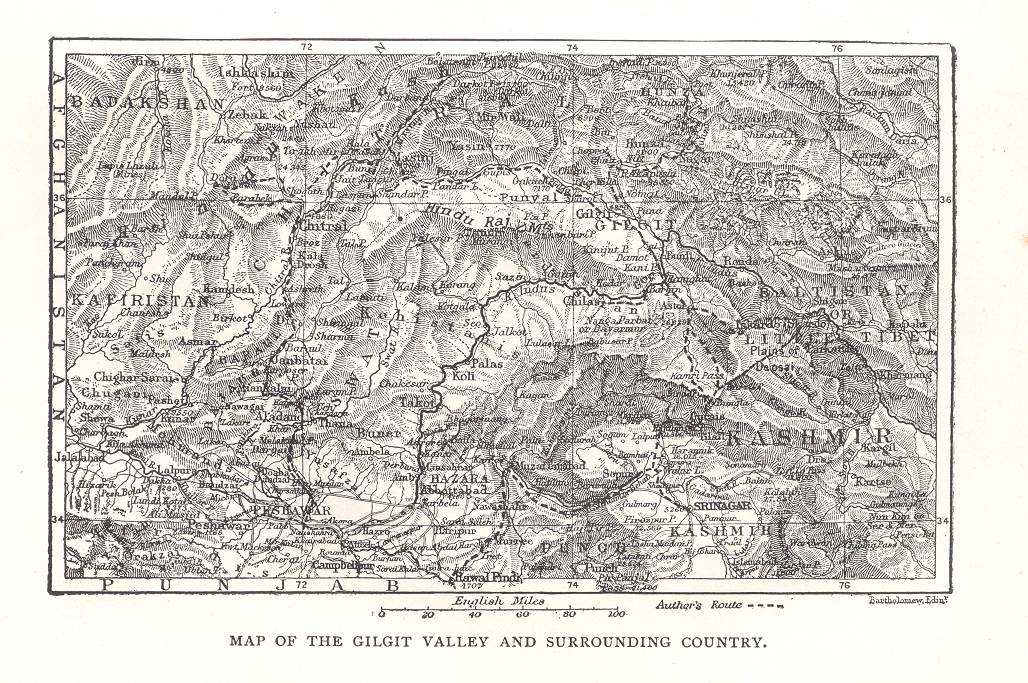
Hunza and Nagar were, according to tradition, ruled by the same chief till some centuries ago, when the ruler of the day divided the country between his two twin sons, who were deadly enemies. The Hunza ruler was murdered by one of his brother's adherents, and left an only daughter. This young lady fell in love with her cousin, the son of the ruler of Nagar, and the lovers met, necessarily by stealth, the prince swimming across the Hunza river every night. The result was a son, the founder of the present line, which is called Ayeshé, or heavenly; for, to conceal the mishap, the story in Hunza is that the father was a prince from Shignan, but that his name having been forgotten he was called Ayesho, or the " heaven-sent." |192 The Hunza chief is styled Thum, as was his brother of Nagar, and the name is supposed to be the corruption of the Chinese word Tung, which forms part of many Chinese titles. The Thum was an absolute ruler, who killed or sold his subjects into slavery as it pleased him; but that the rule, though despotic; must have been tempered by common-sense is shown by the fact that the office of wazir, or minister, has gone down in unbroken succession from father to son for seven generations.
Safdar Ali, the Thum at the time of my visit, had murdered his father, Ghazan Khan, three years previously, and his character caused me some anxiety. He had, it is true, as had the Nagar chief, written to Government, and asked that a mission should be sent to him, but he bore an ill name for treachery, cruelty, and weakness. In common with most of his subjects he belonged to the Maulai sect, the followers of which, though calling themselves Shiahs, were a bye-word on the frontier for their shameless violation of all the leading Mahomedan doctrines. The men drank wine freely; their morals were of the loosest; a man considered himself honoured if his wife attracted the Thum's attentions, and hospitality enjoined that he should offer her to his guest. Withal, they were cheery, pleasant people to deal |193 with, slight, wiry, and very active, first-rate mountaineers, and of untiring energy, a great contrast to the Shins of Gilgit. With none of the bloodthirsti-ness of the Pathan they yet had a great reputation for bravery, and had more than once invaded and severely handled their Nagar neighbours, who wore said never to have carried the war into their country. The cultivation in Hunza is very limited; the finest stretch is just below the fort of the chief, and extends for some six and a half miles in length with a width of from a mile to a mile and a half, the whole of the land being irrigated. This main stretch of arable land, which is studded with villages, lies at an altitude of eight thousand feet, and faces south, and the climate here is delightful. Further up the valley lie scattered patches of cultivation, getting poorer and poorer as the altitude increases. The mountains enclosing the valley are very precipitous even for the Hindu-Kush; wood and grazing for cattle are therefore unusually scarce, and the people suffer in consequence. The clothing of the people is practically the same both in Hunza and Nagar as it is in Ghitral, and has been described before, the only difference being that the men's stockings are not knitted in such elaborate patterns, and that, as a general rule, the woollen outer robe is, in Hunza especially, more |194 often white than brown. All, except on State occasions when the higher ranks don the turban, wear the Dard head-dress. This is a long bag of brown woollen cloth rolled back on itself till it forms a cap, which is one fold thick on the top, with a border an inch or so thick round the head. It makes a light, warm, and delightfully comfortable head-dress, but is a very poor protection against severe sun.
Nagar, as most of the surrounding people and the inhabitants themselves generally call it, though they also pronounce the word Nagér, and the scientific, for some cause best known to themselves, insist on spelling it Nagyr, is a smaller State than Hunza, The population is about the same, and is composed of Yeshkuns, professing themselves Shiahs, but very nearly as lax in their Mahomedanism as the people of Hunza. There is considerably more cultivation than in Hunza, the land is better watered, and the main slopes of the mountains enclosing the country face north, and are consequently covered with forest. The land has the full benefit of the summer sun, and the crops are splendid. The untold profusion of the apricots, and the quantity of gold which can be washed out of every stream, has gained the country amongst the Nagaris themselves the name of "the land of gold and apricots." The people, though of |195 identically the same stock as those of Hunza, show marked differences. They are less warlike than their neighbours; they were never implicated in the raiding of caravans, owing principally perhaps to there being no outlet to the north or east leading to caravan tracks; they are, on the whole, better off, owing to the better agricultural conditions, and the possession of splendid grazing grounds; and last, but not least, slavery is unknown amongst them----that is, they would not brook their king selling them or their children, and the exile of the present ruler's eldest son is said to have been caused by his attempt to introduce the custom from Hunza. The men are not so bright and cheery as their Hunza cousins; they strike one as more sedate and morose, and their reputation for dash and gallantry is far lower. The reason they themselves assign for the difference, and the one generally accepted, is that in the winter, when the sun is in the south, the great mountains backing their valley shut out all the light and warmth, of which Hunza facing south enjoys the full benefit, and that the depressing effect of passing day after day in the cold and darkness of their uncomfortable houses leaves an indelible mark on the national character.
It must be remembered that a house in the Hindu-Kush has no glass windows, no comfortable fire-place |196 and chimney corner. The better-class houses are built round a courtyard, but the rooms rarely have windows, all light comes from the open door or from a skylight. Immediately below the skylight is a square open hearth, on which smoulders a fire; round this run raised platforms, on which are the beds and household paraphernalia; the smoke, before escaping through the roof, fills the whole room, blackens walls and pillars, and chokes the unfortunate inhabitants. If it is very cold, or raining and snowing heavily, the skylight is shut, the room is in pitchy darkness but for a sputtering torch, and the atmosphere horrible. It is no wonder that an existence under these circumstances should be rather depressing, and in Nagar the people get the full benefit of it, for there are several villages which during December and January only get twenty minutes' sun a day; some, I believe, get none. The men having no agricultural work on hand, owing to the land being frost-bound, there is practically nothing for them to do during the winter months but to sit idly round their smouldering fires for about sixteen hours out of the twenty-four.
Nagar has practically no outlet except down the river to Gilgit. Shut in to the east by impassable mountains, and to the south by the great Rakapushi |197 range, there is only the bare possibility of reaching Baltistan by the Hispar pass: there is a tradition that the road was once used, but it is very doubtful if the story is true. It needs a mountaineer properly equipped to make use of this road, which runs over one of the greatest glacier masses of the world, as Sir Martin Conway shows in his book, "Climbing and Exploration in the Karakoram Himalayas." Dependent therefore on Gilgit for their luxuries, such as weapons, cotton cloth, salt, sugar, etc., most of them the produce of India, or on Hunza for the products of Turkestan and Central Asia, the Nagar people were more easily squeezable than their neighbours across the water, and not so aggressively insolent in their dealings with Kashmir. They were as little to be trusted, however. It was one of their chiefs who many years ago called in the Kashmir arms to help him break his rival Thum, and who, once the Kashmiris were well within the country, fraternised with his enemy, and turned upon his late allies; and Nagar forces had played a prominent part in the disturbances of the past year. The want of dash on the part of the Nagar warriors was well marked on the former occasion; no badly-disciplined army, abandoned by its chiefs as were the Kashmir forces in the former case, should have been able to escape. |198 Pathans would have wiped them out to a man, even the Chitralis would have inflicted terrible loss, but the Nagar men allowed their enemies to get out of the country scathless, and even to save, owing to the gallantry of one officer, their small mountain guns carried by coolies. These were points which were worth considering and laying up for future guidance. |199
1. * NOTE.----Blue Book Correspondence relating to Chitral, C. 7864, 1895.
VISIT TO HUNZA NAGAR
AT Chalt I dismissed the Nagar men who had come to Gilgit to act as hostages during my absence, and sent them away well pleased. The Nagar people seemed to be really keen on my visiting their country, and the Hunza representative with me explained the rather doubtful tone of his master's letters by the fact that the Thum was suffering severely from fever. In addition to this, which might delay our interviews, the chief feared that the height of the river, which was in full flood, might make our journey difficult and dangerous. In the whole course of the river only two bridges existed, both of them twig rope suspension bridges, one at Chalt, the other exactly opposite Hunza, and there was no other means of crossing the river when in flood. There had been latterly some ill-feeling between the Hunza-Nagar Chiefs, and the upper bridge had not been repaired, neither side caring to take the trouble when it might become necessary to cut the bridge at a |200 moment's notice. However, I heard that the relations were no longer strained, and that the bridge was now being renewed by the Nagar people, who had practically the monopoly of the necessary birch. Our crossing into Hunza was therefore assured, and I received civil enough letters from the Thum repeating his invitations. His epistolary style was always quaint and high-flown, and on this occasion, when welcoming me, he compared my party to "camels without nose-ropes uncontrolled," meaning by this that we were free to wander at our pleasure in all directions. In a former letter he had, with reference to the difficulty of supplying our party, compared us to elephants. On a later occasion he incidentally remarked that he proposed to send my head on a charger as a present to the Government of India: but there was a good deal to come before that.
Crossing a mile above Chalt the rope bridge over the Hunza river, which seemed the longest and steepest we had yet crossed, though that over the Gilgit river had a span of three hundred and sixty feet, we found ourselves in Nagar territory, the first Europeans who had ever penetrated its mysterious wilds. The bridge was a new one, fortunately for us, for they are very unsafe when old, and should be |201 renewed annually. This involves a good deal of labour, as nine cables of twisted birch twigs of the necessary length, in this case some four hundred and fifty feet, have to be prepared. The people therefore often put off the work and chance the bridge lasting, and I have seen bridges three and four years old in use. This is horribly dangerous; the birch twigs dry and perish, and the ropes break suddenly. As a rule they do not go all together, and I have seen a bridge in use consisting only of the foot rope and one side rope, and have crossed them when the connecting ropes were broken and useless, but I never did so willingly, for we had a terrible lesson. A native officer and half a dozen men had been sent on from Gilgit ahead of us to try the bridges, and to arrange for necessary repairs. Corning to one bridge they tried it carefully, going over one at a time, and examining the anchorage and ropes. Thinking all was sound they foolishly returned in a body, crossing, of course, one behind the other. As the leading man got well up the slope towards the timber anchorage, followed by five others, the ropes drew or broke, and the whole party were dashed into the water. Two men, entangled in the ropes, were washed ashore on the bank they had started from, for the anchorages on the far side fortunately held, |202 and the ropes swung across the stream and ashore, but the other unfortunates, caught in the awful torrent, were swept away and instantly drowned. Only one body was recovered, and that forty miles down stream.
The road shortly after crossing the river rose twelve hundred feet to cross the end of a spur from Rakapushi, and, descending again, ran generally at a level of six or eight hundred feet above the river---- which one could hear roaring through its deep-cut bed below----across uncultivated wastes, and in and out of numerous deep ravines till the cultivation of Nilt was reached. Here Uzr Khan, the eldest living son, and the heir-apparent of the ruling chief, Jafr Khan, met us. He was rather a fine-looking fellow, with a pleasant enough face when he smiled, but with generally a boorish and sulky expression. He received us very cordially, and after we had breakfasted under a fine plane tree he came and discussed affairs. I could see that my main difficulty would be to persuade my new friends that we had come to Gilgit to stay. Biddulph's withdrawal had made them very chary of having anything to do with us.
I examined the country very carefully as we marched, and noted the difficulty of the great ravine behind Nilt, which three years later was to baffle for |203 eighteen days the attack of our troops. On the whole the road was better than I expected, and it seemed to me, as I find noted in my diary, "that a decently-armed and led force should not have much difficulty in forcing its way in." My hosts were not averse to my sketching, and I had a road sketch and report made every day, but I did not like to make too much of it, and contented myself personally with noting the positions and the chances of attack they offered. The conclusion I eventually arrived at was that the Hunza-Nagar country presented the most appalling difficulties, and that, with well-armed men holding the country, an advance into it would be terribly costly.
The views of Rakapushi were very fine, though not so grand as I had hoped, for we were marching too close under it. Still, a mountain rising nineteen thousand feet above you, and over twenty-five thousand feet in height, must be fine when you get a glimpse of it. The next day's march was, however, far more striking; the road rose over gigantic moraine masses, crossing ravine after ravine seven and eight hundred feet deep, each one filled up by the end of a glacier, the main mass of which was out of sight. We passed through numerous villages whose cultivation, carried far up the mountain side, was of the |204 richest. Each village was surrounded by fruit trees, and poplar, plane, and walnut trees abounded. Every village was either enclosed in a large square fort, with towers at each corner, or had a fort close to it.
The third day took us into Nagar. On leaving camp we crossed a great shingle slope, nearly a mile in length, at a point hundreds of feet above the river. Huge cliffs crowned the slope, and made this one of the most difficult pieces of road, from a military point of view, that we had yet passed. During our two last marches we saw conglomerate cliffs and rocks full of garnets, some very fine white sandstone, and in one place a cliff of clay, which was said to be full of gold. Nagar lies off the main valley, some three miles up another stream, and the last few miles into it the road ran almost without interruption through cultivation. The fruit trees were a sight to see, apricot trees bending under a burden of red gold fruit, their harvest just beginning, and every house roof, and any other available flat space, was covered with the fruit drying in the sun. As we turned our backs on the main valley the view was superb. Behind us Rukapushi rose in gigantic precipices of thousands of feet of snow and ice, while across the river above Hunza towered another great mountain, its crest broken by sharp granite peaks on which no snow can rest. Its |205 lower spurs are jagged and bare, and below them lay a large semi-circle, one mass of villages and of cultivation, the terraced fields carried right down into the river bed. Hunza itself lies on the right bank of a ravine ending in a dark glacier, from whose melting ice is supplied the channel which waters the whole of the Hunza cultivation. The houses of the main village are clustered tier upon tier on a high spur crowned by the Thum's Castle. The arrangement at Nagar is precisely the same.
Our entry into Nagar was very similar to my last year's entry into Chitral, only that the crowd was on a smaller scale, the courtiers not so numerous or so brilliantly arrayed. Still it was picturesque enough; before us rode a man bearing a scarlet and white banner; around us, wherever the road permitted, was the gay crowd in Bokhara silks or dirty woollen homespun. The usual irregular salute was fired as we reached the polo ground, and the band made discordant music. Raja Jafr Khan could not receive me, being paralysed, so we moved without further ceremony into our camp by the polo ground, preceded by Raja Uzr Khan, who showed, by riding before us, a lack of breeding which scandalised the other Rajas, and which compared very unfavourably with the Mehtar of Chitral's courtesy. |206
Next morning I paid my state visit to Raja Jafr Khan. The road runs up through the village to the Thum's Castle, under a succession of easily defensible doorways, which would make an assault very difficult for bad troops or local enemies. The Palace stairs consisted of the trunk of a tree with notches cut in it, which led up through a square hole in the floor to the terraced rooms above. In this, as in every other house I ever entered in these wilds, the last two of three doors are placed in the right angle turn of a very narrow passage which only one man can use at a time, and the doorways are so low that a tall man has to bend almost double to pass through them. The object is to prevent a rush, and to make it impossible for a man to use his weapons as he passes through the last doorway. Similarly the ascent to the flat-topped roof of a man's house is jealously guarded, and he who considers himself in any danger never sleeps twice in the same part of his room, for the skylight gives an enemy a convenient point of vantage from which to shoot.
We found the Thum in a typical square room, with an open skylight, and a sunk hearth in the floor, seated by a balconied window, from which there was an extensive view over his country. His beard was carefully dyed, and it was difficult to guess his age, but |207 he was not an old man; drink and debauchery had reduced him to his present state, and paralysed him from the waist down. We did not stop long, as the visit was merely one of ceremony, and the audience room was full of people, before whom business could not be discussed. Our uniforms were a source of much interest to our hosts, and of considerable discomfort to ourselves. Frock coats and spiked helmets, high boots and spurs, sword and sabretache, are not quite the thing for the grand staircases of the country. Later in the day Uzr Khan paid me a visit, and we had to sit through an interminable dance programme, which, as the orchestra consisted of six pairs of kettle-drums, six large drums beaten at both ends, and three pipes, was simply deafening. The dances were all very much the same----six or eight men following each other round and round in a circle---- sometimes with sword and shield and the usual flourishes, sometimes with nothing in their hands, now posturing slowly, again flying round with long jumps and steps. In Nagar every one dances----the younger sons of the Thum, Wazirs, and the common herd, all take part. In the pre-Mahomedan days the women also danced, and I should not be surprised if amongst, themselves they did not even now join in, but, of course, not on a state occasion, or before |208 strangers. Immediately after the dance came a couple of hours of polo, still to the accompaniment of the band, which played just below our tents, and whose monotonous noise became maddening.
In the evening I dismissed the son of the Hunza Wazir, who had come with letters from the Thum, with my answer and a present. He was good enough to express himself quite satisfied personally, at which I was surprised, for he was wearing a coat of velvet covered with gold embroidery, worth at least five-and-twenty pounds, the outcome of Lockhart's lavish habits of largesse. It was a much more magnificent garment than any I had to give his master, and of much greater value than the present I could afford to give him. He informed me, however, that a scoundrel with him, to whom I had given some money and a choga, was going away hopeless, because I had not promised to renew to him a pension which his father had drawn from the Kashmir Durbar. They were difficult people to deal with in some ways, showed no sense of proportion in making their demands, and really, I believe, could not understand that there must be some limit to one's power of giving rewards.
The next few days were passed in private interviews and negotiations with Jafr Khan and his son. |209 The former I found very sensible and amenable, but Uzr Khan showed himself day by day more stupid and boorish. He was below the average of the chiefs I had met with in intelligence, and had none of their diplomatic skill. Still I got a good deal of information out of him as to the course of events during the preceding years, an insight into the politics of the country, and a knowledge of the men likely to be important, Here, as in Chitral, the danger of bloodshed and trouble from the enmity of the royal brothers was but too plain.
The only amusement I got out of the negotiations came from the request, put forward by the Chief, that his Wazirs should be granted some pension. I readily agreed, on the condition that the amounts should be deducted from his subsidy, and that of his son. I heard no more of this proposal. After we had had our final State interview, and had sent the old Chief his presents, I held an informal reception of all the Wazirs and head men, gave them presents and robes of honour, and left them fairly satisfied.
During our stay in Nagar we wandered about photographing, in search of anything of archaeological importance. The most interesting thing I saw was a Buddhist chorten, and naturally my camera was not to be found at the moment. The building was in |210 several tiers, stood some fifteen feet high, was circular, with a diameter of about six feet, and was finished off with a crown-shaped storey. I expected to pass that way again, and promised myself to photograph and measure it carefully, but I never saw it more.
We paid several visits to the great glacier which comes to within two or three miles of Nagar from the mountains to the south. It was at this time, late in August, very black and dirty, a mass of irregular columns and broken surfaces, with only one clean white piece, that just above the ice arch, through which the torrent forced its way out. I had no time to go further up the valley, though I should much have liked to have gone up another sixteen miles to see the Hispar glacier, that wonderful stream of ice, forty miles long from the crest of the pass to the foot of the glacier, which at one time must have reached Nagar itself.
The whole country about Nagar and Hunza is carved out by glacier action; gigantic moraines, the skeletons of dead and gone glaciers, meet you on all sides; above Nagar is a wild tangle of ground, where three huge glaciers fought for the mastery; above Hunza, lakebeds and moraines meet you at every turn. Conway's book and beautiful maps have lifted the veil which obscured one's knowledge of this great |211 glacier land, but at the time I looked on it first there was but little information about it. There was the tradition that an easy road existed over the Hispar pass into Baltistan, to which the people attached sufficient importance to fortify certain positions during the late troubles with Kashmir, fearing an invasion from that side. But to me, as we gazed up the long swell of the glacier towards the well-named Golden Parri----a mass of mountain twenty miles to the southeast of Nagar which dominates the glacier streams below, and whose gigantic precipices take the most splendid colouring from the westering sun----it was a land of silent mystery. Looking up from our vantage ground above the glacier, it was obvious that the ice rivers had receded, and, judging from the people's traditions at no distant date, leaving gigantic moraines to the south and in the direction of Hispar.
The road to this point from Nagar was very pretty, running entirely through cultivation and orchards, and occasionally under the walls of a village fort. The people were evidently very hard working, and the cultivation and labour expended on walling the fields was most thorough. At some villages they used to bring us out presents of fruit, and at all they were civil and pleasant They are a nice people, and independent. One old man was very indignant at |212 the men with us for passing along the edge of his field where there was no footpath. We came in one place on an amusing instance of the world-wide tendency to scamp Government work. We were crossing a field which I noticed was very badly gleaned, and I asked the reason. I was told it was one of the Thum's, and that, as the villagers had to cultivate and reap it for him, they did not take as much trouble as if it had been their own.
A boy came along with us one day, and played on a long pipe with a very sweet note. It was quite a pastoral. The last we saw of him he was wandering below us on a classic lawn, by the side of a stream which ran flecked with sunlight under the shadow of great walnut trees, playing his pipe, whose plaintive notes floated up to us, mingled with the murmur of the water. His dard cap was ornamented with a garland of red and white flowers stuck into its folds.
I had to leave Nagar long before I had exhausted the objects of interest, and many places had perforce to be left unvisited. The morning we left we plunged down below the fort for several hundred feet to the rope bridge which spans the gorge of the Nagar stream. It was a nasty bridge, with very steep slopes, and I thought one of the servants had gone, for he stumbled badly; but he recovered himself, |213 and merely dropped a bundle he was for some reason carrying, which went floating down amongst masses of ice which, broken from the glacier above, were dancing down the furious stream. There was a stiff climb up a couple of thousand feet to the crest of the ridge between the two streams, and an equally steep descent down to the Hunza river. The approach to the bridge, which springs from two great masses of rock on each side of the river, is villainous, over smooth rock and by pathways a few inches wide, kept bad for safety's sake. We were met by various deputations----one shortly after entering Hunza territory, a second at the bridge, a third on the Hunza bank, and I found it was arranged that we should camp directly we got to the top of the cliff above the river, and that we should make our state entry next day. Accustomed to these ceremonious delays from my experience of Chitral, I agreed.
Next morning we started at about half-past seven in uniform, and rode up through the terraced cultivation to the polo ground. Here we were requested to halt, while our salute was being fired by the Wazir in person, he being the only man who could be trusted to fire the gun. It was a gun with a history, which had been cast by a refugee from Wakhan, all the brass household implements in the |214 country having been melted down to find metal for it. The Thum of the day was so pleased at possessing it that he at once killed the maker, lest he should go to Nagar and make one there. The Wazir had instructions from his King to go on firing till further orders, but after twenty-three guns we thought they had had enough, and I sent a request that they would stop and let us proceed. We were met at the gate of the fort by Wazir Dadu, rather a pleasant-looking man of about forty-five.
The approach to the fort through the village was much the same as at Nagar, but the road was broader. As we passed over the great water channel which fertilises the Hunza oasis, and which at its debouchere from the parent ravine runs through a low tunnel, an ominous whisper informed me that this was the scene of the old Thum's murder by his rascally son, assisted by his present Wazir, Dadu. The old man was fired at from the roof of a house as he rode in from hawking. The first discharge was not fatal, and the men with the Thum begged him to take refuge for a moment in the irrigation tunnel while they raised help, which, by all accounts, was within an ace of coming, but the old Chief refused, saying, "It was no use; he had lived long |215 enough, and his day was come." His Wazir, Humayum, Dadu's elder brother, was away in Gujhal at the time, and the new Chief sent him an urgent letter, stamped with his father's seal, calling him to return at once to Hunza. But though the letter had been prepared beforehand, was sealed before the warmth was out of the old Chiefs body, and was despatched by a trusted messenger, the plot failed. Warned by some friend, or distrusting the wording of the letter, Humayum turned his horse's head, and rode for his life. He reached the passes in safety, and going by Wakhan, entered Chitral, and claimed the hospitality of the Mehtar. This was gladly accorded him, for he was a valuable man in case of trouble with Hunza, and he remained in Chitral, an honoured guest, until his turn came later. Once inside the fort we had only two sets of stairs to ascend, and they were not so primitive as in Nagar, though they were equally defensible. We were received by the Thum at the top, and seated on an open platform overlooking the village and valley. Safdar Ali Khan was a delicate-looking young man of about twenty-two, with shifty Mongolian eyes, and a chestnut-coloured small peaked beard and moustache. The face was a delicate oval in shape, and weak in expression. He was |216 looking decidedly ill, and considerably pulled down by fever.
The surroundings were richer than in Nagar. A guard of fifteen men armed with breechloaders, English and Russian, surrounded the Chief; the courtiers were better dressed, and good Central Asian carpets were spread on the ground. The Thum himself was handsomely dressed in silks, and wore a beautiful velvet belt of Chinese workmanship, with clasps and bosses of gold studded with torquoise and coral. We stayed but a short time, paying a purely ceremonial visit. On my return to camp I found that the four men of my guard had been prevented from coming upstairs, and that an attempt had been made at stopping my orderlies also. I accordingly at once sent up to the Wazir, and protested against this, saying that I concluded that my men had been stopped without the Chiefs knowledge, and that I would not stand being treated in this way for a moment. My message brought a full apology, but the incident showed the tendency to insolence on the Chiefs part, for which I was prepared, and that it was necessary to prove to the young savage that we were not afraid of him, and should insist on being treated with proper distinction. |217
The Thum sent down during the day a dinner for the whole camp, among the ingredients for which was a half-bred yak. In the old days throughout these regions the chief guest had to cut off the beast's head, or, at all events, to strike the first blow with his sword. This part of the ceremony we dispensed with, but we ate the resulting beef, the first we had tasted since leaving India, for in Kashmir, and its outlying districts----Gilgit, Skardu, and Punyal----taking the life of the sacred cow is a deadly crime, which the Hindu rulers punished severely. There were still at this time unfortunate Mahomedans in prison at Srinagar, who had been confined for years, for keeping themselves and families alive during a famine by killing and eating cows.
In the afternoon we went for a walk and admired the cultivation, which is extraordinarily careful, the terraced fields falling in one continuous sheet to the river hundreds of feet below. Every inch of available ground is made use of, and we found many miniature fields a couple of feet wide and a dozen feet in length, telling of the pressure of the population, and the difficulty of the food supply. I had heard a tradition that during the fruit season the people were prohibited from eating any form of |218 bread or grain, but I was told that this was not the case. What does happen here, and throughout the region of the Eastern Hindu-Kush, is that the fruit crops are so prolific that the people naturally live largely on them in summer. Even the animals take to a fruit diet, and you see donkeys, cows, and goats eating the fallen mulberries. The very dogs feed on them, and our fox-terriers took to the fruit régime most kindly, and became quite connoisseurs in the different kinds of mulberry, preferring the "Shahtut," the king mulberry, a large luscious purple fruit, to all others.
The great water channel referred to before deserves passing mention. Its head waters are some half a mile up the ravine, on the edge of which Hunza stands, a few hundred feet below the end of the glacier which feeds it. For the whole of this half mile the water channel is a monument of patient labour, and of the clever adaption of the rudest means to the most important end. It is carried across the face of a cliff, in some places of sheer rock, in others of hard conglomerate. Sometimes it runs along the top of a built-up wall thirty or forty feet high, at others through carefully excavated channels in the conglomerate which avoid the difficulties of a sharp corner by tunnelling through it. |219 Where the face of the rock is perpendicular, and its foot washed by the torrent is unsuitable for the foundations of a retaining wall, the water flows through timber troughs, supported by wooden brackets adroitly fixed into the cliff. I did not measure the output, but, roughly, the channel must have at its widest a section of four and a half feet wide by one foot deep, which means a considerable flow of water. On this channel the cultivation of Hunza proper entirely depends; should it fail, starvation stares the people in the face. It is not surprising, therefore, that the greatest care should be expended on its preservation. But what is wonderful is the excellence of the result arrived at. It must be remembered that the people have no proper tools, no crowbars and dynamite to assist them. A tiny pick of soft iron, which looks like a child's garden tool, shovels fashioned out of wood, and a few poles as levers, are all that they have to work with. The use of mortar is unknown; all their walls are of dry masonry. Yet with all these disadvantages, with nothing but their eye as a guide to levels, they have carried this great irrigation channel for six miles, and turned an arid desert into a garden. For the most part it is true it runs along the side of a gently sloping mountain, but it also crosses many deep and |220 perpendicular-sided ravines, and encounters masses of rock which have to be circumvented. It is a splendid work, and I admired it more every time I walked along it.
The Thum was too unwell with fever to return my visit, and his Wazir came in his stead. Robertson went up to see the Chief, and prescribed for him, with the result that the descendant of Alexander, as he considered and called himself, got into a state of abject terror, thought his last hour was come, and refused to take the second dose which was the natural sequence of the first. Robertson reported that he was a coward, that he had literally funked himself into a state of great nervousness and a sort of nettle-rash five minutes after he had. taken his first dose, which should not have taken effect for an hour. This sounded bad, for a rank coward is a dangerous man to deal with.
The views from our little camp by the polo ground were superb, especially in the afternoons; the great sugar-loaf peak of Dirran, just opposite, seemed to float and melt in the pale blue sky, and Rakapushi was glorious, with great dashes of sunlight at his base, and bands of clouds resting high up, the great peaks standing out above.
And now came the important interviews at which business had to be discussed. The first one was |221 quite satisfactory. I found the Thum in a small open room or court leading into the private apartments, and we sat down to discuss business. It was obvious that the Wazir was the important man, but also that the Thum, cowardly, shifty, and with a ridiculous idea of his own importance, must be reckoned with very carefully. Everything passed off well, and the Government conditions were readily assented to, the most important one at the moment being the promise of a free passage to Younghusband, who was to come to Gilgit in November from the Pamirs. Wazir Dadu amused us very much when the question of raiding was raised. He made no attempt at denying that this was the custom of the country, and explained it by saying that Hunza was a poor state, and that necessarily its people looted. The evident enjoyment with which he referred to former exploits, and the expressive grin which accompanied his explanations, were too much for me, and I had to join in the general laugh.
We parted good friends, but in the evening came a letter from the Thum, asking for the same subsidy for his son as had been promised to Raja Uzr Khan of Nagar. As his son was about four years old and Uzr Khan thirty, I thought this was pretty cool In the morning came rather an insolent verbal |222 message to the effect that unless the boy's subsidy was granted, my surveyor would not be allowed to proceed to the north, where there was some surveying work to be done. This was in direct contravention of the agreement entered into, but I took no notice, as we were to pay our farewell visits that day. After breakfast, accordingly, we went up and had a long talk, which was quite satisfactory until the question of the boy's subsidy came up. It was useless to point out that Raja Uzr Khan's grant was taken out of his father's, that he was a grown man, with much weight in the country, and that the case of the small boy would doubtless be considered when he came of age, if his father was loyal to his engagements. The Thum got sulkier and sulkier, ruder and ruder, until the Wazir, who was evidently uneasy at the turn things were taking, brought the discussion to a close with smooth and tactful words. We returned to camp fairly well satisfied, to find that we had been meant to march that day, but that with their usual fecklessness the Thum's people had not let us know. It would have saved me hours of anxiety had I but known this the day before.
After sending off the presents I had brought for the Thum by the Raja of Astor and my head orderly, Zyarulla Khan, I sat down and began to write an |223 official letter to India, giving the story of the progress of the negotiations. I had been writing some time, when I saw my orderly strolling towards the tent with a rifle in his hands. I caught his eye, and saw that something was wrong, and that he wanted to see me alone. I therefore dismissed my servant, who was wandering about the tent making preparations for the next day's march, and called Zyarulla in. I never shall forget his coolness that day; he was a well-tried Pathan, for whom danger brought no fears. Looking round to see that no one was within hearing, he walked to the door of my tent, and, laying the rifle on my table, quietly remarked: "Rifle bigr gya, aur Raja bhi bigr gya"----"the rifle has gone wrong, and so has the Raja." Picking up the rifle, a repeater, I set to work to put it right, and listened to the story of his interview with our truculent host. It did not sound pleasant. My envoys had found the Thum sulky about his son's pension, and, after some talk, during which the presents were duly spread before him, he had suddenly flown into a passion, thrown my things about the room, and refused to accept them. He had called for and shown a quantity of presents received from the Russians, and offered to produce the treaty he had made with them, even to show it to me, and generally had behaved like a |224 disappointed and spoilt child. Finally, he had sent me a message that he withdrew all the promises that he had made.
The question I had to solve, and to solve, pretty quickly, was whether this was a serious outbreak, or a mere childish fit of vexation. My position was bad: I was in a camp commanded from the slopes above, as all camps must be in this country; a thousand feet below ran an impassable torrent, flooded to the full by the melting glaciers; the only bridge over it was more than a mile from my camp, could be cut in a moment, and could not possibly be used to remove my men from danger; between me and our own frontier station lay three marches of the most awful road, not to be forced by a handful of men, and with a hundred and fifty followers of my own and the Raja's with me, I had but twenty-one armed men to rely on. I had Younghusband's passage through the country to arrange for, and to get my mission across the border in safety. An attack on us, whatever the result, must bring trouble on the frontier and ruin on my plans. I was in difficulties, and serious ones, but the trouble had its compensations----it showed the Thum and his advisers in their true light. It was perfectly plain that should an attack take place not one of us would get out alive, and that, whatever loss |225 we might inflict on the enemy, it could hardly affect the result: a hundred coolies would be sold as slaves in the bazaars of Turkestan, and the reputation of the Hunza Thum would be enhanced a thousand times. The day of reckoning would come, but war on the frontier was the one thing desirable to avoid.
I sent at once for Raja Bahadur Khan of Astor and Raja Akbar Khan of Punyal, and we discussed the matter. As soon as the rifle was put right, I sent Bahadur Khan up again with it, to negotiate with his savage kinsman. The Thum was a connection of his by marriage. The next few hours were anxious, but gradually, after various pourparlers, peace was restored. The Wazir came to see me in the afternoon, accompanied by the Thum's treasurer, an old villain who was the manager in all sales of slaves; for though the Wazir was his right-hand man, and his brain and hand had helped him to power, the Chief would not trust him to see me alone. I gathered enough, however, to show me that Wazir Dadu had been no party to the day's folly, and that he was for peace and friendliness with us. His companion made the most of his opportunities by stealing, while my attention was fixed on Dadu, an enamel matchbox which was on the table. I found that the man I had |226 to thank for all the trouble was a scoundrel called Daulat Shah, the son of one of the old Chiefs headmen, who used to go regularly to Kashmir with the yearly tribute. On his death the Durbar discontinued a pension they had been in the habit of giving him. Daulat Shah claimed this as a right, and had been refused. He was the man who had been reported to me as "without hope" at Nagar. As I had declined to promise that this pension should be continued to him, he bided his time, and was taking his revenge. Three years later came my turn, and we got more than level.
After Dadu had left, I strolled round camp, and quietly gave orders that none of the fighting men were to leave its precincts, and that the ammunition boxes were to be opened up the moment it was dusk.
It was curious to see the different effect which the knowledge of danger produced on the men in camp. That there was danger all knew by this time, and each faced it in characteristic style. A Kashmiri paled to a dirty livid green, and cringed to any Hunza man who came in sight. The Balti coolies huddled together like a flock of sheep, and stared wide-eyed towards the Thum's fort, conjuring up visions of slavery. The jolly face of Raja Akbar Khan of Punyal showed lines of determination, and |227 his few followers, with their loins girt and arms always in their hands, never left him; my Pathans got more cheerful and cooler every moment, and busily gave the last finishing touch to the cleaning of their Martinis. Just after dark, when I had seen the ammunition boxes opened, and that all was ready, I was informed that men leaving camp had been rudely stopped, and that we were surrounded by pickets of armed Hunza men. I must say that this seemed to me the beginning of the end. There was, however, nothing more to be done, and, striking all tents, except one which I had promised the Thum, and which I now grudged leaving, we made the best re-arrangement of our little force possible, had dinner, and went quietly to bed, prepared for an attack or an early start as the fates might decide.
I was told afterwards that late into the night our fate had been discussed; the young bloods, like Daulat Shah, urging instant attack, and expatiating on the easily obtainable loot, the older men giving wiser counsels, and the weak and cowardly Thum vacillating between the two parties. Finally prudence prevailed, the Thum retired to sleep, the order was given that it was to be peace, and the pickets round our camp were secretly and silently withdrawn. Feeling that something of this sort must be going on, the night |228 was one of anxiety, and I was glad at half-past three to get up and to prepare for our start. We left in about an hour, in as compact a little column as could be arranged, and it was a great relief to me to find that the head of it was not checked when we left the polo ground as I had half expected. After going an hour or so I heard the guns of my salute, and in a few minutes more Dadu, with a few followers on smoking ponies, galloped up, bringing other ponies as presents for us to ride. He was very civil as usual to me, and we parted on the best of terms; but Akbar Khan told me later that he had been most anxious to find out whether I was going away satisfied or not, had said that if we were not he would stop us----"was he not the Wazir Dadu?" This man's action was a great puzzle to me at the time, and I never quite got to the bottom of it. I doubt if he himself had any very definite programme, beyond making what he could out of us, and keeping in with his master.
The march was a very trying one, but luckily we had cloudy weather. Otherwise, accompanied as we were by laden coolies, whom we were bound to keep near in order to prevent any being kidnapped, toiling along the face of bare precipices, which faced due south, and got the full blaze of the August sun, |229 we should have suffered considerably. Shortly after our arrival in camp came a letter from the Thum, saying our early departure had prevented his coming to see us off, and asking if we were satisfied. This letter was brought by our friend, Daulat Shah, who was most anxious to find out if we were pleased, and who had quite changed his tone and manner. It was a volte-face on the part of the Chief, who was probably now cursing those who had counselled him to violence, and in whose fickle and unstable mind the advantages of being well with us were now in the ascendant. My reply to his letter was very much to the point, and the result was a complete climb-down on the part of the Thum, abject apologies and profuse protestations of loyalty to the engagements lately taken. I attached the proper value to his vows, but left the country feeling that, at all events for that year, there would be no further trouble, and that Younghusband's safe passage was assured.
We all liked what we saw of the Hunza people; they were cheery and pleasant and civil as we passed through their villages. The leaders were scoundrels. Dadu and his son had fired the first shots at the old Thum, while the contemptible young parricide who succeeded cowered in a room below them. The moment the old man was dead Safdar Ali entered |230 the fort, seized the wife of one of his father's chief adherents, and murdered his three younger brothers. Two were strangled and cut to pieces, the third was taken to the edge of the cliff, on which the fort stands, and hurled over. He was a mere boy, and only asked that he might be thrown into the water, not on to the rocks; his prayers were unheeded. Safdar Ali's description of the circumstances attending his accession was contained in a letter to Government which ran somewhat as follows: "By the will of God my father and I fell out; he died suddenly, and I have ascended the throne." The old Thum, with all his villainy, had been a man, and I found traces, even during my short visit to Hunza, of deep discontent with Safdar Ali, whose cruelty was unrelieved by any redeeming feature. When the end came, three years later, and he fled like the coward he was without striking a blow, the feelings of the people towards him were well shown; there was a general sigh of relief throughout the country. Daulat Shah may have missed him, for when I next visited Hunza, I heard, with some pardonable satisfaction, that amongst the men carrying stones to build a block house, my orderlies had recognised our old friend.
The last marches out of Hunza were very severe, the road even for the Hindu-Kush was bad; it was |231 perpetually crossing parris with frightful drops or very steep slopes into the river, and it was so narrow that the coolies carrying loads were in constant danger. Fortunately for us the cloudy weather continued, and on the last day we had some rain. The views in consequence were exquisite. All the colouring of the hills, the pale reds and browns and soft shades of green, which are merged by glaring sunlight into one uniform grey, now showed out. The view up the Chaprot valley was particularly fine, heavy clouds lay in a great bar across the mountains, dropping transparent veils of falling rain, through which range after range showed out with delicately softened outline. It was a delightful march, none the less so from my feeling that I had brought my party out of the country safely, and had been able to avoid any serious trouble. We left Hunza territory at the village of Budlas, crossing a heavy torrent by a new bridge, built on the site of the one where the sad accident referred to above had taken place. I halted a couple of days at Chalt to pay the troops there and at Chaprot, and to write my report on the proceedings of the Mission.
Manners-Smith now left me to ride back to Astor and pay the troops there and at Bunji, and I marched |232 into Gilgit, paying the troops at Nomal en route. I paid several hundred men with my own hands. Many of them had seen no pay for two years, but I received few complaints as to the correctness of their accounts. The Artillery to a man objected to having to pay extra for greatcoats, in addition to being mulcted for uniform, most of which they had never received, and I sympathised with them. The whole thing was a delightful example of red tape administration, the returns of uniform and pay were accurate and full, the only slight defect being that the uniforms were not forthcoming, and that the men were never paid. I found several men ill at Nomal, and not the slightest attempt made to do anything for them. The General had given orders that no sick men were to be sent into Gilgit, so that the want of medical arrangements might not be too glaringly apparent. But he had not counted on the unpleasant English habit of searching personal inspections. The want of humanity in the treatment of the troops did not strike the high-caste Hindu. You might not kill a cow in the country, but thousands of troops might be left to rot in foul barracks, with no medical arrangements for their care or healing, without a word of protest, or an attempt at alleviation. Kashmiri mal-administration was maddening, the |233 covert opposition, obstinacy, and callousness of the officials were disheartening, but I could make allowances for it all, and I realised that the old bottles of prejudice and ignorance must not be suddenly and forcibly filled with the new wine of reform, but that patience and consideration would alone enable me to win the day. |234
SECOND VISIT TO CHITRAL
I REMAINED a fortnight in Gilgit, during which the whole of the troops there were paid by us, and much time was spent with the Kashmir officials going into ways and means. Two hundred of the new Kashmir Imperial Service Troops were on their way up to Gilgit to act as my escort, a similar number of the old troops returning to Kashmir on relief. Barrack accommodation had to be arranged for them; it was impossible to put good troops into the horrible huts then doing duty as quarters. The remodelling of the fort had therefore to be at once considered, and a general scheme, in which the new barracks would fit in, had to be drawn up. The repairs and additions to my own house had to be seen to; timber and labour arranged for. Stores and treasure for the troops were still dribbling over the passes, and some sort of energy had to be infused into the civil authorities responsible for their conveyance. There was much correspondence to be got |235 through with my immediate superior, the Resident in Kashmir. The construction of the road to Gilgit had been sanctioned, and an engineer appointed, and many questions had to be answered on that subject. Lastly, Government had sanctioned Robertson's Kafiristan scheme, my visiting Dir and Bajour, and my returning to India by that road if possible. I was promised full instructions as to the terms I might make with Umra Khan. All this, coupled with the fact that the best part of our personal stores and furniture had not arrived, that I had to try and find out where they had stuck, and to arrange for their being pushed on, ensured one's being busy. There was no telegraph line to Gilgit in those days, a thing for which I was, as a rule, most devoutly thankful, but which at this moment was inconvenient, for it took ten days or so to get a letter to Kashmir by ordinary post. There was an urgent post which was supposed to go night and day, the services of which were secured by the simple process of putting the important letter into a red bag, but knowing the hopeless condition of the mail service, and the paucity of runners, I did not like to make too free use of this.
Having roughed out my various plans, and got things more or less into working order, I started for my second visit to Chitral in the middle of |236 September, with the intention of returning to Gilgit in a couple of months, either by Dir Bajour and India, or by the direct route, as circumstances might permit. Younghusband was to be in Hunza by the middle of November, and I meant to be in Gilgit at the time in case he wanted help.
The first day brought difficulty. The native surveyor, a Mahomedan, whom we had brought up from India, and whom I had left doing some work in Hunza and Nagar, rejoined my camp, and at once came and proteste'd against going into Kafiristan with Robertson. He threw himself at my feet and wept, put his turban down before me, the last form of entreaty, and begged me to kill him there and then but not to force him to enter Kafiristan. That country, in his opinion, was no place for a lonely Mahomedan. He vowed that he understood, when the subject was first mooted, that Robertson was going in with a guard, and with suitable camp arrangements, and that he dared not go in with him alone. His excuse was absolutely untrue, as the whole conditions under which Robertson meant to undertake his exploration had been carefully explained to him when the question of his going had been originally discussed. The fact was that the Hunza business had shaken his nerve completely, and that |237 he was quite unfit to go. He was full of gruesome stories of parties of Hunza men, guns in hand, peeping over each hill he passed, waiting for the chance of a shot at him, of Nagar treachery, and of a coming attack on us. I felt that I had no right to force a man into a dangerous expedition against his will, and I accordingly ordered him back to India.
There was a further disappointment for us in this matter. A Christian Scripture reader, belonging to the Peshawar Mission, Syed Shah by name, who had already penetrated into Kafiristan, and had some knowledge of the language, was to have accompanied Robertson. But he had not arrived, and it was evident that Robertson would have to go by himself. After much consideration we decided that the best thing would be for Robertson to enter Kafiristan alone at once, remain there a month or so, and return to India. He could there arrange for a surveyor to accompany him, go to England, get instruction in the use of instruments, collect all he wanted for his longer exploration, come up to Gilgit the following year, and again enter Kafiristan. The flying visit would give him a good idea of the difficulties he would be likely to encounter, and of the outfit which would be most suitable. A proposal on these lines was drawn up and sent off at once to India, and was |238 eventually sanctioned by Government. The scheme was successfully carried out, as readers of Robertson's book on Kafiristan know.
On arrival at Gakuch I found letters from the Mehtar warning me that Raja Akbar Khan of Punyal, in league with the people of Darel and Tangir, in the Indus Valley, had arranged to attack my camp a day's march from Gakuch. The Mehtar solemnly warned me against coming by the direct road over the Shandur to Chitral, and begged me to wait till Nizam-ul-Mulk came to escort me with a suitable force. I was then to march by the Yasin Valley, cross the Darkot Pass, and reach Chitral by the upper road. The whole thing was a plot got up to embroil me if possible with Akbar Khan, whom the Mehtar hated, and to show the necessity for his being supplied by Government with arms in order to be able to repel attacks from Yaghistan, as the independent territory in the Indus Valley is called. The Mehtar had over-reached himself for once, for I had sent trustworthy men into both Darel and Tangir some time before, and they had just returned reporting everything quiet. Further, he had mentioned as Akbar Khan's accomplice in the plot the man whom I knew to be the latter's bitterest enemy. I wrote at once to the Mehtar saying that I should come by |239 the Shandur or not at all, and that I expected him to make the necessary arrangements for the safety of our party. At the same time I wrote to our native Agent who would, I knew, pass on the gist of my letter to the Mehtar, that the latter's story was untrue. I told him that if my camp was attacked it would be at the Mehtar's instigation, and that if he could not guarantee the safety of a small party of British officers marching through his country the Government of India would attach very little importance to his friendship, and that there would certainly be no question of receiving any proof of its good will. I then sat down at Gakuch for a week to give my letters time to arrive, knowing my hint would be sufficient, and that I should hear no more of impending attacks. It would have been stupid to go on at once, for had an attack come off I should have been naturally blamed by Government for disregarding the Mehtar's warning, and I should have played into my old friend's hands. I knew he was quite capable of arranging a small fight, so that he might reap the reward of having come to my assistance. There was plenty to do at Gakuch. We selected the site for a hut which was to be my headquarters when I visited Punyal, had beats for brown bear, shot chickor, went into the question of establishing |240 a dispensary, and inspected various water-courses which wanted the assistance of skilled labour to improve them, and to bring much land now lying waste, under cultivation. There were also interminable but interesting interviews with our friends the Punyal Chiefs.
Finally the Mehtar's Agent at Gilgit, who had preceded me to make arrangements for our march, returned to enquire the reason of our not following him. He came to see me, full of indignation at the idea of an attack in the Mehtar's territory being for a moment considered possible. He loudly averred that the whole story was a lie; I said it might be so, but when his master himself wrote and warned me, what was I to do. He was very angry, and said the Mehtar had been deceived, which, considering his knowledge of the frontier, was hardly likely. Altogether it was rather an amusing scene, and showed the importance of warning diplomatic agents of an intended coup.
Next day we started, as I calculated that the Mehtar's letter in reply should reach me at the first Chitrali fort across the frontier. We were met by a great deputation of Nizam-ul-Mulk's head men, amongst whom were many old acquaintances. The marching was now delightful, the stream a dream of |241 beauty, its banks aglow with autumn colouring, and snow falling nightly on the hill-tops. At one camp two nobles from Badakshan, refugees from the Amir's knife, came to see me. The Mehtar had given them asylum, and of course wished to pass them on to our care. They looked very down and unhappy, and I was very sorry for them, but beyond giving them some temporary assistance could do nothing. It was a miserable position for them, wanderers dependent on the charity of a poor and close-fisted Chief, who naturally did not wish to have his country turned into a refuge for penniless exiles. The Mehtar was bound to assist them by the traditions of these wild countries, where a man never knows what his own fate may be. A ruler must extend such hospitality as is in his power, so that if it should come to his turn he may receive the same treatment.
Throughout the march, to keep up the fiction of danger from the Indus Valley, we were furnished with a numerous escort; and strong guards were posted on the passes, from whom hourly messages were received that all was well. Afzul-ul-Mulk met us outside Chashi with a large following, and escorted us into camp. It was the usual medley, a crowd of mounted and dismounted men in velvets, cloth |242 of gold, Bokhara silks and woollen homespun. The effect, as our horses splashed through the glittering crystal of the ford, was very picturesque; shields and arms flashed in the sunlight, and the gay colours of the horsemen and the darker mass of the footmen, winding through the autumn-tinted scrub jungle, made a scene which would have delighted an artist. Afzul marched with us for several days, till he left us to go on ahead and make preparations for our reception at Mastuj. Like all Chitralis, he hated riding a march fast, and, as the roads this year were much improved, and we disliked riding at a foot's pace, we used to march independently, our party, as a rule, getting some shooting en route. Afzul used to come to my tent and have long talks every day, discussing every possible subject, and full of enquiries as to the political conditions and modes of government of the different European states whose names he knew. He was much shocked to hear that Lord Dufferin had passed from the Viceroyalty of India to the post of Ambassador at Rome, and expressed his opinion that the British Government should pension ex-Viceroys, and place them above the necessity of taking up appointments so little befitting the dignity of the position they had held. |243
The night before we marched into Mastuj I received a letter from India, eighteen days' old, giving me the gravest news as to my brother's health. It is difficult for any one with all the facilities of the telegraph at hand to realise the terrible anxiety which the absence of the means of rapid communication often entails. I started a couple of mounted men off at once with orders to ride for their lives, and to bring me the next post they should meet on the road. They had to cross the Shandur Pass at night in bitter wind and in parts to get over very bad stretches of road, but they caught me up next day, having done about seventy miles, and brought me a welcome post giving good news. It was good going, and I paid them a royal reward. My brother's severe illness was most unfortunate for me at the time, for it delayed the consideration of points of great importance, and prevented my getting important orders which I was anxiously awaiting.
We had the customary reception at Mastuj, followed next day by a state visit from Afzul-ul-Mulk. It had been raining at night, and was now bitterly cold, so we paid our return visit, and enjoyed Afzai's subsequent dinner in the fort. Our Agent in Chitral and Mian Rahat Shah, the Mehtar's confidant, had |244 met me a few days before, and I had an opportunity of learning all the changes in Chitral politics that had taken place during the preceding year. I found that Afzul-ul-Mulk had made considerable progress, and had detached some of his brother's most trusted adherents. The proposed return to India viâ Dir and Bajour was discussed with care, and the general opinion was that I could go down in safety if Umra Khan invited me. Both the Khan of Dir and the Khan of Aladand, the last man through whose bounds I should have to pass, were said to be most anxious to arrange my passage, but all depended on the Napoleon of Bajour.
Afzul accompanied me on my way to Chitral, and Nizam-ul-Mulk met me half-way there. The brothers, after the first formal meeting, carefully kept out of each other's way, their followers glowered at each other and kept their swords loose in their scabbards. Prince Hal, as we christened Nizam, was the same as ever, in manner and looks infinitely superior to his brother; but feckless as to the future, he was busily throwing away his chances of succession to the throne.
He came to see me after dinner one night and nearly finished his earthly career. We offered him tea, but he voted for something stronger, and |245 we brought out one of our last bottles of champagne. He had never tasted it, and to my surprise was quite delighted with it. Unfortunately, accustomed though he had become to spirits, he was not proof against the sparkling wine, and a couple of glasses got into his head. Towards the end of the interview he looked extremely handsome, had a good colour, and was just sufficiently elevated to be on the best of terms with us all, and to enjoy himself thoroughly, while at the same time he knew perfectly well what he wanted to say, and said it in the confidential, good-humoured drunken man's way. But the return to his own tents was the serious thing; he did not mind his own men seeing him happy, but did not like Afzul's doing so, and he sat on till near midnight. Then, with protestations of eternal friendship and appreciative remarks as to the efficacy of the Dagonet, he wandered solemnly off, one arm round our Agent's neck, the other round his foster-brother's.
Poor Prince Hal, I was always sorry for him; it was so evident that he was playing a losing game and did not realise it, and if to his other vices he was going to add drink, it did not require a prophet to foresee the end. Afzul's private interview followed next evening, and I heard before he |246 came that the little savage had been furious at his brother's visit the night before. He persuaded himself that I was promising to recognise his brother on the part of Government as the heir, and only the strongest dissuasion on the part of his principal adherents prevented his attacking and murdering Nizam as he passed from my tents to his own. We should have been in a pleasant predicament had he done so. After our interview we went and sat round a camp fire and watched Afzul's boys, and afterwards our Balti coolies, dancing. The latter were most grotesque and uncouth in their movements. The entertainment was diversified by a well-acted pantomime, representing the attack and murder of a party of Pathans by Kafirs, the comic element being supplied by the Pathan's servant, who was kicked by all his masters.
We were much amused one day at our old native doctor, whom we were taking up to establish the Chitral dispensary. The road ran for a mile or more along the face of a conglomerate cliff, about sixty feet above the river. It had been much improved, and was six feet wide. We had swung along this at a canter, and turned a sharp corner where the path ran into a side ravine and was steep and narrow. I was leading, and just had time to pull up to prevent |247 riding over the native doctor, who, on all fours, and with a huge blinker of thick paper fixed to the side of his head to prevent his seeing the precipice, was crawling up what he considered the most dangerous piece on his hands and knees. The poor old gentleman never got accustomed to the cliffs, always vowed that he would return to India by Bajour to avoid them, and eventually did so.
The Mehtar met me some miles from Chitral, as he had done beforehand, coming officially as we were, we of course got into uniform. The show was not so fine as the year before, as one of his grandsons was dead, and he had sent a lot of men down the valley to the obsequies. Moreover, he informed me that he had hundreds of men watching the passes into his country. This I knew was untrue, but it was said to emphasise the need of assistance from Government on his part, and the danger of his position from the Amir and others. The reception does not need describing. A Janáli was improvised on our way in, so that we were saved an extra three-mile ride to the polo ground and back; the guns thundered from the fort, and we were escorted by the Mehtar, surrounded by a brilliant crowd of retainers, to our quiet camp in the well-remembered orchard. The day was hot and the dust blinding, and we were delighted when the |248 old Chief, with his tactful courtesy, having seen us home, left us in peace.
Next morning the Mehtar came with a legion of sons, and we received him in uniform, and with a guard-of-honour. He at once began talking business, but as I did not want to discuss my instructions coram populo, I turned the conversation first on to Robertson going to Kafiristan, to which he at once assented, and then to the establishment of the dispensary. The native doctor was summoned, and was presented to the Mehtar. I put his hand into the old Chiefs, and entrusted him to his care. As usual the Mehtar's manners were perfect, and he promised to take every care of him, a promise he loyally fulfilled. We then cleared the tent, and proceeded to business, which was concluded in this and following interviews fully to the satisfaction of both sides. The interview closed" by my saying that I hoped this would be always remembered as an auspicious day. By the old Mehtar I am glad to think it was, but the seeds of strife sown in his day were even then germinating, and the little kingdom was to reel through a period of battle, murder, and sudden death; the princes, their hands red with brothers' blood, were to go down in rapid succession into the grave, and of all the sons I saw that day but one, then a child of seven, was to weather the storm. |249
As soon as the Mehtar had departed, Robertson interviewed his Kafirs, and brought them to me to be given presents. This was his way of impressing upon them that he was merely entering their country as a doctor and friend, empty handed, and that if any one gave presents it was not he. They were a fine representative set of savages who had come to escort him into Kafiristan, and to make as much out of the transaction as possible. The chief among them were Turg Murg, a very grave, handsome old man, Diwan Malik, a shrewd, more pleasant-looking elder, and a wild-looking priest. The old men were rather absurd to look upon, as their beards were dyed, and for about an inch from the roots the hair was bright violet, shading from there gradually down to black. They all carried walking-sticks, Turg Murg's being ornamented with a small brass bell, in token of his having killed over a hundred men. One's disgust at these murderous savages increased when the fact was realised that women and children, even babies at the breast, were indiscriminately murdered to make up the tale of killings.
The assembled elders promised to look after Robertson in every possible way, and to let him come and go in Kafiristan as he liked. After some talk, during which the frogs of my uniform were |250 handled in a way which showed how maddening our new friends would be to live among, owing to their inquisitiveness, I took the Kafirs off to give them their presents. Turg Murg declined to receive his, and asked for money and breech-loading guns, which I promptly refused to give him. The others took theirs, some, of course, wanting more. It was a mistake my giving them their presents in person----it would have been wiser to send them out to them by an orderly ----but I was anxious to help Robertson in every way, and we neither of us saw the mistake till too late.
An extract from my diary sums up the Kafiristan question pretty fairly as it looked then:----"The episode showed the difficulty of dealing with these savages. They claim to be of the same stock as we are, and profess to be delighted to see us, but the moment they are given anything the trouble begins. Every one wants the same present as his neighbour, or something a little better. One cause of the failure of previous attempts to penetrate into the country was undoubtedly the present difficulty, and the hideous jealousies raised amongst the Kafirs by it Robertson's is the only plan, to go in as a doctor, prepared to rough it, with no presents. What will be the end is curious to speculate on. The Amir is evidently anxious to conquer the country; the Mehtar has |251 brought a certain part of it under his sway; the Pathans across the mountains in Bajour all want to wipe the Kafirs out. The end will probably be gradual annexation, incorporation in the neighbouring states, and Mahomedanism. It seems now that they are too divided amongst themselves to become a people, and with a well-armed girdle being drawn tighter and tighter round them, conquest can but be a matter of years."
Personally I did not expect the denouement to come so soon as it did, but I cannot say I was sorry when it did come. The only real cause of sorrow, when the Amir conquered the country, lay in the unscientific character of his methods, which destroyed the possibility of fully studying the Kafirs before their conversion to Mahomedanism. Many most interesting questions of race, of language, and of religion must go unstudied, not the least fascinating being the suggested connection being their religious songs and those used by the Greeks in the worship of Bacchus. This connection was, I think, first pointed out by Colonel Sir T. Holdich, R.E., who has localised close by in Swat, a country which must have been Kafir, both Nysa, the city of Bacchus, and Mount Meros.2 From the archaeological point of |252 view, the fact that a fanatical Mahomedan soldiery has swept over Kafiristan, and subdued it, gives much cause for grief. But the sentimentalism which in the Kafir saw the noble savage stretching out his arms to welcome his brother Aryan, the Englishman, prepared to receive his religion, and to form, under his guidance, a homogeneous power, ready and willing to fall into line with our armies in the defence of the empire, was born of ignorance. The Kafir was a savage, pure and simple; every valley was held by a different clan, each alike ready to fly at its neighbour's throat, and to call in the nearest Mahomedan power to subjugate its enemy. They were a murderous set of brutes, who were a curse to their Mahomedan neighbours. The latter had, after all, just as much right to live as the Kafir, and a perfect right to conquer them if they could, in order to put a stop to their incessant frontier raids. I never understood the attitude taken up by some eminently enlightened people in England, who, while fulminating against the policy which had landed us in Chitral, and apparently desiring our withdrawal from that kingdom, cursed the Indian Government by all their gods for not establishing a protectorate over Kafiristan, and for not preventing the Amir from conquering the country. An entire ignorance of geography, and a want of |253 appreciation of the racial and territorial questions involved, and of the ties which bind us to the Afghan ruler, alone explain the position assumed.
We stayed some time in Chitral, and I saw a good deal of the Mehtar, and again was much taken with him. He must have been a strikingly handsome man in his youth; even now it was a very fine face, stern and bold, but with a charming expression when he smiled. He was in high good humour during my visits, and we used to go to the Janáli together and watch the polo. He wanted to play the first day, but I dissuaded him, not desiring to be present in Chitral during the inevitable free fight which must follow his death. When we got off our horses at the side of the ground there was but one chair, on which of course neither of us would sit, so we stood talking while another was being brought. Something I said pleased the old man so much that he turned and hugged me, and stood with his arm round my neck for some moments. It showed how pleased he was, and was satisfactory from that point of view, but it was a dreadful ordeal from another----for the Chitrali gentleman does not wash too much, and his clothes swarm with vermin. After an interview in one of their houses it was always a case of a complete change, all one's under-linen going into boiling water |254 and outer-garments being put into the sun and searched. It is a sickening experience for the Englishman.
After Robertson had started for Kafiristan I broke up the camp, sent off all coolies and most of the baggage, guard, etc., by single marches to Gilgit, and prepared to move myself in either direction, as the fates might decide. I paid the usual ceremonious visits to the Mehtar at the fort, took my guard with me, had them put through their drill for the Mehtar's amusement, and made them fire volleys at a mark. Their firing impressed the local people very much; they were not accustomed to the Martini. The Mehtar offered to present me with a little Kafir girl "habited proper," but I declined the embarrassing offering.
All the time I was in Chitral I was waiting for the promised instructions as to my dealings with Umra Khan. They never came, my brother's illness having caused the question to be hung up, but I expected them every post, and awaited their arrival eagerly. I spent my time seeing all the leading men, amongst others whom I interviewed with much interest being Humayun, the refugee Wazir from Hunza. He gave me a good deal of information about Hunza, mostly erroneous, and calculated to show that he, and not |255 his brother Dadu, was the, man to make friends with. But much that he said was of value, and I knew enough of the effect of exile to sift the false from the true. He had a very strong party on his side, that I knew, but I could not fall in with his suggestion that he should compass the murder of the Thum. This man was, I think, after the Mehtar, by far the cleverest native gentleman I met in the Hindu-Kush. In some ways I think he was superior to the Mehtar; he seemed to take a more extended view of questions affecting the welfare of the frontier states. He belonged to a younger generation, and may have imbibed some knowledge of the power of the Indian Empire from men who had travelled, but that could not quite explain the difference. His appreciation of the value and power of outside states seemed to me to be almost intuitive. He had never read a book; he read men instead. He was a born diplomat, courteous, polished, and pleasant, a man who could make up his mind rapidly and act decisively, and to a winning charm of manner he added a great personal reputation for courage. He longed to have an opportunity of revenging his old master's death, and of repaying the indignities he had been put to, on the heads of Safdar Ali Khan and his own murderous brother Dadu. |256
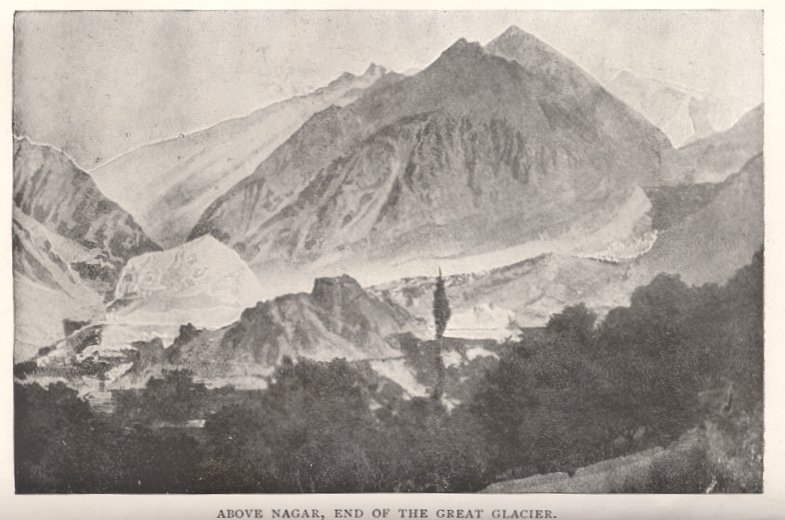
Nizam-ul-Mulk came to dinner with me one night accompanied by a Kashmiri officer. Nizam regretted the absence of champagne, but I was adamant; it would never have done to have had here in Chitral a repetition of the former scene. It was curious to see how easily these native gentlemen, who had never dined in the European fashion, adapted themselves in their new surroundings. Nizam's sole lapse from the customary manners of the dinner table was when he blew his nose on his table napkin. Otherwise the dinner was a complete success, and my cook, the best camp cook I ever had, surpassed himself. Nizam's enjoyment of foreign cookery surprised me, but everything appealed to him from a hors d'oeuvre of anchovy to the final strawberry ice.
At last, after many days of anxious waiting, came a letter from Umra Khan, the upshot of which was that, unless I could make definite terms with him on the part of Government, there was no use in my coming to Jandol. Unfortunately no instructions had reached me, so there was an end of the matter. I have often wondered what effect my going with full powers to treat might have had. The Napoleon of Bajour was a gentleman, as was shown by the treatment of two British officers who fell into his hands during the Chitral campaign. He was perfectly |257 straightforward in his dealings with me; He pointed out that he had for the moment conquered his enemies, but that they were still on the watch in a ring round him, ready to take advantage of any slip. Could he be certain of the support of Government he avowed himself ready to throw in his lot with us, and he was then the most powerful factor in Swat and Baj our politics: Had I been empowered to go down, and to make definite terms with him, it is possible that the troubles of a few years later might have been avoided, but it would have been difficult to arrive at an agreement satisfactory to both sides. Umra Khan's was a personal rule, born of war. His demands might have been prohibitive, and would most likely have included the payment of a subsidy which it might have been advisable to grant, and the presentation of a number of rifles which it might not have been wise to give: Had we been able to establish a powerful and friendly Chief, ruling the country from the Swat river to the borders of Chitral, the peace of that portion of the frontier would have been assured, and the question of opening the road between Chitral and India would have been solved for the time, but there would always have been the risk of chaos in the event of his death. This is the ever-present difficulty in dealing with frontier states. You can scarcely ever count |258 with certainty as to the succession. You may sometimes strengthen a vigorous ruler with advantage; to bolster up a weak one is, in the end, almost always useless.
The visit to Dir hinged on that to Bajour, and both now had to be abandoned. Preparations were at once made for the return march to Gilgit. Several posts reached me during my last few days in Chitral, and some had been tampered with and parcels stolen. I reported the matter to the Mehtar, who was furious, and who caused instant enquiries to be made, and a man sent for from each of the houses which had furnished the runners. The culprits were tracked, and the Mehtar proceeded to order condign punishment. The men were to be sold into slavery, but escaped at my intercession. The old Chief said it was no use he knew to offer me the wives and children of the robbers, but that he thought my Pathans would appreciate the gift. I had much difficulty in persuading him to leave the unfortunates in peace. But if no one suffered very severe pains and penalties, the fuss made had the desired result, and our posts were sacred for the future.
My last days in Chitral were full of business, and the evenings were spent as usual round a camp fire watching the dancing, and listening to the boys singing. Three Kafirs joined the circle one night, one of |259 them having the most revolting type of face I ever saw, and danced badly for some time. Nizam then asked them for the chaunt which is sung when a successful raiding party arrives near its own village. They refused to sing it unless a goat was given them to eat, so one was brought and presented to them. To my disgust one of them rushed at it, knocked it down with a tremendous blow of his fist, and a second dashed in with his dagger. It was done like lightning. I saw his hand clutch the hilt, and the next moment the dagger crashed through the poor creature's ribs. It was a most disgusting exhibition, and one we had hot bargained for, merely the pure savage devilry and love of killing coming out. The goat was removed at once, and the Kafirs came into the ring and sang two or three times over the same few bars; the air had a very weird refrain, a sudden rise and fall in the cadence. One could well understand the effect being most telling if the song broke out suddenly in the silence of the night near some sleeping village, and roused its savage inhabitants with the glad tidings of successful raid and murder. The Kafirs had so disgusted me with their cruelty in killing the goat, and looked such low brutes, that I was glad when they went, and we returned to the "legitimate drama," our dances and |260 singing boys. Nizam promised me a glorious reception if I would come to Yasin and visit him next year. We were to have the band and dancing boys all night, and not one of them twice over. It was a terrible prospect, and I should have had to go through with it, for I meant to make friends with my host, but the visit never came off.
The last day was spent in farewell visits, in sending the Mehtar and his ladies their presents, arid in distributing rewards to my various friends. The Mehtar accompanied me for a couple of miles when I left Chitral, and after giving me some really sensible advice against wandering about my own kingdom without escorts, parted with me for the last time. I never saw him again, though we had three years more to work together in, and whatever snares he laid for me, however much he plotted to my annoyance and sometimes to my anger, my personal friendship and admiration for the old man never changed. Considering his surroundings he was a great man. He was a typical border chief of the old school; for him and his brothers the question had been whether to kill or to be killed. He had chosen the former, and had carried out his plans with unwavering determination, backed by the coolest calculation and the most ruthless execution. |261
The lines from Sir Alfred Lyall's well-known poem, "The Amir's Soliloquy," used to ring in my head as I sat looking at the old man's striking face:----
"The virtues of God are pardon and pity, they never were mine;
They have never been ours, in a kingdom all stained with the blood of our kin;
Where the brothers embrace in the war field, and the reddest sword must win."
The brothers who opposed him slept where they had embraced, and his red sword was sheathed. He ruled over a united country, and no man might gainsay him.
My return journey was uneventful. Afzul-ul-Mulk entertained me at Mastuj. We crossed the Shandur ahead of a heavy snowstorm which overtook us next day, but nothing of importance happened. I received en route a letter from Younghusband, forwarded by the Hunza Chief, saying that the latter was on his best behaviour, and was making all necessary preparations to speed him through his territory. This was so far. satisfactory that it showed that the Thum for the present meant to abide by his engagements.
And so we passed out of Chitral territory, and left "the land of mirth and murder," as we named |262 it in opposition to "the land of gold and apricots." I was not to see its capital again until my old friends had all gone. The Mehtar was the only one to die in peace and the fulness of years; six of his sons lie in bloody shrouds.
At Gakuch, Syed Shah, the Scripture reader from Peshawar Mission, met me, too late to accompany Robertson into Kafiristan. As it turned out this was probably for the best. He gave a harrowing description of the slave trade in Chitral, and told how women were torn from their husbands and children to be given to other men, families broken up, the boys and girls sent as presents to Kabul, and the rest sold to go to Yarkhand, small children exchanged for sporting dogs, and boys for horses. The slave trade was one of the things I most wished to see put an end to in this beautiful country, but it was not a question to be approached easily. In the end I am glad to think we had our way, but if we left the country to itself to-morrow the trade would flourish again.
Four days' halt at Gakuch rested the camp, and, knowing that accumulations of work were piling up for me at Gilgit, I pushed on, and regained the shelter of my house by the middle of November, well pleased with the results of my long tour. We |263 had been marching steadily for four months and a half from the time we left Kashmir, and had covered nearly a thousand miles.
In a few days Robertson passed through on his way to India, Younghusband followed him shortly after, having safely accomplished the object of his mission, and Manners-Smith and I settled down to our first winter in Gilgit. Within a month the first heavy snowfall of the year came down, hermetically sealing the passes in our rear, and we were left, two solitary Englishmen, shut up in the wilds of Hindu-Kush. For weeks at a time no letters were to reach us; for six months the great snow barrier would prevent all possibility of help from India in case of trouble, and all that I had to rely on in the shape of an armed force was a body of two hundred Gurkhas of the newly-organised Kashmir Imperial Service Troops. Though of excellent material this little body was entirely undisciplined, untrained, and ignorant of the use of the rifles served out to it The outlook was, however, peaceful, and I relied with confidence on the result of my visits to the neighbouring states. My confidence was not misplaced, and the winter passed quietly. |264
2. * Journal, Geographical Society, January 1896.
DARDISTAN
THE limits of the Gilgit Agency correspond roughly with the region to which has been given the name of Dardistan. The name Dardistan, or country of the Dards, is misleading, for there is no race to which the title of Dard can fairly be given, no country so called by its inhabitants. However, such as it is, the name is a convenient one, and has been adopted, if not invented, by the scientific. Dardistan comprises the whole of Chitral, Yasin, Punyal, the Gilgit valley, Hunza and Nagar, the Astor valley, the Indus valley from Bunji to Batera, the Kohistan-i-Malazai, that is the upper reaches of the Panjkora river, and the Kohistan of Swat Kohistan means the country of the hills, and corresponds to our word Highlands. The section of the Indus valley included in the above is again divided into two main portions, the upper containing the Shin republics of Gor, Chilas, Darel, Tangir, called Shinaka or Shinkari, and the lower generally known as |265 Kohistan. It is in this lower portion alone, from the Kandia river to Batera, that the inhabitants of the right bank of the Indus are said to use the word Dard, and they apply it to the dwellers on the left bank. Throughout the rest of the country inhabited by the Dard races, a block roughly two hundred and fifty miles from east to west, and a hundred and fifty from north to south, the name is, to the best of my belief, entirely unknown. It is a name found in the ancient geographers, both Pliny and Ptolemy use it, but it is very difficult to define exactly the limits occupied by the tribes to whom the name was applied. It is perhaps safe to conclude that the whole of the mountainous portion of the Indus valley from the plains of India to the source of the great river, was held to be occupied by tribes so called.
Who the Dards were originally is a most puzzling question, and one for the trained ethnologist and philologist rather than for the plain soldier. However, following Leitner, Drew, and Biddulph,3 who made a special study of the question, it is possible to arrive at certain broad principles, which is all |266 that the general reader requires. The Dard races may be put down as largely Aryan, and the position now held by the different classes and languages points unerringly to waves of conquest. The mass of the population of Chitral are the Kho, speaking Khowar, and they probably represent the earliest wave of invasion which swept into Chitral from the north over the passes of the Hindu-Kush. So remote is their antiquity that they may fairly be Considered aboriginal. They owned the whole of the country of Chitral, but were dispossessed by the Ronus, the most honoured caste amongst the Dards, and by various other privileged classes, among whom are certainly the offshoots of families from Badakshan, who followed the fortunes of the founder of the present ruling dynasty. These upper classes have absorbed all the power, and treat the Kho with contempt, calling them "Fakir Mdshkin," which one might translate les misérables. The despised aborigines, however, have imposed their language on their superiors, and are interesting from the fact that they have no castes. This, I think, conclusively shows that they belong to the earliest Aryan race, and broke off from it before the acquisition of Hinduism; for in all other cases the Dard proper is emphatically a man with a caste. |267 The principal caste is that of the Ronus, a small body held in the highest respect, always ranking next to royalty, and from whom the Wazirs are as a rule taken. Then come the Shins, below whom are the Yeshkuns, and lastly a collection of low castes, Krámins, Doms, etc., the millers, potters, and musicians of the community. There is one plainly marked rule about the three leading castes; they give their daughters in marriage to the caste above, never to the caste below. The Ronus give their daughters in marriage to the ruling families, and in return receive the illegitimate daughters of princes, but not a daughter born in wedlock. The Shins give their daughters to Ronus, the Yeshkun to Shins, but a lawful daughter is never given to a man of the lower caste.
It would seem from a study of the map, and of the proportions in which the main castes occupy the country, that the later waves of Dard invasion rolled in succession up the Indus valley from the plains of the Punjab, penetrating into the side valleys as the tide rose, and either completely submerging the aborigines, or else driving them and the wrecks of previous waves into the inmost recesses of the hills. The first of these waves must have been Yeshkun, the second Shin. There are no less than eleven |268 different languages and dialects spoken in Dardistan, and their distribution confirms the above view. Putting aside eight of the dialects, and taking the northern half of the country under discussion, you find Khowar generally spoken in Chitral; Burishki, the language of the Yeshkuns, spoken in the inaccessible Hunza, Nagar, and Yasin valleys; Shina, the language of the Shins, in the Gilgit, Astor, Punyal, and Ghizr valleys. Roughly speaking, the proportion of Shins to the whole population falls from ninety-five per cent, at Koli, in the Lower Indus valley, to thirty-five per cent, at Gilgit. In Nagar, the Shins are about twenty per cent.; in Hunza, five per cent, of the population. The Yeshkuns are in inverse ratio. In Yasin, almost the entire population; in Hunza, eighty per cent.; in Nagar, sixty per cent; in the side valleys of Astor and Sai seventy-eight and sixty-five per cent, of the people are Yeshkuns, driven up the valleys by the advancing Shins. The numbers generally go falling as the Indus valley is descended, until at Koli you find perhaps only four per cent, of the inhabitants are Yeshkun. In Chitral you find neither Shin nor Yeshkun; the waves had spent themselves at the Chamarkand and Shandur passes. As to the dates of the different invasions, or the |269 last stage occupied semi-permanently in the tribe wandering before Yeshkun or Shin turned from the plains, and came surging up the Indus valley, who can give a definite answer? Biddulph inclines to take the Yeshkun, or Boorish, as they style themselves, to be the Yuechi who conquered Bactria about 120 B.C. Boorish, he says, may stand for Pooroosha, the ancient name of Peshawar, the seat of the Indo-Scythian kingdom founded by the son of Kitolo of the little Yuechi tribe who conquered Gandhara and Ariana in the fifth century of our era. The tribe must have swept up the Indus, and occupied it and the tributary valleys from Jalkot to the Shigar valley in Baltistan, subjugating the Aryan inhabitants as it passed. The beauty of the Aryan women----famous in all time----would soon tend to merge the races, and to stamp the Aryan type on the invader.
Buddhism must have flourished now, as the countless "mannis," or long stone altars, which abound throughout the Hindu-Kush show. The topes, chortens, and sculptured Buddhas scattered about in Chitral, Punyal, Gilgit, Nagar, and Baltistan, also testify to the spread of the gentle faith, and the voice of history in the writings of the Chinese pilgrims is not silent. With the Buddhist |270 era came a proficiency in the arts never since equalled, as is shown by the masonry, sculpture, and clean-cut sockets to support the timbers of wooden irrigation channels taken across perpendicular cliffs near Gilgit. After an interval of some centuries, but how soon seems impossible to decide, followed the Shins. That the Shin race was Hindu there can be no reasonable doubt; this is shown by their peculiar regard for the cow, their strict regard for caste, and the absence of the slightest feeling of reverence for the Buddhist remains abounding within their limits. Biddulph places their last home before the final move at Pukli, the modern Hazara district, a corner between Kashmir, the Indus, and the plains of the Punjab, and thinks that they swept up the Indus valley as far as Leh. Certain enclaves of Shin-speaking villages in Baltistan, the inhabitants of which are called Brokpas, or Highlanders, by the Baltis, prove the latter proposition. The Baltis again are Tartars, who swept in from the east, swamped the Shin population, and drove it in its turn into inaccessible fastnesses.
The smaller broken Dard tribes, living for the most part in the southern portion of Dardistan, it is unnecessary to mention in detail. Biddulph |271 considers that they fled from the increasing pressure of the Afghans in the sixteenth or seventeenth century. Like a shoal of small fish when attacked by a pike, they seem to have broken up and scattered in all directions, never to reunite. The Gaware of the Indus valley, and the Gabars of the Chitral valley, near Narsat, are probably of the same stock, and may be identified with the Gabrak of the Emperor Baber's Memoirs, possibly with the Gouroei of the ancients. Similarly many other of the smaller scattered tribes may be traced to a single root located probably in the north of the Punjab, or in the Swat and Panjkora valleys. But the research is tedious, and enough has been said to explain the origin of the races now occupying Dardistan.
Conjectures have been hazarded that to the northern half of Dardistan applied the name of Bolor, the country mentioned by Marco Polo immediately after his description of the Pamirs. Colonel Yule disagreed with the view, and placed Bolor north-west of the Pamirs, and in a note quotes Colonel Alexander Gardner's testimony in confirmation. In one of the final notes on Marco Polo, however, Colonel Yule leans to the opinion first held by Forsyth that the word Bolor is merely a corruption of the Persian "bálá," high. This |272 seems extremely probable, for to the European ear the broad pronunciation of the "a," which is turned into "aw," verges very closely on "or." This would explain the great difficulty in fixing on the actual position of Bolor, for the term may well have been applied to the highlands surrounding the Bám-i-Dunya, or roof of the world, as the Pamirs are called in Central Asia, Bilauristan, the name given in a seventeenth-century Pushtu poem, as Yule points out, to the mountainous country north of Swat, on this supposition, merely means the same thing as Kohistan, the highlands. A similar use of the corresponding word occurs in Chitrali, where one of the main valleys is called Turikho in the higher half, Murikho in the lower, the literal meaning being "the upper valley" and "the lower valley." "Bálá" and "páin," high and low, are words constantly used by all the Persian-speaking people in the Hindu-Kush for describing ground, and travellers have very likely hundreds of times, on asking the name of lines of mountains, merely received the word "bálá," for with one or two very rare exceptions, mountains, and certainly mountain ranges, are never named in this part of the world. In this way one can understand the adjective passing into a name. At the same time it is difficult to |273 account for a man like Gardner, who, living as he did as a native among natives, must have talked Persian perfectly, being taken in in this way, and it seems not unlikely that the word "Bolor" may be the corruption of "bálá," picked up by the non-Persian-speaking population from their Persian-speaking superiors, and applied to definite tracks of country north of the Hindu-Kush. The corrupted word might well, under these circumstances, have come into general use among all classes to express the highlands, which would explain its use by Marco Polo and later travellers. Personally, I never heard the word "Bolor" applied to any tract of country, but I never crossed the Hindu-Kush, and to a region north of Hindu-Kush alone was the name applied by Marco Polo and Gardner.
My time at Gilgit was too much occupied by my multifarious duties to enable me to study the race and language questions, but I was naturally constantly in contact with the people, and gained a very fair knowledge of their peculiarities. There is no doubt that the Shins are a dying race: in Chilas their numbers have dropped with dreadful rapidity during the last few years; it is the same lower down the Indus valley, and in Gilgit they are being gradually supplanted by immigrants. They |274 are unenterprising, wanting in stamina and in perseverance. They are men of fine enough physique, but they are soft, and have little or no warlike instinct. Very much attached to their lands, they will not move except under official pressure or the compulsion of the direst poverty. Half a dozen able-bodied men of one family prefer starving on a tiny piece of ancestral land to dividing their forces and taking up ample grants, distant perhaps but a few miles from their old home. The systematic oppression of their rulers, which deprived a man of much of the fruit of his labours, accounts in part for their attitude on this particular point, but, allowing for this, the race is sadly wanting in initiative. The Yeshkun is, I am inclined to think, a better man than the Shin, there is no doubt about his being a better fighting man, and the small caste or clan of the Ronu is the best of all. Taking the whole of Dardistan the inhabitants are not warlike, and in the southern portion alone, which is under the religious influence of the Mullahs of Swat, do you find fanaticism. The people are peaceful; there is none of the natural devilry, dash, love of war, and enterprise, which you find in the neighbouring Pathan, and they never have stood up, and never would stand up, against severe losses. |275 But that they could fight behind suitable defences I always felt was pretty certain, and we found this at Nilt. Centuries of desultory warfare have made them adepts at the art of field fortification, and awkward customers to deal with when on the defensive. In attack they are contemptible, and only dangerous when overwhelming numbers force disciplined troops on to the defensive, as at Chitral. Even then they would never push an attack home, it is always an affair of a ring of stone breastworks drawn tighter and tighter round the invested body, of incessant fire and perhaps mining, never of a stern open assault such as Pathans would deliver. From the soldier's point of view they are certainly not first-class fighting men. Their rulers alone are blood-thirsty, and that really from the accident of birth and of religion. Even among them, though you might find instances of ruthless severity such as must accompany succession in a Mahomedan state, you but very rarely found the cruelty of the savage who delights in the torture of his victim. It was generally a case of a short sharp shrift. Among the people murders are very rare, and are almost invariably the result of a slip on the part of a lady. By their own laws the resulting punishment, if inflicted under certain circumstances, is |276 perfectly lawful, so that it can scarcely be called murder.
The great difference between the Dard and the Pathan cannot be better illustrated than by the condition of Hunza and Nagar after our fighting there in the year 1891. Within a day of the last fight which decided the short campaign, officers could and did traverse the country unarmed: Conway's mountaineering party wandered all over it six months later without the semblance of an escort, and not one single shot was fired at us after the power of the tribesmen had been broken. They "took their licking," and bore no malice, and within a year, from the very men who had fought against us, I had organised local levies who were ready to fight on our side, who turned out without hesitation when called on, and who did excellent work. Had the country been held by Pathans a small force could never have done what ours did, we should have lost dozens of officers and men on the line of communication, and the real trouble would have begun when the final successful action gave us access to the heart of their country. The characteristics of the two races could not be more dissimilar.
An incidental proof, if one were needed, of the connection of the Dards with an Aryan race is to be |277 found in the ornaments worn by men and women. These are of gold, silver, or brass, many being of rather debased design, overloaded with filigree detail. But some of the designs are remarkable and interesting. The brooches worn by all classes are discs of metal with a large hole in the centre crossed by a pin, and are identical in design with the fibulae so common in Scotland and among the ancients. The necklaces of round and oblong beads, one of which in gold is figured in the plate of ornaments, are curious. The beads, more especially the long ones, are practically replicas in metal work of beads in coloured clay at least two thousand years old, dug up on the site of ruined Buddhist cities in India. So marked a persistence in designs would go far to prove a connection between races employing them in the common objects of everyday use. |278
3.
* Leitner: "Dardistan."
Drew: "Jummoo and Kashmir Territories."
Biddulph: "Tribes of the Hindu-Kush."
FOLK-LORE AND SPORT
THE folk-lore and the festivals are most interesting, but for want of time I could not follow up the researches I should have loved to make. Vestiges of dead faiths meet you at every turn. Fires blaze at certain seasons on the hill-sides and on the mountain top, and remind you that what we call fire-worship originated but a stone's-throw to the north on the other side of the Hindu-Kush. The cedar, sacred in Kafiristan, and still exported to India for Hindu ceremonials, is sacred here; outside every village almost is a stone altar yet visited by the women, the names of the village gods are remembered, often surreptitiously invoked, and soothsayers and witchcraft abound. Some little distance up the Chaprot nulla is a clear spring of water, and if a piece of cowskin is thrown into this, by order of the Thum of Hunza, to the accompaniment of suitable incantations, the heavens are immediately obscured with clouds, and the most dreadful storms rage over the |279 district, to the terror and danger of the obnoxious wayfarer or invader. I was solemnly warned on more than one occasion against this particular power for evil possessed by the Hunza Chief. The power was not confined to him, and seemingly in some cases lay more in the spring than in the person, for I heard of various other springs in different places, the throwing into which of any defiling substance was followed by bad weather. It is curious here to see the cowskin considered an impurity, and it shows the connection with Hinduism. Sacred as the cow is, no high-caste Hindu will touch cow leather. The regard for the cow amongst the Shins is most marked, but I think that in the main valleys, where there is now considerable communication with the outer world, it is losing its hold. It has gained for the Shins the name of Dangarik, or the cow people. The Shin used to have some one of another caste to tend his cows, and nothing would induce him to touch a new-born calf. If there was no one else handy, and it was necessary to put the calf to the mother, the little creature's head would be caught at the end of a cleft stick, and pushed to the udder. The Shin hatred of hens was another distinct link with Hinduism.
The feasts, many of which must be of Hindu rather than Buddhist origin, are beginning to fall into |280 desuetude; Mahomedanism is gradually pushing them out, but they, and the observances which accompanied them, are still to be seen in some parts. I have assisted more than once at the "Chili" festival, which marks the commencement of wheat-sowing, and which had years ago a further connection with the worship of the cedar, now in the main dropped. What the connection was I failed to find out, most probably the dates of the aboriginal feast of "Chili" or cedar worship, and of the Shin feast of sowing synchronised, and the two thus became welded together. The connection now is limited to a certain amount of wheat being smoked over a cedar wood fire, and of cedar twigs being in use next day when the sowing takes place. From a portion of the smoked grain a large unleavened bannock is made overnight, which is carried before the Rá or Chief of Gilgit when he rides out next morning to the sowing. Arrived on the selected ground the headman of the village holds up to the Rá the skirt of his choga full of the smoked grain, and into this the Rá throws small quantities of gold dust. The golden grain is then scattered amongst the circle of villagers, the ceremony being repeated till the grain has been thrown to all four points of the compass. The Rá then dismounts, a plough is brought, and, taking the |281 handles, the Chief draws two furrows, one running east, the second west, and over these he again scatters the golden seed. A goat is then sacrificed, the drums strike up, and the Rá rides off, the rest of the day being one of continuous feasting, polo-playing, drumming, and dancing.
There are many other festivals, almost all connected with agriculture; spring-time and harvest, autumn and winter, are all marked by appropriate feasts. The Yudeni drum, or fairy's drum, which was kept on the top of every Chiefs castle, played a part in the ancient ceremonies. It was very unlucky to look towards it while the sounds rang out; if the fairy drummer was seen, the direst calamities followed. I never to my knowledge heard the fairy drum myself, but no feast in the old days was complete without its note, no warlike expedition could be expected to succeed which started without the fairy approval. But if I never heard the fairy drum, I have seen what few will ever have the chance of seeing again, the Dainyal, the diviner or soothsayer inspired by the fairies. Dainyals are usually women, but men sometimes become possessed, and the seers are seemingly of all ages. The one I saw was a buxom married village girl of about twenty, held in great estimation in the village and district on account |282 of her supernatural powers, and ruling her household with a rod of iron.
I had ridden up the Bagrot valley, down which a stream from the southern glaciers of Rakapushi reaches the Gilgit river, in order to see what could be done to improve the water channels, which were carried along very difficult cliffs, and which the people only kept in even partial repair with the greatest labour. It was a melancholy ride. The valley had been raided years ago by the Yasin ruler, and some two-thirds of the population carried off into slavery or killed, and the traces of the tragedy were recognisable on all sides. At the mouth of the Bagrot valley lay hundreds of acres of land gone out of cultivation, the terraced fields and the raised irrigation channels still intact, their lichen-grown and sunburnt stones showing that water had not run over them for decades. Further up the valley half, and sometimes two-thirds, of the village land lay in the same state, the dead and gone vineyards easily recognisable by the small stone vats, which had once run full of foaming must; the flat stones above them, on which the grapes had been trodden out, and the little stone runnels, through which the juice had poured, were still in their places.
For several miles the road runs up the narrow gulley between what was a lateral moraine and the |283 hillside, not a drop of water is passed, not a tree or glimpse of vegetation is to be seen, not a sound is heard save the ring of one's horse's hoofs on the burning rock, for the stream frets a thousand feet below; not a sign of life is there, but perhaps the passing shadow of an eagle. I had been riding slowly on, lost in a reverie, my horse picking his own way, when there came a sudden change. There was a sharp turn in the path which led into a deep ravine cut by a side stream, and then rose in sharp zigzags to gain the crest of the opposite bank. The moment I turned the corner a shot rang out, the edge of the cliff "sprung to life with armed men," and a rapid feu de joie rippled along the crest above me. Arrived at the top I was met by the village elders, was incensed with the smoke from a platter of burning cedar twigs, and presented with a flat unleavened cake soaked in clarified butter, the local variant for bread and salt. As I broke a piece and ate it, I noticed that the bread itself was apparently consecrated, sprays of the sacred cedar lying on the dish on which it was carried.
I spent some days making friends with the people, and visiting every yard of their watercourses, which were, as usual, a monument of patient skill. To carry water channels across the face of perpendicular |284 conglomerate cliffs cut out of moraines by the action of a stream which rages below, sometimes impinging on one bank, sometimes on the other, is no easy matter even for that most handy of creatures, the Royal Engineer, however well he may be equipped. For the poor villager it is a labour of Sisyphus. The stream is always cutting away a frail prop, undermining a high retaining wall, breaking the side of the water channel, or washing away the intake headworks, and the work has to be done all over again. Truly, the people compelled one's admiration by their steadfast patience and determination, and filled one with a desire to help them in every way in their desperate fight with nature.
As I passed through a stretch of abandoned cultivation given up to the barberry, the wild pomegranate, and the brier rose, we stumbled on a time-worn altar, the stones of which attested its great age. It was covered with a few cedar boughs, others lay scattered around as the wind had displaced them, and the men with me said it was the shrine of the village god, and that these were the offerings of women who had come to pray. It was a scene which made a vivid impression on me. Far away above us, the culminating point of the valley, rose a snow peak against a bright blue sky, open hillsides fell back on |285 each hand, swept by a fresh spring wind, patches of bright cultivation lay across the stream whose voice rose from the gorge to our left, but no house marred the view. Before us, backed by the silent terraced fields of a dead generation, lay the little altar of a dead faith. And yet one felt it was not dead; the great god Pan laid his hand upon one's heart, all nature was filled by his presence, and one felt the impulse which brought the women there to offer their humble sacrifice to the living god of the stream and the hillside rather than turn to the cold deity of Mahomedanism, so essentially the god for men, and not for women. I replaced the scattered boughs, and invoked peace and prosperity on the stricken valley.
Above the village where we were camped was a conical hill inhabited by the local fairies. It is easy to realise how certain their existence is to the people. It always seems to me that it is only in the heart of the great mountains, thousands of feet above the last trace of human habitation, when you lie by some time-worn rock, lulled by a silence which can be felt, and gazing at the eternal snows, that the real voice of Nature speaks to you. Then truly do the heavens declare the glory of God; you feel the pulse of the All-pervading Presence, the beauty and sublimity of |286 Nature sink into your soul, and for the moment the mysterious veil which falls between us and the light wavers and half fades away. If Nature so speaks to us what must she say to men and children who spend days and weeks of absolute solitude on the mountain sides? A simple mountain people must have a simple faith, must bow to visible and tangible deities, not to abstract objects of pious belief. It needs the pure clear skies of the desert to produce a race which can recognise that "there is no god but God," centuries of high civilisation working on the acute and introspective Indo-Aryan mind are required to produce the Buddha. The gods of the valley and the mountain, of the mist and forest, the dwellers in the glacier and the torrent, are the natural first step in worship and in the supernatural. They are born of the solitary watching of the wandering flock in the day-time, of the sheepfold at night. The supernatural is ever with the lonely shepherd; the avalanche sweeping down the mountain side is the protest of the solitary god against any attempt to scale the approaches to his throne; the mountain sickness which seizes the wayfarer on some pass is the vengeance of the disturbed fairies; the shriek of the wind behind the veil of mist attests their presence; the snow flag streaming from some great peak |287 is a sign of the god's abode; the voice of the gods speaks in the moaning forest and the rushing waterfall. The fairy and the god seem at first to trench on each other's domains, and the distinct separation between them is a thing of later growth. At least so it seemed to me was the case in the Hindu-Kush.
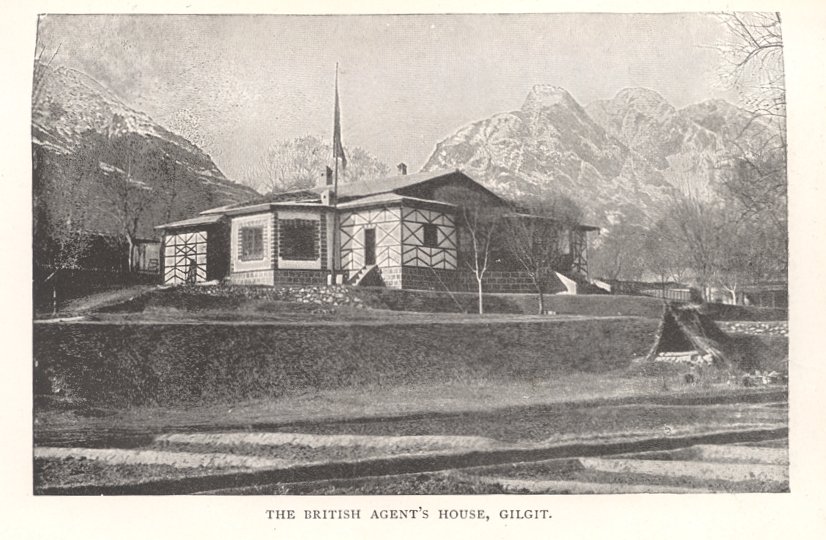
The last day before I left the valley I saw the Dainyal. We were taken to the village dancing ground, round which sat all the men of the village, and were accommodated in the verandah of the guest house, from which an excellent view of the scene was obtained. A few old women and children were seated in an outer ring, but all the young women, dressed in their smartest clothes, were collected in the surrounding houses. The inevitable band formed part of the inmost ring. After a short interval of waiting the Dainyal stepped into the circle and sat down. She was at once covered with a woollen choga, and a platter of burning cedar-twigs was placed before her, over which she bent, inhaling the smoke. After a few minutes she rose, and stood facing the orchestra, leaning her hand upon a drum. Bare-headed, her long black hair streaming down her back, she stood swaying slowly backwards and forwards to the accompaniment of low music from the band; gradually the band played faster and faster, |288 the swaying quickened, until it seemed as if her neck must be dislocated by the violence of her movements, and her locks stretched to their full extent threshed in a heavy mass, at one moment over her face and bosom, the next down her back to her waist. She looked horrible, a very Maenad. Suddenly she ceased, and stood as if dazed. Then with slow and faltering step she began to wander round the circle, keeping the spectators on her right hand. The pace gradually increased until she danced round, the band keeping time to her every motion. The fairy hill lay to the north-west of the place where we were sitting, and her eyes were constantly fixed in its direction as she came round the circle and faced towards it.
I watched her very carefully, and for some time failed to detect anything but an expression of entire abstraction from her surroundings, till, in one of her circlings, she suddenly shot a glance at us, which showed that, however much the fairies possessed her, she was still fully conscious of our presence. At last, after many weary wanderings, she halted by the band, the music of which dropped to the faintest murmur, and listened first to a pipe then to a drum for the fairy voice, to be heard only by her. There was a slight pause, and then she sang a couplet, which was taken up and repeated by the village elders, who |289 formed a sort of chorus and sat by the band. The onlookers listened with rapt attention, and it was easy to see that they were full of implicit faith in the genuineness of the "possession," and in the importance of the spoken words. Again and again the Dainyal spoke, her words being caught up and repeated by the chorus of old men. Then she wandered round the circle again, till she could think of something more to say.
We were not deprived of interludes, comic and otherwise. There was a man hanging some dyed clothes to dry in the bare branches of a walnut tree, beyond which rose the fairy hill. The man's presence, when he climbed high among the branches, infuriated the Dainyal, and she tried hard to break the ring of spectators, and to get at him. She was good-humouredly but firmly stopped, but the man was ordered out of his tree at once, and she solaced herself by throwing stones at him. I never quite made out what would have happened had she broken out of the ring while under the influence of inspiration, but it was evidently something bad, either for her or for the community at large, possibly for both.
At one period the Dainyal got tired, and sat down on a drum waiting for water to be brought. During this interval a baby began to cry, and was ordered to |290 be removed by a peremptory glance and gesture, which were instantly obeyed. A dog came gently wandering by to investigate what was going on, and retired much injured in his feelings before a shower of stones, thrown by his familiar friends in the crowd, for dogs and babies were particularly distasteful to the Dainyal during her periods of active inspiration. When the water arrived, an old man pronounced a long incantation over the gourd containing it, then handed it to the woman, who, after drinking a little of it, began again her weary wanderings, sprinkling the water as she went round the circle. And so it went on, the Dainyal occasionally chewing a piece of the sacred cedar as an additional help, until all the subjects she had learnt up, or thought of interest to her hearers, were exhausted. She prophesied various things in our favour, and gave vent to one or two shrewd sayings about local abuses, which seemed to please her audience immensely. No doubt in the old days public opinion could often only reach a chief in this manner, and full advantage seems to have been occasionally taken of the opportunity, which the performance of the Dainyal afforded, of enlightening the mind of an unpopular ruler. Finally, when it was evident to all that the source of inspiration had for the day run dry, a couple of men came into the ring, |291 and one of them stooping down and giving the Dainyal a back, she took a run and flying leap on to it, and was so gracefully carried out of the circle. A few minutes' rest in a neighbouring house, and a sprinkling of water, enabled her to come to. The whole performance was extremely curious, and there is no doubt whatever that the onlookers firmly believed in the woman being inspired.
The ceremony of initiation is unpleasant; we fortunately were spared seeing it. If any one, man or woman, claims to be inspired by the fairies, they have to go through the rites described above with a recognised Dainyal. At the end of the performance a goat is brought in and decapitated, and the novice has to seize the neck and drink the spouting blood. If successful in this, he or she is at once recognised as inspired. If the ordeal is too much, then a contemptuous pity is extended to the aspirant, as to one who has been on the verge of attaining to great things, but has failed owing to personal defect. Those who cannot fulfil the conditions are said invariably in the end to go mad.
The Bagrot valley, where we saw the Dainyal, was further of interest in that about the best gold of the country is found in its bed, and in the Gilgit river below where the Bagrot stream runs in. Every |292 year, after the summer floods are over, the deposits in back waters and sand-banks are carefully washed, and a fair amount of gold, considering the rough methods and unskilled labour of the prospectors, is collected. When we first went to Gilgit pure gold was selling there at two-thirds its price in Srinagar, and the Kashmir officials and soldiers were doing a profitable trade. The amount collected by the officials each year must have been considerable. Every petitioner or visitor, as a rule, presented his little nazzar----the complimentary offering from an inferior to a superior always given in the East----in gold dust. The gold was poured into the blossom of a dried flower like a lupin, of a very tough texture. The mouth of the flower was screwed together, and the tiny packet was popped into another flower, and again screwed up, each packet containing a recognised weight. I have had double handfuls of the little packets poured on to my table by an anxious royal petitioner, an unsatisfactory arrangement so far as I was concerned, for my nazzars were returned to the donors. A native gentleman naturally keeps the offerings, and the amount of gold which left Gilgit when a Governor was changed, or his confidential man went to Kashmir, was pretty considerable. We had rather an amusing instance of the differences of method after I had been |293 at Gilgit for a couple of years, and the local chiefs had become accustomed to having, in official language, their offerings "touched and remitted" instead of kept. One of the Kashmir princes, Raja Ram Singh, came to Gilgit, and I had summoned all the neighbouring chiefs and leading men to a Durbar held in his honour. As each man came forward he produced, according to custom, gold or silver, and the looks of horror and bewilderment which followed when the Raja with a graceful movement of his hand indicated that the offerings were to be put down and left were most entertaining. The word was soon passed, however, and the presents fell off in value with extraordinary rapidity. The disgust of the donors when their offerings were collected and sent to the Government Treasury afforded us all, even the victims, considerable amusement.
But if we could not collect gold, we set ourselves to collect heads. The sport round Gilgit was magnificent for those who could get time for it. Personally, I only managed twice to get away for any length of time, once during my last months at Gilgit, when I got the best ten days in the year, when the ibex in the spring are just off the snow enjoying the fresh spring grass, and once in winter, when I went a little way down the Indus valley after markhor. |294
This was within an ace of being my last shoot, for I left my escort a march below Bunji, and made a dash for a nullah ten miles lower down with only my shikari and servant. I had meant to be only one day on this ground but heavy snow and rain came, and having seen some grand markhor I stayed on three or four days. I was nearly shot for my pains, for the Chilasis heard of my move, collected fifty men, and came up the valley to rush my camp. Luckily for me the Gor men, with whom my shikari was connected, assured them that I had only remained one day, and had returned to Bunji, and they did not persevere in their search.
It was not a lucky expedition; the weather was horrible, snow leopards spoilt my best stalk, which had practically lasted three days, and as I was regaining my camp, walking along the bed of a ravine in the dusk, I found myself confronted with an absolutely impassable place. Perpendicular walls of conglomerate towered above me on either hand, the path which had run along the cliff to the right had been destroyed by a spate in the spring, and only a remnant, just visible a hundred feet away, showed where it had been. We stood on a platform forty feet above the level of the ravine bed below, the general slope of the stream bed being here broken by a band |295 of huge rocks, at the base of which boiled sulphur springs. In the fast-growing dusk it was impossible to find a way down. To regain my camp by the way I had come meant a round of many miles and a climb for several thousand feet, some of it in very bad ground. There was nothing for it but to remain where we were, and to seek the shelter of the most convenient rock. It was not very pleasant, for there was a sharp frost, we had nothing to drink but sulphurous water, very little to eat, no spare blankets beyond one from which I never parted, and, owing to the rain of the previous days, we were in constant danger from falling stones, which had pitted the rocks in the bed of the stream as if they had been under a heavy musketry and shell fire. All night long above us we heard the roar of small stone avalanches, followed by silence as the stones shot into space a thousand feet above, and then by the rattle and crash as they struck the stream bed. However we found a small water-worn cave, the mouth of which was protected by a large rock, under the cliff from which most danger was to be expected, and we passed a safe and fairly comfortable night Next morning, after a very nasty shave of being brained by a falling stone, we discovered a way down, which involved one of the worst pieces of |296 rock-climbing I ever came across. For about fifty feet the only foothold was a line of depressions a couple of inches deep, the only hold for the hands was well above one's head, and that was the smooth round cornice of a water-worn rock round which the fingers could bend, but which gave no grip; thirty feet below steamed the boiling sulphur water. It was nearly too much for me, but the knowledge that breakfast was within half a mile, that to go back meant several hours' work, carried the day. Even then I could not have crossed without help, but my shikari, who was like a monkey, got on to the cornice above me, and dropped me the end of his turban, with the assistance of which I got over all right, the shikari moving along the ledge above. It was impossible for him to get down at the end, and he had to go back and follow by the path I had come, an easy enough job for him. My weight and height were against me at performances of this sort, and I used to envy my light and lithe shikari, to whom no ground came amiss.
One way or another we all had exciting times stalking. I have a nightmare recollection of one snow slope, which dropped a couple of thousand feet below one and ended in ghastly precipices, which we had to cross to reach ibex. The slightest |297 slip meant death, and we had no ropes or ice axes, nothing but one small alpen stock with which to dig out steps in the frozen snow. Providence protects the ignorant mountaineer. A Pathan orderly of Manners-Smith's flew down a similar snow slope on one occasion, and, luckily for himself, took the first turn to the right, which landed him in a soft snow bank. The first turn to the left would have carried him over a cliff a couple of hundred feet high on to rocks.
On the other hand, at certain seasons, both markhor and ibex can be got on fairly easy ground, and during a severe winter we have more than once watched markhor feeding on the slopes of the mountain behind my house at Gilgit, on ground almost as easy as the South Downs. There are, generally speaking, four well-defined belts of ground on which you find game. The snow to which in summer the ibex retire, never leaving it except to feed, and the grass and juniper-covered slopes immediately below the line of perpetual snow, where at the same season you will find the markhor, form the first belt; the second is generally a line of cliffs, the third a slope varying from a few hundred to some thousands of feet in depth; and the fourth, the final perpendicular cliffs into the valley. Of |298 course this is a generalisation, and some ground goes up thousands of feet into the snows like a sheer wall, broken with but tiny patches of forest and narrow lines of grazing, and on this you find the biggest markhor.
The altitude at which you find game depends generally on the snow line, and the work is easier perhaps in winter than in summer, except that you are handicapped by the shortness of the days, and that in some valleys the lower ground is distinctly worse than the higher. To me three-quarters of the enjoyment of the stalk lies in the scenery, in getting up above the animals and studying them, perhaps for hours, in listening to the call of the snow cock at dawn, in lying watching the little round-eared rock rats, or the circling flight of the eagle, in the freedom and the silence of the mountains. I always feel like a murderer when successful, and miserable when I have missed, but I loved going out, and envied the easier-worked subaltern under me, who could get away fairly often for his few days' shoot. With all who worked under me I always went on one plan,----I asked of them their best work and got it, and it was often at very high pressure for weeks at a time, but the moment I could I gave leave |299 for shooting. The results were excellent, no man was ever better or more loyally served, no man had ever a cheerier, brighter, and harder set of officers working for him. |300
ADMINISTRATION AND WAR
OUR first years in Gilgit passed in peace and hard work, tempered by "excursions and alarms," born of the wild and ever-varying plots and intrigues indulged in by my native friends on all sides.
My position presented some of the curious anomalies to which the Indian Administrator on the frontier is accustomed. I was the representative of the British Government on the frontier, and the external relations with the neighbouring States were under my control. But the rule within the Gilgit border was in the hands of the Kashmir Governor, while the command of the forces rested with the Kashmiri General, with the proviso that no important move of troops should be undertaken without my sanction. It was a difficult position, for every one recognised that, in addition to my own responsibilities, I was really answerable for the proper government |301 and progress of the Gilgit district, and for the discipline and control of the troops.
The difficulty was solved by the formation of an unrecognised Committee of Public Safety composed of the Governor, the General, and myself. We met two or three times a week at my house and discussed our various schemes, the necessary steps for which were invariably carried out in the name of the Kashmir Durbar and by order of its own officers. Even so the task set one was no easy one----a reformer's rarely is, but patience and courtesy go a long way in the East. Personally my Kashmiri colleagues and I were very good friends, and in the end what was required was generally carried through. For the first few months we turned our attention mainly to the re-modelling of the Forts occupied by the troops, with the object of replacing the foul huts in them by proper barracks, and of building suitable granaries and stores. Much time and labour were also spent in improving the irrigation channels in the Gilgit district, on which the food supply of the inhabitants and the troops depended. The whole subject of the grain and other revenue was also gone into, and the question of the improvement of the local communications exhaustively examined.
Christmas, 1889, saw the beginning of a series of |302 gatherings of the neighbouring native chiefs, and of their leading men, at Gilgit. I held a formal Durbar, and had as much trouble over the precedence of the different chiefs as might have been expected in India had all the nobles of Hyderabad, Central India, and Rajputana met at once. I took advantage of the opportunity to make a speech, informing all of the intention of Government that the British Agency should be permanent. The doubts on this point, carefully kept alive by interested people, whose power was slipping from their hands, were the main cause of all my initial difficulties. After the Durbar we had a week of sports of all kinds, during which, to our satisfaction, and to the great astonishment of the natives, Manners-Smith and I, with a couple of Gilgiti players, defeated the Nagar team completely at polo. This was one of the most useful lessons of the week, for the Nagar men were, till then, undefeated, and fancied themselves accordingly. Another little object-lesson provided for my guests lay in a small field-day, an attack on a ruined fort by my Pathan guard and the Kashmiri Gurkhas. The accuracy of the shooting impressed the tribesmen very much, but my outside friends had no intention of fighting should the necessity arise except behind good walls, and they knew that rifle-fire was of no use against those. |303
The spring of the year 1890 was at Gilgit itself one long struggle against incompetence and opposition on all hands. I went down to Kashmir in the summer to interview the Resident, then on to Simla and saw the Viceroy, Lord Lansdowne, and got promises of all that was wanted, and cheering words of encouragement from one whom all men in India loved to serve. The rabble in the Gilgit command were to be withdrawn, and I was to have a couple of the new Kashmir Imperial Service regiments by the autumn. As I wanted to see the engineers' stores, the staff for the new road, and all the treasure, ammunition, and troops over the passes ahead of me, all of which would take several months to collect, I took three months' leave and went home, for there was nothing much to be done at Gilgit till my wants were partially supplied, and the organisation of the troops and the collection of stores was not in my hands. I could only point out my wants, my authority only began on the Gilgit side of the passes.
During my absence, Manners-Smith acted for me; the long-expected doctor went up to Gilgit in July, George Robertson passed through, en route to Kafiristan, and lost all his baggage in the Indus at Bunji, much to his annoyance. On my return from England I found things very much as I had left them, and to |304 my great regret the Resident, Colonel Parry Nisbet, was going home, and another, who knew not Joseph, was to reign in his place. The troops had gone up, or were just leaving, but treasure, stores, and ammunition were all on the wrong side of the passes. I sat down for three weeks and worried the Governor of Kashmir daily till he must have hated the sound of my name; you realise the point of the story of the unjust judge in the East, none but the importunate can get anything done. The arrangements of the Kashmir authorities were just as inept as they had been two years before, and no proper scheme of transport had been worked out Finally, having got all the essentials in money and stores for the troops over, I crossed the passes myself, just in time to avoid the first heavy fall of snow, but having to abandon to next year most of my own stores, and, what was far more important, the personnel of the road-making establishment. The engineer of the road got through, but with the scantiest number of skilled workmen, the contractors, with their men, remained behind. It was very disgusting, but one learnt patience by experience, and it was better to delay the road than to have fifteen hundred Pathan and Hazara coolies, for whom no food had crossed the passes, turned loose on the country. The engineer spent his time in |305 hunting for bridge sites, searching for lime, reconnoitring lines of road along the cliffs between Gilgit and Bunji, and in laying out the approaches and collecting material for the bridge over the Indus.
My time was now fully occupied at Gilgit. The year before I had drawn up complete schemes for putting the postal and transport arrangements on a proper footing. Both had, of necessity, been shelved, and. the matter had to be gone into again. The first difficulty was finally solved by including Kashmir in the Imperial postal system of India, the second by placing the whole of the commissariat and transport arrangements under an officer of the Indian Commissariat Department. These changes were not, however, carried out for another two years, and I had to struggle on as before.
On going into the question of supply I found that the figures given me the year before by the Governor of Gilgit, with reference to the grain revenue, were incorrect. There was a deficit of over a hundred and forty tons of grain, no light matter with no surplus grain in the country, and a brigade of troops and a mule battery to feed. By dint of the most careful supervision the troops were fed, but at the beginning of June 1891, when the first crop was cut, I had but a week's consumption left in hand. It was |306 most anxious work. My enquiries into the management of the grain stores----the whole revenue of the district was paid in grain----showed that extensive peculation was going on. After weeks of patient investigation, I found that the Governor's right-hand man was the chief culprit. I handed over the papers proving the case up to the hilt against this man to the Governor, who acknowledged his servant's guilt, but informed me that he would do all he could to prevent his being punished, and that, if necessary, he would spend five hundred pounds in Kashmir to ensure his acquittal.
The troops were now well and regularly fed so far as their grain ration went, but they received no issue of salt, clarified butter, etc., and I had another year's struggle with the Durbar before this was righted. In Kashmir the grain issue might have sufficed; the men could buy salt, ghi, and vegetables for a trifle, but these necessaries were ruinously dear and very scarce in Gilgit. We did our best for the men by getting up vegetable seeds from India and starting gardens for them, but this was merely a palliative. Every year, towards the beginning of spring, scurvy broke out, and the troops suffered seriously, until, when my cultivation had spread, I was able to check it by issuing Lucerne grass to the men to eat as a vegetable. |307 The investigation of the supply difficulty showed that for my next year's consumption I should require, in addition to what the Gilgit district supplied, a little over five hundred tons of grain to be landed at Astor from Kashmir, of which four hundred and eighty tons must come on to Bunji, and of this again three hundred and sixty tons to Gilgit This was a terrible prospect with no mule road beyond Astor, and the serious result of the road contractors and their workmen not having crossed the passes became every day more evident. It was in no way their fault, but that of the authorities in Kashmir. The latter, however, were, I knew, heavily handicapped, owing to changes in the administration of the country, and to embarrassed finances.
Feeling that the whole secret of supply for the Gilgit troops lay in extending cultivation, I had turned my energies to making water channels which would bring thousands of acres of waste land under the plough. To this end I had obtained the services of a company of Kashmir sappers under a most excellent and well-trained officer, Major Gokul Chand. His men were badly equipped, but willing, and he was a tower of strength. We had done a good deal towards improving the irrigation of the valley before I realised the full extent of my coming |308 difficulties in supplying the troops. When I found out exactly how we stood I took off every available man from this most necessary work, and turned all my strength on to the still more urgent task of improving the existing tracks into paths fit for mule traffic. The necessity for this was evident. Over bad roads coolies can only carry a load of from sixty to eighty pounds, in addition to five day's food for themselves. After the first few days they begin to consume what they carry, and bad roads make short marches. Mules carry four and five times as much as men, and only eat twice as much. Roughly stated, that is the whole problem of supply over frontier roads.
Eighteen miles from Gilgit was the fort of Nomal, which the tribesmen had besieged three years before. For fourteen miles the road was fairly practicable for mules, but four miles were impassable in summer. In winter the road ran down into the bed of the river, and mules could use it, but when the snows began melting and poured their floods down the valleys the lower road became impassable, and only men using the upper path could reach Nomal. There were ominous mutterings of a coming storm brewing in Hunza and Nagar, and it was imperative that I should be able to move troops to Nomal and |309 reinforce the garrison at a moment's notice. The road was therefore taken in hand in November 1890, and in a couple of months we had driven a good six-foot road through the bad piece. It was not a pleasant road to ride over when it was finished, for there were sheer drops of two and three hundred feet into the river below, but it sufficed. The last hundred yards of the worst bit of cliff nearly broke our hearts. The hillside was formed of alternate layers of sand and loose water-worn stones, and, cut back as we would, we could not get to firm ground. Four times our carefully-built supporting walls Went with a run. The men were in despair, even my ever-cheery Major Gokul began to despond. Then, at the men's request, we sacrificed a goat, and made offerings to the god whose business it was, erected a little cairn with a duly consecrated flag, rebuilt our walls with layers of brushwood between the stones, and our road stood. I could now sleep in peace so far as Nomal was concerned, and I turned my attention to the bad cliffs between Gilgit and Bunji, and to the road further back.
The labour question was an incessant difficulty. The people of the country were very bad at road-making, and, moreover, had already plenty of work, and I had not enough tools to employ, or money to |310 pay, large numbers. The men of the Kashmir Imperial Service Troops could not be taken away from their drills, musketry, and hut-building. They had come up the autumn before made up into regiments it is true, but they had received no instruction in the use of their arms, and were useless from the military point of view when they arrived. Willing as they were, they had to be licked into shape, and taught everything from the beginning. It was out of the question to use them for road-making. I had therefore nothing but my company of sappers, and for ten months they worked on the roads practically every day, except on Sundays. It was hard on the men, for road work is very severe, but it was absolutely necessary, and I did my best by giving them extra food and pay to make it easy for them. The result was excellent; before the passes opened we had made the road to Nomal, opened a mule road between Gilgit and Bunji, a distance of thirty miles, and run a track practicable for laden animals up most of the six thousand feet of the dreadful Hattu Pir Mountain, besides improving some bridges on the road to Astor. Luckily much of the thirty miles between Gilgit and Bunji was open ground, but there were many miles of bad going, and to open a mule track through this was a triumph for my men, vile as I must admit the |311 road was to the uninitiated. All this work kept me pretty busy, and I was in the saddle almost every day, riding backwards and forwards to inspect the work.
With the spring of 1891 from all directions came renewed rumours of trouble. The Indus valley tribes, and indeed most of my neighbours, habitually spent the winter, when there was no agricultural work to do, in discussing the advantages and disadvantages of resuming their raids on Kashmir territory, or of attacking each other, and in weaving plots. Embassies passed from republic to republic, and from ruler to ruler, suggesting combinations and general risings. It was the custom of the country, and as a rule it meant but little, but this year, as the scraps of information from all sides reached me, and were collated and pondered over, it seemed to me that all tended to show that real mischief was brewing. The threads I held in my hands persistently wove themselves into one pattern, and that pattern meant war.
However, it was no business of mine to meet my troubles half way, and we went about our work as usual. Thinking it would do the troops good, I moved in April with a couple of guns and some infantry to Gakuch in Punyal, forty miles from |312 Gilgit. The road I have described before; it was an education to the officers and men of the mule battery, and also taught the infantry much that was useful. The marches, short as they were, were very severe. The Governor of Gilgit and the Kashmiri General accompanied the party, of which I was very glad. We, of course, never left the troops, and saw them over the difficult pieces. I gave the men meat rations occasionally, and we saw to their comfort ourselves. This may seem not worth mentioning, but it was a revelation to the Kashmiri officers. Most of the regimental officers and the men were already with us, grateful for the increased comfort of their quarters, for the punctual issue of pay, and for the good quality of their rations, but one and all were unaccustomed to being cared for on the march by their superiors, and appreciated the attention accordingly. Our little expedition had the best effect on the troops. On our return to Gilgit it was much discussed, and I heard with satisfaction that the Governor himself, in an assembly of the senior officers at his house, had pointed the moral.
"Which of you," he said, "would have remained out in the sun on the march, and come into camp with the men? Not one. You would have all ridden on and made yourselves comfortable in camp, and |313 left the men to look after themselves. It is the same all through; no wonder that the 'ikbal' (the fortune) of the English Government is great, and that they rule India."
In the beginning of May, as the snow was now melting and the forests were approachable, we began to fell timber, and to bring it down for the new quarters being built for the troops. The labour was very severe, for the mountain torrents were too violent to admit of floating logs down, and the whole of the wood had to be carried for ten miles by the men. The work was hardly completed by the autumn. We found good timber and a site for a summer camp a couple of hours' ride from my house, up a narrow valley at the head of which was a pass leading to Darel. I went up there one day in May to look at the timber, and to see if we could manage to erect a saw-mill, for we had nothing of the kind, and all sawing had to be done by hand. On my way down I heard that the expected storm had broken in Nagar.
The old chief of Nagar had a favourite son named Gauri Tham, who was married to the daughter of the Raja of Astor. I had met the boy there, and he had been a good deal in Gilgit. He was a very bright cheery fellow of about nineteen, a |314 capital polo player, and we were all fond of him. To my sorrow I heard that he and a younger brother had just been murdered by their elder brother, Uzr Khan. They lived in a village at the lower end of the Nagar valley, given them by their father to keep them out of Uzr Khan's way, and to enable them to reach the frontier quickly in case of trouble, and Gauri Tham had left his home on a visit to his old father. Half way between his village and Nagar is the Yol Parri, a piece of road which runs across a shingle slope some three thousand feet in height, at the far end of which the path rises through a tangle of rocks to the cultivated plateau. As Gauri Tham reached the rocks he called out to the man behind him that he smelt a burning matchlock fuze; he pulled up his pony and tried to turn, but the beast was awkward, and before he got him round he was shot dead. The pony breaking loose galloped home, and the younger brother, who was outside the village gate at the moment, caught him. Seeing blood on the saddle he jumped on the pony's back, and started to ride for his life towards the frontier. But Uzr Khan's plans were well laid, and he was at once surrounded and stopped. Seeing that all was over he threw himself off, tore open his shirt, and called on his murderers |315 to complete their work. In another moment he was dead.
I felt the murder deeply, for, at the old chiefs request, I had advised Gauri Tham to return to Nagar territory some months before. I had known for some time that Uzr Khan was desperately jealous of the boy, who was his father's favourite, and very popular with the people, that he hated his brother with added bitterness for his popularity with us, and that in his ignorant and suspicious mind lurked the fear that on the old chiefs death we should support his young brother, should he attempt to gain possession of the little kingdom. Yet I had been obliged to advise the boy to act as his father wished, and this was the result.
The murder did not affect the position on the frontier, but the news which came at the same time that I heard of it did so very seriously. Twelve miles beyond Nomal lay Chalt, a small fort held by Kashmir troops under an agreement with the Nagar Chief. Close to it lay Chaprot, in which also there was a detachment of Kashmir troops. Uzr Khan was now collecting his forces, and preparing to attack both Chalt and Chaprot. He would have moved the moment the murder was committed, but that he was not quite sure of what his father would do, and that he was in correspondence with the |316 Hunza Chief and not in complete accord with him, Two young nephews of his were in Hunza, and he had sent to the Thum and asked that they might also be killed. The Hunza Chief had declined; he was apparently of opinion that they might be useful later in case of trouble with Nagar, being nearer in succession than Uzr Khan, and, moreover, they were his sister's boys. So he declined with indignation, and relations for a few days were strained between the two scoundrels.
There was not much time to think; moreover, I naturally had in mental pigeon-holes plans to meet emergencies, and I decided at once to make a dash for Chalt. I thanked my stars for Major Gokul and his sappers, and for our new road to Nomal. I gave the order at three in the afternoon, and by dusk two hundred men of the Kashmir Body Guard regiment, little Gurkhas and Dogras, were over the rope bridge and on their way, with their full complement of ammunition and rations. It could not be done quicker, for not more than half a dozen men at most could be on the bridge at one time.
To cross the guns was a more difficult matter. The Gilgit river was in full flood, a hundred and fifty yards wide, and running like a mill race. The mules we swam over, their kit and ammunition |317 crossed by the rope-bridge, but we had to make a raft and cross the guns on that. It was ticklish work, but by two in the morning the detachment of two guns was safely over.
There were other things to think of, and selecting a couple of men I could trust I started them off as hard as they could go to Chalt, with orders to cut the rope bridges over the Hunza river and over a stream which ran into it just above Chalt from the Hunza side. If they succeeded in doing this before Uzr Khan moved I knew that I should forestall him, for I calculated that he would not dare to cross on rafts even if he could, and that it would take several days to repair the bridges. At the same time I sent an express to Raja Akbar Khan of Punyal, calling on him to turn out his merry men, and to move across the hills and join me at Nomal. We had organised a couple of hundred Punyali levies, who on this and subsequent occasions did yeoman's service. The moment I decided to move I also sent off a handful of local levies to seize the Chaichar Parri, a terrible cliff position on the Gilgit side of Chalt, the possession of which was rightly held by the Hunza-Nagar people, and by the inhabitants of the neighbouring states, to be of the utmost value. Once this was in our hands |318 our march to Chalt could not be disputed, though a column might be harassed by fire from the left bank of the Hunza river. Knowing the nature of the road between Nomal and Chalt I sent an urgent order to Major Gokul to leave all standing on the Hattu Pir, on which he was at work, and to bring his sappers up by forced marches. Finally, having set everything going, I reported by letter my proceedings to the Resident in Kashmir, and started after the troops.
This was one of the numerous occasions on which the absence of a telegraph line was a godsend. A man must be able to take responsibility on the frontier, and so long as he honestly sticks to the spirit of his general instructions, it is much better that he should have a fairly free hand.
A couple of hours' canter in the early morning carried me to Nomal, where I found my little army in high feather, and full of fight. I had left the Governor of Gilgit wringing his hands and prophesying disasters, but the General girded on his sword and came cheerfully along, confident in my star. At Nomal I heard that the Chaichar Parri was in my hands, and in the afternoon we pushed on another six miles before halting for the night. The last part of the road had been so bad that I could not |319 bring on the guns, but I turned out every available man of the Nomal garrison and set them to work to improve it, and arranged for the guns to be brought on later. Early next morning we pushed on, being caught up half way by Raja Akbar Khan and the Punyali levies under their chiefs, mostly the Raja's cousins and brothers, and after a severe march reached Chalt in the afternoon. I found that my men had cut the bridge, and that my arrival was totally unexpected. I made the best dispositions feasible for my little force, and sat down to wait events. An attack was threatened the first and second nights, but it did not come off. I heard afterwards that my move had come as a complete surprise on Uzr Khan, who was collecting his forces at Nilt, eight miles off.
 The next few days were a little anxious, but each day that passed without my being attacked made for peace. Uzr Khan wanted war, but feared to make it, and his old father and the more sensible men of the country were against fighting. Every hour's delay saw us strengthened, and the chances of an attack on Chalt by the Nagar forces being crowned with success rapidly diminished. The guns got through on the third day after my arrival, though getting over the Chaichar Parri was difficult work. The mules had
|320
to be swum across the river below the great cliff, and recrossed again above it, a reach of fairly smooth water, making this possible. It was dangerous work at the best, and some of the men had narrow escapes of being carried down the river and drowned. The arrival of the guns strengthened my position very much, and I awaited events with equanimity, utilising every moment to improve the road behind me. When we marched up there were eight places where mules had to be unladen in as many miles; on our return, three weeks later, there was a practicable mule road open right through from Chalt to Gilgit, a distance of thirty miles.
The next few days were a little anxious, but each day that passed without my being attacked made for peace. Uzr Khan wanted war, but feared to make it, and his old father and the more sensible men of the country were against fighting. Every hour's delay saw us strengthened, and the chances of an attack on Chalt by the Nagar forces being crowned with success rapidly diminished. The guns got through on the third day after my arrival, though getting over the Chaichar Parri was difficult work. The mules had
|320
to be swum across the river below the great cliff, and recrossed again above it, a reach of fairly smooth water, making this possible. It was dangerous work at the best, and some of the men had narrow escapes of being carried down the river and drowned. The arrival of the guns strengthened my position very much, and I awaited events with equanimity, utilising every moment to improve the road behind me. When we marched up there were eight places where mules had to be unladen in as many miles; on our return, three weeks later, there was a practicable mule road open right through from Chalt to Gilgit, a distance of thirty miles.
After ten days or so of pourparlers the Hunza-Nagar envoys came to my camp in a suitable frame of mind, and we discussed the situation. Both states were for the moment honestly anxious to avoid war. Uzr Khan's contemplated coup had completely failed, and the boot was on the other, leg very completely. The fort of Chalt, though contemptible from the military point of view, was now three times as strong as we had found it; it was garrisoned by picked Kashmir troops amply provisioned, and last, but not least, we had driven a road through the Chaichar Parri. I had been told that any attempt to make a road, or to strengthen |321 the fort, would inevitably lead to war, that the tribes looked on Chalt "as on the strings of their wives' paijamas," and by a timely move I had prevented war, strengthened the hold of Kashmir on its frontier posts, and made it easy to reach them. The first and most important step towards curbing the tribesmen and barring the road to their raids had been taken, and without firing a shot.
Having come to an understanding with the envoys, and given them some advice which I much doubted their taking, and a plain warning that any attempt to occupy the Kashmir frontier posts, or to hold the road between them and Nomal, would be taken as an "unfriendly act," and treated accordingly, I marched back to Gilgit. The storm was for the moment averted, but I had no hope that the settlement was permanent, for I knew Uzr Khan's ambition to make himself master of Chalt, and the Hunza Chief was busy breaking every one of the terms of his agreement with us. He was still raiding across the northern passes; a band of his ruffians had had the insolence to kidnap a Kashmiri subject at Nomal, and to sell him into slavery on the Pamirs, and we had further serious causes of complaint. In other ways than those mentioned above my move had been a success. The Punyali levies were radiant at |322 our having forestalled Uzr Khan, and occupied the Chaichar Parri without striking a blow. The news spread through the country-side like wild-fire, the prestige of the Kashmir troops and their own which was connected with it rose with a bound, and they felt confidence in our leadership and fortune.
For the next few months nothing of importance occurred, until early in August Raja Ram Singh, the Maharaja's brother, and the Commander-in-Chief of the Kashmir army, came up to inspect Gilgit. I was delighted at his coming, for it gave me an opportunity to show him what we were doing to increase the comfort and efficiency of his troops, and to consolidate the power of the Kashmir Government on the frontier. Various little traps were set with the object of embroiling me with him, but my Intelligence Department was fairly well organised, and I was able to avoid them. It afforded me much interest to explain them to him, and they gave us both a good deal of innocent amusement. The meanest was got up by one of the military officers. I heard that he had collected the sweepings from a condemned store of old and weevil-eaten grain, and had made up a packet which he meant to submit to the Raja as a sample of the rations issued to the men.
The evening after the Raja's arrival I took him |323 all over the fort, showed him some of the dog holes the troops had been accustomed to live in, all of which were not yet cleared away, and the fine new quarters for the men which were just approaching completion. I then took him round the grain stores, and showed him the grain being issued to the troops. After a most exhaustive inspection, for I was determined that he should see everything as it really was both good and bad, we were standing outside the fort gate in a large group; every officer, British and Native, being present, and my turn came. Turning to the Raja I said I understood that an officer had some grain he wished to show him, and that with his permission I would ask the gentleman to produce it. If a shell had burst in our midst it would not have produced a greater effect. The culprit turned white, and looked helplessly round, his fellow-conspirators showed consternation in their faces, and those who were not in the secret bent eagerly forward. I insisted on the sample of grain being brought, and when it was produced I opened it and showed it to the Raja, It was, of course, absolutely unfit for human consumption, but the visit we had paid to the granaries had completely knocked the bottom I out of the plot. Pouring the stuff on to the ground I said to the Raja that any explanation was |324 unnecessary, and, addressing my friend, advised him to get up a better case if he wished to make mischief between his Commander-in-Chief and myself.
In consequence of my reports as to the condition of the frontier, and of the difficulties likely to arise with Hunza and Nagar, war with which had only been averted by my dash to Chalt, I had been summoned to Simla. Taking leave therefore of Raja Ram Singh, who extended his tour to Nomal, I started for India. During my absence the frontier was much excited by the military promenade of the Russians on the Pamirs, portions of which they annexed, and by their arresting Captain Younghusband on them, and marching him back to the limits of their newly acquired territory. On my arrival in Simla the whole question of the Gilgit frontier was exhaustively examined, and the Government of India decided to reinforce the Kashmir troops in the Gilgit Agency by a detachment of two hundred men belonging to the 5th Gurkha regiment, and by two guns of one of our native mountain batteries.4
Further, in consideration of the fact that the |325 Hunza ruler had broken all his engagements with us, that an attack on the Kashmir garrison of Chalt had only just been prevented, and that it was more than likely that a further attempt would be made in the autumn by the tribesmen, the Government of India decided to order me to move troops to Chalt in October, to build a small fort there, and to improve the road between that place and Gilgit. I was instructed, when I moved the troops to Chalt, to write to the Chiefs of Hunza and Nagar, saying nothing about their misconduct, but informing them that it was necessary for their safety, and for that of Kashmir, that we should have free access to their territory, in order to make all requisite arrangements for holding the line of the frontier. They were to be told that we had no intention of interfering in their form of Government, but that our arrangements would include the making of military roads, and that, as they owed allegiance to the British Government, they would be expected to give any aid in their power. If the Chiefs refused their consent to the road-making they were to be told that the roads must be made, and that unless they complied with our demands, troops would enter their country, and make the roads in spite of them. In this case, or in that of the Chiefs assembling their |326 forces to prevent the building of the Chalt fort, I had orders to move across the frontier.
In order further to strengthen my hands, the want of British officers having been much felt by me in the previous May when I had moved to Chalt, I was given a picked lot of fifteen young officers. Orders were also sent to Gilgit to occupy at once the Chaichar Parri. It took some time to settle all this, and it was October before I left Simla. From there I went to Srinagar to see the Resident in Kashmir, and to make various final arrangements for the move through Kashmir and up to Gilgit of my reinforcements. I found the Durbar fully occupied in making arrangements in connection with Lord Lansdowne's coming visit to Kashmir, and from what I heard of the transport arrangements I feared that the supply of the Gilgit force was in a bad way. How bad matters were I did not discover until I had crossed the passes. We crossed the Burzil in a heavy snowstorm, which entailed some danger and two days of extreme discomfort, and which boded ill for the troops coming up behind us, and for the transport on the road. The shelter houses on each side of the pass, the construction of which I had unavailingly urged, were not completed, and the lives of many men were in consequence sacrificed. |327
On arrival at Astor the full measure of my difficulties disclosed itself. The arrangements for the supply of the Gilgit force had this year been put by the Durbar into the hands of a great contractor in the Punjab, totally ignorant of the conditions existing on the frontier, and of the nature of the roads over which transport had to work. His arrangements had absolutely broken down, nine-tenths of the grain and stores were lying at Astor, eighty miles from Gilgit, and the contractor's agent was waiting my arrival at Astor utterly helpless. Again I was thrown on to my own resources, but this year the difficulties to be solved were greater than usual. War on the frontier was almost a certainty, and in addition to the Kashmir brigade I had to feed two hundred of our own men, a section of a mule battery, and some thousands of coolies. I spent a few days at Astor trying to evolve order out of chaos. I ordered Manners-Smith from Gilgit to Skardu in Baltistan to collect coolies and send them to Astor, placed an officer in charge of the transport, granaries, and stores at the latter place, and scattered others along the road to act as transport officers. All responded well to the calls I made on them, and in little over a month I had a sufficiency of grain and stores landed at Gilgit, at |328 the expense of tremendous exertions on the part of officers and men, and of considerable suffering to coolies and transport animals. For the third year in succession I cursed the ignorance and mismanagement of the authorities in Kashmir.
Before leaving Astor I received bad news. The detachment of Gurkhas, crossing the Burzil in cloudy weather, had been caught in fresh snowstorms, and eighty men and coolies were seriously frost-bitten. Among the sufferers was their Commanding Officer, Captain Barrett. Many of the unfortunate men died, and many more were maimed for life. Having made the best arrangements possible for the relief of the sufferers, I pushed on rapidly to Gilgit, and was not altogether pleased with the news which awaited me there. There were fresh persistent rumours of an intended attack on Chalt, and the garrison of that post had been allowed to fall short of food supplies. Foreseeing the necessity which might arise for rapidly preparing flour for the troops, I had given orders for a number of water-mills to be constructed; not one had been built. However, if there were shortcomings on the one hand, on the other there was cause for satisfaction. The two best Kashmir regiments under the careful instruction of my staff officer, Captain Twigg, and of Captain Townshend, now |329 Lieutenant-Colonel Townshend, C.B., D.S.O., of Chitral fame, had made rapid strides, and were in fairly efficient condition.
It was a time of stress and anxiety, and I sent pressing representations to Kashmir, urging that every effort should be made to push on stores and munitions of war to Astor. Late as the season was, I kept a thousand mules working between Astor and Bunji for another month, at the risk of having the passes closed behind them, and of having to sacrifice the greater number, for I had no fodder to keep them during the winter. They were sent back late in November, and got through to Kashmir after great hardships, but with no serious loss.
I had obtained the services of a lot of boatmen and boat-builders from Attock, in the Punjab, men accustomed to dealing with the Indus in flood, and with their help we had built several good boats, and established a ferry across the Indus above Bunji. But, great as their help was, it would have been but of little use but for the talent of my friend, Captain Aylmer, R.E., who had come up with me. Some fifty miles of telegraph wire was lying at Bunji, sent up by the Durbar, with the object of opening a line between Gilgit and Skardu in Baltistan. This we impounded, and with it and such frail timbers and scraps of wood |330 as we could hastily collect, Aylmer, in three weeks after his arrival, built a temporary bridge over the Astor river, another over the Gilgit river, and established a wire-rope ferry over the Indus, which worked the big boats, and crossed hundreds of tons of grain and military stores, and thousands of baggage animals and coolies. It is impossible to over-estimate the value of this work to me at the moment. Duncan, of the Pioneers, was in transport charge at Bunji, and his indomitable energy, and that of the other officers working behind him, piled the landing stages with mounds of grain and munitions of war. But even his ceaseless activity could not have conquered the difficulty of crossing convoys over the Indus in barges that had to be rowed, and of landing the stores in Gilgit in time. The establishment of the wire-rope ferry over the great river solved the question. A good Royal Engineer officer on the frontier is worth his weight in gold, and Aylmer was one of the best He was invaluable; without him my force would have been paralysed.
By the middle of November all was ready. The necessary troops were collected at Gilgit, and I had a month's supply in hand, and more coming in daily. It was a month later than the Government had meant me to move, but that was not my fault. |331 The position was not without elements of risk. To the south the Indus valley tribes, as usual on the approach of winter, were discussing the advisability of forming a strong coalition, and of attacking Bunji. If we failed in Hunza, I knew that the attack would come off. I had, therefore, to leave one Kashmir regiment at Bunji, and on the road near it, guarding the line of communication with Astor, where my grain reserves were, and holding the posts at bridges and ferries. Chitral was uneasy, and my friend Prince Hal, from his headquarters in Yasin, was in communication with the Indus valley tribes, and was ready for a dash at Gilgit in case we came to grief.
No one on the frontier believed in the possibility of a peaceful settlement of our differences with Hunza and Nagar. These states were arming. Confident in the strength of their defiles, and of their power to seize Chalt, and to defeat Kashmir troops as of yore, they meditated seizing the Chaichar Parri, and possibly besieging Nomal. A spy of theirs had been captured near Nomal, and gave valuable information as to the intended move. The tribesmen were collecting for a dash, and the time was come to advance. The detachment of the 5th Gurkhas reduced by losses from frost bite to a little over a hundred and |332 eighty men, and the two guns of the Hazara mountain battery were accordingly moved to Chalt, and the improvement of the road behind them was undertaken. Mr. Spedding, the head of the firm of contractors which was making the road from Gilgit to Kashmir, had placed his European staff and a body of picked Pathan labourers at my disposal, and they did splendid work on the road, and subsequently advanced with the force as far as Nilt.
A few days before I started the remainder of my force to the front George Robertson rejoined me from Kafiristan. We had much to talk over. Having a presentiment that I should not see the little campaign through, and feeling that the next senior officer, from his ignorance of the people and country, would not be in a position to deal with the chiefs when opposition was over, I wrote an order appointing Robertson chief political officer to the force, in the event of the command passing out of my hands. I had reason later to congratulate myself on having done so.
By the end of November my troops were concentrated at Chalt, and I moved there myself. I had for some time been in constant communication with the chiefs, and had exhausted every means of persuasion by letter, and by the mouth of trusted envoys, |333 in the hopes of arriving at a peaceful solution, but in vain. Finally, on the 2gth of November, I sent in my ultimatum to the chiefs who were with their forces, Safdar Ali Khan of Hunza at Mayun, and Uzr Khan at Nilt, about eight miles from my camp. I gave them three days to think it over, but on the second my envoy returned on foot, having been robbed of his horse, insulted, and threatened with murder, and informed me that the chiefs had decided to fight The Nagar Chief wished for peace, but Uzr Khan and the war party were too strong for him to resist. The Hunza Wazir had drawn his sword during the deliberations, and sworn to kill the first man who spoke of agreeing to our demands. The answer from Nagar was firm and dignified, that of the Hunza Chief was couched in the most insulting terms. There was nothing more to be done, and on the afternoon of the ist December 1891 we crossed the Hunza river above Chalt by a temporary bridge thrown by Aylmer, and bivouacked on what was now the enemy's ground. I had done my best to preserve peace, and I had failed. But as I lay under the stars, listening to the talk and laughter of the bivouac, and went over again and again in my mind the events of the last few months, I knew that I had left no stone unturned to avoid war. The tribesmen had rushed on their fate, the die was cast, |334 and all that remained was to strike quick and to strike hard.
There is a certain school which is never tired of accusing soldiers and political officers on the frontier of stirring up strife out of a desire to extend the limits of our power at any cost, and to snatch personal distinction from the resulting war. If these critics had ever commanded, even in the smallest expedition, they would understand the terrible responsibility which weighs on a leader, not alone on account of the hundreds of lives depending on his judgment, but from the fact that the honour of his country's arms, and its good name for truth and honesty are in his hands. Had they once felt what this means they would be less free with their unworthy imputations. If there are responsible English gentlemen who would plunge their country into the smallest war le coeur léger for the pure lust of conquest, or for the sake of their own paltry personal ambition, I thank God that I have not met them. Such men must be few and far between. |335
4. * Blue Book. Correspondence relating to the operations in Hunza Nagar, 1892.
THE HUNZA-NAGAR EXPEDITION
I HAD chosen the Nagar bank to advance on, although it involved leaving a bridge in my rear which had to be guarded, because the left bank of the Hunza river was easier to move along, and I could make certain of reaching my objective, the fort of Nilt, in one march by midday. The fort of Mayun on the Hunza bank, though the same distance as Nilt from Chalt by the map, was further by road, and the last mile of the approach to it lay under precipitous cliffs, the tops of which I could not crown with my little force, and to pass under which, without holding them, would have been insane. The task before us was difficult. Nilt, I knew, had been strongly fortified, and it was essential to storm it the day we moved, for the road to it ran several hundred feet above the river for some miles, there was no way down to the water within a reasonable distance of the fort, and without water I could not keep my force before the place. With the first streak of dawn the |336 little force fell in, and small as it was as I saw it defile past me, I felt full confidence in its power to do the work appointed. I had a thousand rifles and two guns. There were a hundred and eighty of the 5th Gurkhas, the backbone of the force, four hundred Gurkhas and Dogras of the Kashmir Body Guard Regiment, two hundred and fifty Dogras of the Kashmir Ragu Pertab Regiment, a hundred and fifty Punyali levies, and a small detachment of twenty men of the Twentieth Punjab Infantry, my personal escort, half with a gatling gun and half attached to the Punyalis to stiffen them, and the seven-pounders of the Hazara mountain battery. A larger force could not have been fed in the country, a smaller could not have undertaken the job. Opposed to us I counted on finding some four or five thousand men indifferently armed, but very skilful and dangerous enemies behind stone walls.
Our advance was unopposed, but the path had been cut away in places, and the march was slightly delayed, so that it was about midday before we crossed the last rising ground and saw Nilt and Mayun before us. Flags fluttered gaily from their walls, and a burst of cheering and a roll of drums told us we were expected. Men could be seen hurrying into the fort and entering the sungahs, stone breastworks, on the |337 hills behind it. At the foot of the slope we were descending I halted my little army, which looked tinier than ever as the detachments closed up, and I sent for the officers commanding the different bodies to explain my plan of attack.
The forts in the Hindu-Kush are generally square, with towers at the corners, the solid walls, often ten to fifteen feet thick for some feet from the base, are built of stones and mud strengthened by timbers, but the towers, which are high, are more flimsy, and the loosening of a timber frame might bring them down with a run. My intention was to try the corner of a tower with my pop guns, in the hopes of bringing down the tower and giving us a point to storm; if this failed, Aylmer, with a handful of sappers covered by the Gurkhas, was to make a dash for the gate, and blow it in with gun cotton. The necessity of storming the fort at all costs was known to all. The moment the fort was ours the Body Guard Regiment, which was held in reserve, was to be pushed past it into the ravine behind to storm the defences on the far side. The fort stood at the junction with the river of a great ravine coming down from the snows of Rakapushi. The cliffs forming the ravine and river bank from which the walls rose were some three hundred-feet in height |338
The fort was too far off for the little guns to make the necessary accurate shooting, and every one having their orders we pushed on. The river here took a sudden bend, and we had to march round this to our right, and in doing so lost sight of the fort, which was hidden by a spur of hill. Closer and closer we moved, till we were right under the spur, which I occupied with the Punyalis; as we rounded its end the top of a tower came into view. But only a foot or so was visible, and we had to get nearer in. At last, when about ten feet of the towers and half the wall could be seen, we halted the guns and came into action. A death-like silence had prevailed, and the enemy made no sign, but as the first shell sailed over the wall and burst behind the fort a wild cheer rose from the garrison, which was caught up from point to point and went rolling up the valley ahead of us. We had got in closer than the officer commanding the guns, Lieutenant Gorton, R.A., thought, and the range was only two hundred and fifty yards.
Then the game began in earnest; the little guns pegged away at the corner tower and burst shells inside the fort, and the enemy opened a very heavy but ill-directed fire on us, from which we suffered but little, for they were firing down hill, and our men were fairly well under cover of the walls of the |339 terraced fields, and the bank of a big irrigation channel. Ten minutes was enough to show Gorton and me that we were doing no good; the tower, we found out afterwards, had been built up solid to the top, and the time had come for the decisive attack. The order was given, and with a cheer a covering party of Gurkhas dashed forward, lined the last terrace wall, and opened a hot fire on the loopholes of the fort; under cover of their fire Aylmer and his storming party crossed the open and threw themselves into the ditch.
The gate of the fort was in the centre of the main wall, and was hidden from our view by a six-foot wall built on the edge of the ditch, which the enemy had loopholed but had omitted to hold. The ditch was full of abattis made of whole trees, which also stretched from it to the end of the spur above the fort. A path was found through the abattis leading to a small door which gave access to the passage between the outer and main wall, this door was under a heavy fire from the sungahs across the ravine, but it was speedily forced with the loss of one man, and once through it the little party found themselves in comparative safety, for there was no flanking fire covering the gate.
Aylmer laid his gun cotton, lit the fuse and stepped |340 back under the wall; the fuse did not burn, and he had to return, cut it, and relight it. It was a desperate venture, for the defenders now knew what was going on, and were firing through loopholes in the gate itself. But the second time the explosion succeeded, and the gate was blown open. The little party dashed in, and were at once engaged in a furious hand-to-hand fight in the tunnel through the wall behind the gate. It was then that Boisragon, who was commanding the Gurkhas, found that he had only half-a-dozen men with him; the rest were still struggling through the abattis, and had missed the only possible path. His bugler had picked up a rifle and was in the thick of the fight, and he himself never thought of sounding the "advance," which would have told us the place was ours. There was nothing to be done but to go back under a hot cross fire and fetch up more men. Badcock, his junior officer, volunteered to go, but Boisragon insisted on going himself. The little party, too weak to push on, held their own grimly, repelling gallant and repeated attacks, till their reinforcements arrived and the fort was stormed. Badcock was severely wounded, and Aylmer desperately hurt, hit in three places. The struggle lasted twenty minutes.
I meanwhile was getting a little anxious. Only a |341 couple of minutes after ordering the assault, I had seen a column of smoke from an explosion behind the covering wall, but it was so soon after the party had rushed forward that I hardly dared believe it was Aylmer's gun-cotton, and I was inclined to put it down to the blowing up of a magazine of the enemy's, who had a small gun in action firing through a loophole in the wall quite close to the spot. There was no bugle call, no cheer of troops dashing into the assault, and there was nothing to be done but to possess one's soul in patience for a few minutes. I walked across accordingly from the guns near which I had been standing, and after looking at the position of the Kashmir troops, who had been pushed up under cover of the irrigation channel to within a hundred yards of the fort, I moved back a few yards to take cover under the end of the spur of the hill, where Robertson and others were standing.
As I stepped into the irrigation channel I halted a second to take another look at the fort, and was knocked over. It was hard luck, for the command passed out of my hands in the moment of victory. Picked up and my wound hastily dressed, I was put into a litter and lay for a couple of hours listening to the firing in front of me, watching the wounded as they came dropping in, and longing for news. At last |342 it came; the fort was ours and the wounded were to be moved into it. As my litter was carried into the fort we passed within eighty yards of the sungahs on the opposite bank of the ravine without a shot being fired at us; their defenders had bolted, and a golden opportunity had been lost. The Body Guard Regiment, specially kept in reserve for the duty by me, instead of being led across the ravine after the flying enemy, had been allowed to enter the fort, and once in had become broken up in the desultory fighting which was going on within. Officers and men, flushed with victory, had been ferreting about the fort, taking prisoners and capturing useless flags. When the idea of advancing had been taken up it was considered too late, and the advance was put off till next day. It was to be three weeks before that advance could be made.
Early next morning Robertson came to my bedside, told me the troops were falling in, and explained to me the programme. As we spoke a couple of bullets whizzed over the little tent I was in, and it had to be hurriedly struck and my bed pushed under the wall for safety. In a few minutes Gorton came in wounded, and later I heard that the troops were checked and could not move They had been formed up to descend into the ravine behind the fort, when it was |343 found that the path up the other side had been cut away during the night, and that an impracticable cliff faced them; the guns exposed on the edge of the ravine had in a few minutes lost their only officer, several men and mules had been killed and wounded, and they had been withdrawn. It was a bad business; we had lost four British officers, and close on forty men killed and wounded, and owing to the failure to advance after storming the fort half the value of our success was discounted.
Three days afterwards all of us wounded were sent back to Gilgit, where I think I spent the most miserable fortnight of my existence. Lying helpless, I was consumed by terrible anxiety. My calculations had been, I knew, correct, and the little campaign should have been a brilliant success. If it failed, not only was my reputation as a soldier gone, a bitter enough prospect, but I felt that the Government of India would be landed in serious difficulties. The Indus Valley tribes would be certain to rise, the Chitralis might join in, the whole frontier might be in a blaze, and though I knew neither Gilgit nor Bunji could possibly fall, the difficulty of feeding the troops at the front would become insuperable; added to this the passes were closed, and no help could possibly come till June. I knew I should not want troops to enable me to |344 hold my own, but the anxiety of the authorities in India might prompt them to try and despatch them; and failure now would necessarily entail the despatch of a costly relief expedition in the spring. It was a miserable time, and nothing but the knowledge that George Robertson was political officer with the force, and that his fiery courage and stern determination would brook of no failure, kept me confident.
Day by day reports reached me from the front, and they were not very cheerful reading. Our troops occupied the captured fort of Nilt and the open ground over which we had advanced. Their water supply was assured, and there was a sufficiency of food. The enemy were unenterprising, were wedded to a passive resistance, and showed no desire to attempt the recapture of Nilt, or to work round the little force and to attack the line of communications. So far all was well; the question was, how to break through their guard?
There were the traditional three courses open. It was a case of either crossing the Hunza river and storming the fort of Mayun, or of pushing up the river bed and thus turning the enemy's position on the Nagar bank, or, lastly, of finding a way up the opposing cliffs and piercing his line of defence by direct attack. There was yet another alternative |345 ----to blow up the captured fort and to retire to Chalt to await the arrival, six months later, of help from India. The last had but to be raised to be at once rejected. That way madness lay, and a general conflagration of the frontier.
It was decided to try and tackle Mayun, and one night a force crossed the river and felt its way silently towards the walls. The reconnaissance----for such the movement resolved itself into----effected nothing, and the troops were back in Nilt by daylight. The first course held out no promise of success. The fort was strongly fortified and held, and was very difficult of approach.
The feasibility of moving troops up the river bed and of turning the enemy's position was next considered. The game was too risky. Our troops would have had to pass for six hundred yards under a line of cliffs held at every point, and then to push up the river, exposed to a raking fire from both banks, before they could get round the right of the Nagar position. The cliffs into the river were some hundreds of feet high. Only at rare intervals did a path lead up a ravine to the plateau above, and down these well-known passes the enemy had turned water, which, freezing at once, converted them into sheets of ice. To storm up such paths seemed |346 impossible, and the enemy, ever on the alert, redoubled the difficulty by letting down fire balls at night into the river bed, which lit it up plainly. The second alternative, after careful consideration, had to be given up.
There remained but the third course----to find a way up the clififs opposite Nilt and to deliver a direct assault. Night after night reconnaissances were pushed up the great ravine leading to the glaciers of Rakapushi, and the opposing cliff was explored. The enemy's posts ran right up to the glaciers, and the cliffs became more forbidding the farther our men pushed their researches. Finally, with the necessity came the man. A little Dogra sepoy called Nagdu one night succeeded in climbing twelve hundred feet up the cliff, and found a practicable path, and preparations were made for the final assault.
For some days I had heard nothing definite, though I knew the decisive moment had nearly come. At length one morning, after days of horrible anxiety and nights of ceaseless pain had almost worn me out, Manners-Smith burst into my room with the glad news that the position had been carried and that the troops were far on their way to Nagar. The success had been obtained under the command of Captain Colin Mackenzie of the Seaforth |347 Highlanders, an Aide-de-Camp of Lord Roberts', who had come up with me, and whom I had made quartermaster-general of my little force. The officer in command had been obliged to return to Gilgit for a few days to see about the ever-anxious question of supply; an opening had offered in his absence, and Mackenzie, who was in temporary command, had seized it. The action is admirably described in my friend Knight's book, Where three Empires meet, and does not call for description from a man who was not present. Suffice it to say that Manners-Smith led a little body of Kashmir troops up a cliff a thousand feet in height, under cover of a tremendous fire from our side of the ravine, that the attacking column was not discovered until more than half of the ascent was completed, that in consequence it escaped the danger of an avalanche of stones hurled down from the sungahs covering the path, and that these sungahs once taken the enemy's line was pierced, his opposition ceased, and the campaign was over. Within two days we had occupied Nagar, the Hunza Chief and Uzr Khan fled northwards across the frontier, the Hunza people made submission without striking a blow, and our plans were crowned with success.
It was an open secret that Safdar Ali Khan had |348 counted on help from the north, and had sent an embassy to the Russians, at Tashkent. The Governor-General had refused any assistance, but by all accounts his staff had held very different language, and Safdar Ali Khan had apparently attached some importance to the reports his messenger brought In his reply to my ultimatum he had threatened me with the wrath of the three Empires----Hunza, Russia, and China. The help expected had not been forthcoming, and the "descendant of Alexander" was now an exile. The result of the little war may best be summed up in the words of a well-known Russian statesman, who said when he heard of our occupation of Hunza: "Ils nous ont fermés la porte au nez" (They have slammed the door in our faces).
The gallantry of officers and men during the operations was fittingly rewarded. Aylmer, Boisragon, and Manners-Smith received the Victoria Cross, and a number of Orders of Merit, the equivalent to the Victoria Cross in the native army, were distributed among the rank and file.
My friend Humayun, the ex-Wazir of Hunza, had naturally been with us, and arrangements having been made for the civil government of the country, and a small body of troops left there temporarily, the |349 force was withdrawn, and the headquarters reached Gilgit six weeks after the first move from Chalt. I may mention that no interference in the internal affairs of the states was attempted. Nazim, a half-brother of Safdar Ali Khan, was installed later as Chief of Hunza, with Humayun as his Wazir, and the old King of Nagar continued to reign, with his son Sikandur Khan as heir-apparent. Uzr Khan came back, gave himself up, and was deported to Kashmir, where he now lives. Safdar Ali Khan fled to Yarkhand, where he lives on a small property granted to his father by the Chinese, and his truculent Wazir Dadu died in exile.
Robertson returned with the troops and started in a few days for India, taking in his train a selection of chiefs and head men from Punyal Hunza and Nagar, to whom I thought a visit to India would prove instructive, and some Kafirs who had followed him from their native home. These last had accompanied us to Nilt to see the fun, to which they had looked forward with much interest, but they had not enjoyed themselves at all, and had been terrified by the heavy fire and serious fighting.
I was now much better, though really unfit for hard work, but there was no one else to do it, and I |350 had to set to at once. Not that I was the only one. Aylmer, though still suffering severely from his wounds, spent all his time designing bridges, and, as soon as he could crawl, passed his days on the river bank, superintending the preparations for throwing a wire-rope suspension bridge over the Gilgit river. The bridge he had built in the previous November was only a temporary one to serve while the river was low.
My first difficulty was food, and I had to send one regiment away at once eighty miles up the Indus valley to Skardu in Baltistan, where the state granaries were full. There was no danger in doing this now, for the sound of our success in Hunza and Nagar had reverberated through Chitral, and rolled down the Indus valley. No one felt in the least inclined to attack us at the moment.
The failure of the Kashmir transport arrangements during the previous autumn had been too marked to be overlooked, and I received orders from the Resident in Kashmir to submit a scheme to remedy the existing evils. I was pretty sick of submitting schemes, but I knew what was wanted and could point out the difficulties, which no one who had not visited Gilgit would ever believe in or |351 realise. The result was that the whole commissariat arrangements for Gilgit were put into the hands of an officer of the Indian Commissariat Department, and that the difficulties properly grappled with were conquered.
An untoward event occurred in the spring of 1892. I had started vaccination in the Gilgit district with marked success, but the work had been put a stop to by the campaign, and our supply of lymph had run out. More was sent for, but the first consignment was frozen crossing the passes and proved useless. Before the second lot arrived small-pox broke out, and most unfortunately one of the prisoners taken at Nilt contracted it. This was not discovered before the men were dismissed to their homes, and the disease went up with them. In a few weeks it was raging, and in Nagar alone two hundred and fifty people died of it. The danger was increased by the habit of inoculating which obtained in the country.
 By the beginning of April I was sufficiently recovered to travel, and I started to visit Hunza, and Nagar. Colin MacKenzie, now a Major for his conduct of affairs, accompanied me, and we visited Nilt with interest and fought the battles over again. The country was recovering, but showed traces of the war. Nilt and Mayun were in ruins, many villages along
|352
the road had been set fire to by Uzr Khan in his flight to spite us, and the people, sore and angry with him for the losses his folly had entailed on them, were civil but depressed. Small-pox was raging---- almost every man, woman, and child you met showed signs of the disease. I received the old chief of Nagar at the village of Sumayar opposite Hunza, and had to sit for an hour hand in hand with him discussing the affairs of his country. He had been inoculated and had small-pox on him. It was not a pleasant experience, but I had been vaccinated shortly before, and it had to be gone through.
By the beginning of April I was sufficiently recovered to travel, and I started to visit Hunza, and Nagar. Colin MacKenzie, now a Major for his conduct of affairs, accompanied me, and we visited Nilt with interest and fought the battles over again. The country was recovering, but showed traces of the war. Nilt and Mayun were in ruins, many villages along
|352
the road had been set fire to by Uzr Khan in his flight to spite us, and the people, sore and angry with him for the losses his folly had entailed on them, were civil but depressed. Small-pox was raging---- almost every man, woman, and child you met showed signs of the disease. I received the old chief of Nagar at the village of Sumayar opposite Hunza, and had to sit for an hour hand in hand with him discussing the affairs of his country. He had been inoculated and had small-pox on him. It was not a pleasant experience, but I had been vaccinated shortly before, and it had to be gone through.
We had a very pleasant time in Hunza, where the people were delighted to have got rid of their tyrant, and rejoiced at Mahomed Nazim reigning over them. Moreover, in consequence of our attack having been directed on Nilt and not on Mayun they had suffered trifling losses, half a dozen men or so, and they were proportionately delighted, and chaffed the Nagar men, who had suffered heavily, most unmercifully. While on this expedition I laid the foundation for raising the Hunza-Nagar levies, which were within a year to do good work for us.
Leaving Hunza we went up, escorted by Humayun, then, as always, a most interesting companion, to the foot of the northern passes, seeing some of the wildest |353 and most picturesque country in the world. The roads were appalling, but luckily the water in the river was only just beginning to rise, and we used the river bed both going and returning. The fords were getting very deep, and in one place we all had to swim for it, only for a few yards, but enough to wet one through with icy water. On our way back one of my assistants developed smallpox; he was the only officer unvaccinated, haying put off the operation in order to play a polo match in Hunza, and we had some difficulty in getting him back.
I returned to Gilgit after a pleasant month's tour, very much better in health for the change, but with the knee of my wounded leg seriously injured from climbing too soon up one of the horrible cliffs of the country. The injury was of no moment at the time, but it was a serious handicap a few months later. I had felt for three months that I was not fit to carry on my work, and had begged to be relieved, and now heard that George Robertson was to come up and take my place. Before I left for India, Conway arrived in Gilgit with his mountaineering expedition, and it was very pleasant to greet some one from the outside world. It was not the time I should have selected to send a party touring through Hunza and Nagar, for the people wanted rest, but I did the best |354 I could for them, and then in May 1892 started for India.
I remained some time in Simla, and having settled my business, prepared to go home on leave. I was on the point of starting when the news came that my old friend the Mehtar of Chitral had died, that Afzul-ul-Mulk had seized the throne, and that Nazim-ul-Mulk had fled to Gilgit without striking a blow. At the same time came reports of unrest in the Indus valley, of Chilasi raids and murders in Kashmir territory near Gilgit, and the customary threats of coalition and attack.
There was nothing for it but to offer to return to Gilgit, and a couple of days after I should have started for home I was on my way back to the frontier. The Gurkhas and guns were on their way down, and a couple of hundred Sikhs were to take their place as my escort. Not liking the look of things, I had wanted some more, but I saw that it would be a fight to get them, and I did not care to press the demand, thinking I might with luck pull through without them. I did pull through, but it was a near thing, and a couple of hundred more men would have made all the difference.
On the way to Gilgit I heard that the agent representing the Kashmir Government in Chilas had been |355 turned out by the wayward tributaries of that power, and that he had arrived at Gilgit alive, but with a bullet through his shoulder. The path of the diplomatist is not always smooth on the frontier; he was the same man who had carried my ultimatum to Hunza and Nagar, and who had then also escaped by the skin of his teeth.
At Astor I had a conversation over the telegraph wires with Robertson, and found he had stopped the Body Guard regiment, which was on its way back to Kashmir, at Bunji. I did not like it; I had the strictest orders against any interference in the Indus valley, and I naturally meant to stick to them, but it looked as if the tribes meant to be the aggressors, and that keeping an extra regiment was a necessary precaution. In any case there was nothing to be done until I had seen Robertson, and resumed charge of my appointment. Feeling anxious to know exactly how things stood I pushed on and rode into Gilgit a couple of days later. |356
THE INDUS VALLEY RISING
THERE were many changes since I had first come up to Gilgit. A ten-foot mule road now ran through all the way from Kashmir, only a few bad cliffs were still being worked on, good bridges existed over the Kishengunga and Astor rivers, and the Indus bridge, a wire-rope suspension bridge, was being rapidly constructed. Aylmer, who to my great regret had been transferred elsewhere, had before leaving built a temporary four-foot wide suspension bridge of telegraph wire over the Indus, just below the site of the permanent structure, which was of the greatest assistance, and for the first time in the history of the mighty river its upper reaches had been spanned by a bridge over which men, if they dared, could ride, and across which laden baggage animals could pass. I found the whole road covered with long trains of properly organised transport, and, mirabile dictu, on arrival in Gilgit, eighteen months' |357 supply for the troops in hand. The change was startling and welcome.
There was much to discuss with Robertson after I had again taken over command.5 The Government of India were considering the advisability of despatching a mission to Chitral in accordance with the wish of Afzul-ul-Mulk, who seemed to be establishing his power firmly throughout the country. My unlucky friend Nizam-ul-Mulk was a refugee in Gilgit, and his affairs required delicate handling; and last, but not least, the Indus valley tribes were uneasy.
A word of explanation as to the position of these tribes and their relation to Kashmir may not be amiss. Looking down the Indus from Bunji, there were on the right bank of the river three independent Shin republics----Gor, Darel and Tangir; on the left bank, some forty miles below Bunji, was the Shin republic of Chilas. The Chilasis had been confirmed disturbers of the peace of old, and had raided into Kashmir territories much to the detriment of the valleys between Astor and Kashmir proper, some of which had been practically ruined and depopulated in consequence of their incursions. In 1855 the Kashmir Durbar had in retaliation invaded Chilas |358 and captured the principal fort. Since that time the Chilasis had been tributary to Kashmir, and an agent of the Durbar's had resided amongst them. The fighting strength of the tribe was estimated at between two and three thousand men, but the calculation was too high, for the race had suffered very severely of late years from the ravages of small-pox. The Chilasis were bigoted Sunni Mahomedans, much under the influence of the Mullahs from Swat who visited the country. Gor, the smallest of the republics, lay nearest Bunji, and was a group of village forts perched thousands of feet above the Indus. The people were quiet and inoffensive, and much in fear of the Chilasis, who in any raids in the Gilgit direction had to pass through their territory. The fighting force of Gor was insignificant, and the little state was tributary to Kashmir. The next republic was Darel; it was more important than Gor, and could turn out from a thousand to fifteen hundred men. The Durbar troops had in 1866 penetrated into the country, the people of which had made submission, and every year hostages were sent in to Kashmir, and a small tribute paid. Tangir, which lay next, was about equal in importance to Darel, and paid tribute to the rulers of Yasin. Below these tribes stretched a band of |359 country inhabited by Kohistanis of different clans until the Pathan border was reached.
I found on my arrival at Gilgit that the Gor headmen had expressed their anxiety to come more directly under the protection of Kashmir. They were anxious to avoid being drawn into trouble should the Chilasis, as seemed likely, create disturbances, and to throw in their lot openly with Kashmir seemed to offer them the best chance of security. In a few days their representative deputation arrived, and after listening to their views I dismissed them to their homes with suitable presents, pointing out that they had nothing to fear from our side.
Rather disturbing news now began to come from Chitral. Umra Khan of Jandol had moved over his border, and occupied a portion of Chitral territory, and Afzul-ul-Mulk clamoured for the despatch of the mission. The arrival of a mission and his recognition as Mehtar by the Government of India would strengthen his hands, and would tend to prevent aggression from the neighbouring powers. To my disgust but not surprise, for I knew the little savage well, he had signalised his acquisition of the throne by wholesale murders of his elder brother's adherents, and had killed three of his brothers in cold |360 blood. However it was no business of mine to interfere, and I could only watch from a distance. Robertson was very anxious to reciprocate the advances made by the Gor people, and I suggested to the Government of India that the wishes of their representative should be acceded to, and that he should visit the country. Sanction was accorded to the proposal, and early in November Robertson started for Gor.
The day he was to leave Bunji came a messenger in frantic haste, bearing the news that Sher Afzul, a brother of the old Mehtar, who had been in exile for years in Afghanistan a pensioner of the Amir's, had crossed the frontier by the Dorah, surprised and killed Afzul-ul-Mulk in his fort at Chitral, and proclaimed himself Mehtar. This was bad, but the most serious news was that he had proclaimed a religious war against us, that our native agent and doctor were in danger of their lives, and that troops were being collected and hurried towards Yasin, the tract of Chitral just beyond our borders. Later in the day the late Mehtar's minister and the Governor of Mastuj rode up to my door. I could hardly recognise in the haggard travel-stained man, carrying his favourite son on his saddle-bow, who swung himself off his horse and stood broken with hard |361 riding before me, the picturesque, cheery gentleman, who, clothed in silks and cloth of gold, had ridden, hawk on fist, so many a pleasant mile beside me. He had ridden a hundred and forty miles for his life, only stopping to change horses.
The story the refugees brought tallied with the first news received; Afzul was dead, the country in the wildest confusion, and no man's life was safe. For the next few days refugees poured in, until I had nearly all the leading men of the old régime in Chitral camped outside my gates. The news they brought, and that which reached me from other sources, tended to show that unless I acted at once and decisively the whole frontier would be in a ferment. There was no possibility of referring to Government for orders, and once more I had to act on my own responsibility. Nizam-ul-Mulk and his nobles came hourly to see me, vowed that the audacious usurper whose successful coup de main had put Chitral under his feet had no real following either among the leading men or the people, and that once Nizam crossed the frontier he would be received with acclamation, and his uncle's power would crumble to pieces.
I knew enough of the effect of exile to discount their views, and did not attach too much importance |362 to them, but I was in a difficulty. Nizam-ul-Mulk was our guest, free to come and go as he pleased; he had not dared to face Afzul-ul-Mulk, but he seemed determined now to make a bid for power. I could not prevent his going without violating the right of asylum, and making him a prisoner. This was out of the question. On the other hand, if I did nothing, and he failed in his enterprise, I should have his beaten forces flying into our territory pursued by his uncle's exultant following, the Indus valley tribes probably pouring over the yet open passes to join Sher Afzul in an attack on Gilgit, and serious fighting within our borders. I decided therefore to move a force to a point just beyond our border, opposite to the mouth of the Yasin valley. Here I could watch events, and should be in a position to close the road into our territory, to prevent disturbances in Yasin and our western border, and to treat with Sher Afzul if necessary.
Hunza and Nagar I was fairly sure of, and the moment I had made up my mind I sent an express to Captain Frank Younghusband, who was now my assistant political officer in Hunza, and called on him to start at once bringing the Hunza-Nagar levies with him. In sixty hours they were in Gilgit, full of enthusiasm and spoiling for a fight. There was |363 very little carriage at my command, but I took all there was, and started with two hundred and fifty men and two guns and the levies for the border. When I arrived at Gakuch, our last post to the west, I heard that Sher Afzul's forces had crossed the Shandur pass sixty miles or so further to the west, and had advanced two marches down the valley. I halted here awaiting news of Robertson, who was, I hoped, on his way out of Gor, and took leave of Nizam, who started on his venture to recover the throne of his fathers.
A curious episode now happened which I did not hear of till later, but which turned many waverers to Nizam. I had taken my confidential Persian-writing clerk with me to carry on correspondence. At the last camp before Gakuch the local headman had brought him a present of a water melon, and some grain for his horse. Both had been put down in the shelter where he slept, and were overlooked in the morning. After we had marched the headman of the village went round the camp to see if anything had been left behind, and found his little present. Giving it to a passing postal runner, he told him to deliver it at the next camp. We had established a service of runners all the way to Chitral, and being men of the country the disturbance did |364 not affect them, and they remained at their posts. The first runner handed the parcel at the end of his six miles to his relief, but apparently with no message. The parcel sped on its way, passed our camp, which was off the postal road, and went from hand to hand till the last runner carried it into the camp of Sher Afzul's forces. The parcel was taken to the men in command, and the bearer was interrogated as to its meaning. He was, of course, unable to throw any light on the subject. The question was discussed at length, and the conclusion arrived at was that this was a message from me. Its purport was deciphered; the grain meant the number of the army which I was moving into Chitral, and the water melon, that as a melon is cut to pieces so would those be who opposed our wishes. The interpretation, I was told, had a marked effect, and Nizam reaped the benefit.
The second day after my arrival at Gakuch came news from the Indus valley, and it was my turn to receive a bolt from the blue. I heard that Robertson, instead of being as I hoped safe at Bunji, was forty miles below it at Thalpen, that he had been attacked, had retaliated by crossing the Indus with fifty men and burning Chilas, that the Indus valley was up, and he himself in urgent need. As he had |365 gone in to Gor on a peaceful mission I had given him an escort of fifty rifles of the Body Guard regiment, and some of the Punyali levies, and had moved another small body to a point within our border a few miles below Bunji, to keep up communication with him. Before leaving Gilgit for Gakuch I had written to him explaining my movement and its object, and recalling my staff officer, Major Twigg, who had accompanied him. I was under the impression that, Robertson's visit to Gor over, he would at once return to Bunji, and that the whole party would be out of Gor by the time I had reached Gakuch. What had taken him to Thalpen I could not for the moment imagine.
The fighting in the Indus valley had come at the most inopportune moment. There were plenty of troops, it is true, at Gilgit and Bunji, but I was absolutely devoid of carriage, and to send troops in any adequate number forty miles down the Indus through one continuous and most difficult defile, along a path over which no animal could be taken, seemed an almost impossible task. My presence was urgently required on the Chitral frontier, but I could not remain there, and handing over the command of the troops to Major Daniell, my second in command, and the political duties to |366 Captain Younghusband, and leaving them to early out my programme, I started back for Gilgit next day. The moment I received the news I had sent an express into Gilgit with orders to collect every available man in the country, and to send them to Bunji to carry loads. I sent at the time to Bunji and asked Captain Capper, R.E., who was there as Executive Engineer, to take command and to push reinforcements at all hazards down the river. I also asked the Governor of Gilgit to send expresses to Skardu in Baltistan to collect a corps of Balti coolies. They could not reach Bunji, I knew, for three weeks at least.
My ride to Gilgit was not a pleasant one. I had come up from India charged as usual with instructions to keep the peace, and especially to avoid at all costs trouble in the Indus valley, and here were we in the thick of a fight with the tribes. There was no saying how far the conflagration, once started, might spread. My closest friend and a handful of troops were besieged by thousands of tribesmen, and I had not enough carriage to move a strong body of troops forty, miles down the Indus. There was no food to be found on the road below Bunji, so that it was useless to push troops down trusting to their living for a few days on the country. Every ration, and every |367 spare round of ammunition, must be carried by coolies. I had to watch Hunza and Nagar pretty closely, for though the former state was I knew sound, and I had drawn the teeth of both for the moment by sending the levies towards Chitral, the latter was very shaky, Last, but for me not least, my knee had gone wrong, and though I could ride any distance, I could barely walk half a mile on the flat, and to try and walk down the Indus valley with the troops was out of the question. I had to sit chafing at Gilgit, and to devote the whole of my energies to getting Robertson out of the hole into which he had fallen.
What had happened was simple enough. Robertson, at the invitation of the Gor people, had moved down the valley to their border, and while there had received the headman of Chilas, who had visited his camp. This worthy on leaving confided to one of our men that the Chilasis were collecting, that he meant to fool Robertson, to seize the most difficult point in the defile behind him at once, and to cut up the whole party. Robertson's position was bad, he could not move his escort with the rapidity of the tribesmen; if he started back hurriedly it would only precipitate matters, and he might after one short march find himself confronted by a strong cliff |368 position held by the tribesmen, and also attacked in rear by a force coming up the valley. A march lower down lay Thalpen, a small village fort which, if he seized it, he could hold against twenty times his strength. He naturally chose the boldest course, made a dash for Thalpen, entrenched himself, and sat down to await events. They developed rapidly; a raft manned by Gurkhas which had been sent over the river to bring back a deputation was treacherously fired on, three men killed, and Captain Wallace, who had replaced Major Twigg in command of the escort, was wounded while exposing himself in a vain attempt to save the men. Desultory fighting went on for some days, culminating in an attack on Thalpen by thousands of tribesmen which was beaten off. Robertson then turned the tables, and with the sublime disregard for odds which characterised him, attacked in his turn with about eighty men, and routed the enemy. Reinforcements began to arrive, one body under a native officer after some very pretty fighting in which the Kashmir troops cleared a hill held by ten times their number at the point of the bayonet, and after an anxious fortnight our troops were installed in Chilas, the line of communication was shifted to that side of the river, and the first round of the game was over. There had been many instances of gallantry |369 and devotion amongst men and officers. The troops had responded to the call made on them with the greatest eagerness, detachments had carried double the usual allowance of cartridges and several days' food, and had marched cheerfully forty miles with no real halts. The Sikh native officer commanding a detachment, seeing Capper was anxious, had asked him what was the matter, and was told that there was no sign of an expected convoy of supplies. "Never mind, Sahib," was the answer; "give us another hundred cartridges, we can tighten our waist-belts and go three days without food." With such men much can be dared.
Major Twigg had an extraordinary escape. He had left Robertson in compliance with my order, which had reached them before the trouble began. On his way back he was fired on while crossing a cliff by men posted above him; charging them single-handed, he put them to flight and pursued his way. He and his orderlies had been taken for the survivors of the little mission, for his attackers belonged to a party who knew of the intended treachery, and were on the look-out to kill stragglers. A short distance further on was the ferry where he was to cross the Indus, but the raft could not be found, and in the search his orderlies got separated from him. |370 There was nothing to do but to pass the night in the rocks by the river, emerging from which in the morning he saw moving off a party of the tribesmen who had evidently been searching for him. Mounting the bank, he hastily built a little sungah with the help of his shikari. It was not long before he was attacked, and all day long he lay behind his little stone wall returning the fire of his cowardly assailants, who had not the pluck to come to close quarters. Late in the afternoon a detachment of troops appeared, the enemy drew off, and he was in safety.
Chilas having in this manner fallen into our hands, I decided to retain possession of it until the orders of Government were received, and we set to work making a six-foot track down the river to it. Chilas was occupied by three hundred men of the Body Guard regiment under Major Daniell, and a line of posts was established between it and Bunji. Robertson returned to Gilgit in December, and prepared to carry out the mission to Chitral'which Afzul-ul-Mulk's death had prevented. For Nizam-ul-Mulk had recovered the kingdom, his uncle having fled without striking a blow, and he was most anxious to receive an officer deputed by the Government of India. Early in January 1893, Robertson started for Chitral, taking with him fifty Sikhs of my escort, and |371 accompanied by Captain Younghusband, who was selected to remain as political officer in Chitral should Government decide on keeping an officer there. Robertson found the people as usual excellently inclined towards us, but the condition of the country was bad. The successive revolutions had shaken the little kingdom to its foundations, the leading men mistrusted each other, and feared they knew not what. The weak and vacillating prince sat on an unstable throne, and had not character and decision enough to make himself respected and obeyed; his promise to me not to indulge in a carnival of slaughter tied his hands, and the absence of reprisals caused him to be not even feared.
In February, I received certain information that a great rising of the Indus valley tribes was really preparing, that large detachments from the Indus valley Kohistan were mustering, and that in conjunction with the forces of Darel, Tangir, and Chilas, they meant to make a determined attack on Chilas and the post ten miles in rear of it. I warned Daniell at once, and a few days later was able to tell him the day----a day of great virtue amongst Mahomedans----on which the attack was to be delivered. With Daniell was the Kashmir Agent in Chilas, a Mahomedan who knew the frontier well. By some unfortunate mistake |372 this man, working out the dates from his Mahomedan calendar, calculated wrong. The mistake was found out, and a fresh calculation made, but I believe a confusion still existed. The day passed off quietly, and the last letter I got from Daniell expressed his belief that the enemy would not come. So certain was he of this that he gave Lieutenant Moberly, the only British officer with him, leave to go for a few days' shooting. Luckily for him, he put off starting till next day. It had been the custom to post a picquet every day a mile below the enclosure held by the troops. from this point a native officer with a telescope commanded the Indus valley for ten miles down. On this day, as no signs of the enemy had been seen, and the men were very hard worked building up the stone breastwork round their enclosure, the picquet was not posted. Had it been in its accustomed place, the enemy's advance must have been noted. In the middle of the night Moberly was awakened by the sentry challenging the officer going the rounds, and heard them talking. He got up and asked what was wrong, and was informed by the sentry that he had heard many men in the ruined village a couple of hundred yards off. Hastily waking Daniell, Moberly turned the men out of their tents and lined the walls. As he did so a couple of shots |373 rang out in the village, and an instant later a dark mass of men left its cover and advanced to the attack, to be driven back by a couple of quietly delivered volleys. The long foretold Indus valley rising was a fact.
At three o'clock Moberly with a handful of men left the enclosure, with orders to clear the village. He got into it to find himself in the face of overwhelming numbers, and after twenty minutes of fighting, at the end of which he had lost a couple of men and had been stunned by a bullet which grazed the top of his head, he saw that the thing was hopeless, and withdrew his men. The available number of rifles in Chilas on that day was two hundred and seventy, a detachment being on the road to Bunji on convoy duty. At half-past eight Daniell moved out with a hundred and fifty men----more could not be spared, as the enemy were now holding positions all round the entrenchment----and attacked the village. Heavy fighting went on till eleven when wounded men began to dribble in, and Daniell's orderly returned reporting that his officer had been killed. Shortly after Moberly heard that the men were running short of ammunition, and sent some out. Then came news that three native officers were killed, and shortly after the attacking party fell |374 back in good order under the remaining native officer. Our loss was severe: one British officer, three native officers and twenty-two men killed; one native officer and twenty-five wounded, most of them severely.
For the rest of the day a desultory fire was kept up, and all night Moberly lined the walls. No further attack came, and in the morning the enemy were gone. Their loss had been very heavy ; a hundred and twenty men lay in the village. Eighty more were buried in their flight down the valley, and at their first camp. The wounded were not so numerous, the fighting had been too close and deadly. We had to mourn in Major Daniell one of the most gallant and experienced soldiers on the frontier, and in Adjutant Nain Singh, Subadars Man Singh and Dir Singh, three of the most fearless of their race. The little Gurkhas and Dogras had fought like men, but they had been tried a trifle too high; another hundred men with the attacking party, had it only been possible to spare them, would have achieved a complete and immediate success. As it was, fifty-one officers and men were down out of a hundred and fifty, and all their leaders but one were dead, before they acknowledged that the task set them was too heavy. Then they fell back sullenly in |375 good order, checking by steady fire any attempt of the enemy to follow. It was a grand piece of work.
I had been playing polo at Gilgit, and was changing my pony when I saw my cheery staff officer coming up to me, with a more serious face than usual. I was anxiously awaiting news from Chilas, and he brought a telegram from Bunji giving it. To prevent worse rumours getting about, I read out the telegram to the Rá of Gilgit and the leading men, who had all been playing with us, and rode home to see what could be done.
I sent down Twigg at once to take command, pushed down reinforcements, and gave orders that the village which the enemy had held was to be razed. An instance of shutting the door after the horse was stolen, perhaps, but an instance also of the importance of seeing everything with one's own eyes. I had heard that the ruined fort of Chilas was close to our entrenchment, and also of the village, but I had understood that, as is generally the case in the Hindu-Kush, village and fort were one, and I had sent orders to raze the fort. This had been done, but the village allowed to stand, with dire results. A second attack was threatened, and as for various reasons the entrenchment could not be moved, the |376 village should not a second time give cover to the enemy.
I remained myself long enough in Gilgit to inform Robertson, who was still in Chitral, of what had happened, and to discover what effect the action was likely to have on the frontier. There were rumours of difficulty in Chitral, and warnings from there of a great coalition of the Indus valley tribes to avenge their heavy losses. The second attack was to come off after the forty days of mourning for the dead were passed. Robertson wanted troops pushed up in his support to Ghizr, seventy miles to the west from Gilgit, I had the Hunza-Nagar valley to watch carefully fifty miles to the north, a reverse on our part might upset the latter state, and Chilas, seventy miles to the south, was none too strong. I felt like a man throwing up three balls in the air; it is a pretty game to watch, but a difficult one, and one ball going a little out of its course brings down the others. Fortunately for me my knee was now all right, and I started a week before the promised attack was to come off for Chilas.
I took with me my last reserve, my old guard, two hundred men and two guns. I had not one single man more available anywhere. The two |377 hundred extra Sikhs I had wanted to bring from India would have been worth their weight in gold now, and I felt their absence every day. The further I went down the Indus valley the less I liked it, and the more I wondered at Robertson's audacity in going below Gor. I could only get the mules down two marches, and even then I lost a couple down precipices. I tried to take the guns with me on coolies, but the first march it took them two hours to do a mile, and I pushed on with the infantry alone. The road was awful, even for the Hindu-Kush; it ran along the face of precipices a thousand feet above the river, plunged down into great ravines with perpendicular conglomerate sides hundreds of feet high, and offered a series of positions almost impossible to force. The posts I found the troops in nearly turned my hair grey; they were a nightmare from the military point of view. The only water to be obtained was from the great river, and they had been built here and there in the best places available. But these places were either close to the water, and therefore commanded on all sides, or far from it, and with no means of reaching it in case of siege. There was no timber available, and consequently no possibility of making proper head cover for the men, and I could only be thankful that |378 the tribesmen had been stupid enough to break their heads against Chilas instead of masking it and attacking the other posts. I reached Chilas a day before the attack was expected, and was honestly very glad when Twigg came into my tent late at night and said that information just received showed that the tribesmen's hearts had failed them, and that the gathering some miles below us had broken up. Those posts behind were too great an anxiety for me to wish for any further fighting.
I found now that the explanation of the very determined fighting the month before was that the bulk of Daniell's opponents were Kohistanis, much better fighting men than the Shins, who had been Robertson's opponents in November. They had reviled the latter for their cowardice, and had killed one of their headmen to encourage the others. There had been two detachments of Kohistanis, five hundred strong each, the first one day's march ahead of the second. The Chilasis had told the first lot that there were only fifty men in our entrenchment, and, anxious to get all the loot they could, they had forded the fighting without waiting for the second detachment. About one-half of the party never returned to their homes, and it was, I believe, the fact of the patent very severe punishment which had |379 fallen on half a dozen villages eighty miles down the Indus, which prevented a second great gathering assembling and making another attempt When it was evident that no more fighting was to be expected, I returned to Gilgit, leaving Chilas now really impregnable, and with two guns in position there.
I had gone through grave anxiety during the last two months, but the worst was over. I had to play a game of bluff, and I held my annual durbar somewhat later in the year than usual, and spoke to the assembled kings like a father. After the failure of the second coalition to effect anything, the frontier very rapidly quieted down, and in a month affairs had resumed their normal condition.
My move to the Chitral frontier was considered by the Government of India to have been justified by events, and they conveyed officially to me through the Resident in Kashmir their approval of my conduct. I was glad to get it, for the game, though it had turned out well and had prevented a conflagration, had been risky, and I expected to be sharply criticised. Lord Lansdowne's approval was worth having, and the kindly terms in which it was conveyed gave me great pleasure. The Chilas business would I knew raise a storm, and I was not |380 disappointed. The occupation of Chilas was, however, a fait accompli, and the Government of India eventually decided to retain it. Its position on the flank of the Gilgit-Kashmir road made it of considerable military importance, and a force stationed there effectually barred the way to any incursion of the Indus valley tribes. Moreover, it gave us command of new and shorter road to British territory crossing only one pass, the Babusar, and leading through the uplands of Kaghan to Abbotabad in the Punjab.
In the month of May I left Gilgit for India, as it turned out for good, Robertson, who reached Gilgit a few days after I left, taking over the work of the Agency. My last official act was of a pleasing and peaceful character, and consisted in unlocking with a silver key the gates of the completed Indus Bridge, which was declared open and named after His Highness the Maharaja of Kashmir.
I spent some weeks at Simla, during which the affairs of the Gilgit frontier were again gone into. It was decided that a regiment of British Indian troops, one of the pioneer battalions, should be sent up, and some other modifications were made in the arrangement of the frontier garrisons. The whole of the troops were to be placed formally under my |381 command. Matters having been settled satisfactorily, I took three months' leave and went home, intending to return again in the autumn. But the fates decreed otherwise, and I did not rejoin my appointment.
And so I parted without formal leave-taking from the people I had learnt to love so well, from the work into which I had for five years thrown my whole heart, and from the great mountains whose fascination can never be forgotten. The changes five years had wrought were great; the Kashmir troops on the frontier, instead of an ill-paid, undisciplined and ill-armed rabble, were an efficient body of troops regularly paid and well fed, who had given their proofs in severe fighting; good roads existed in the place of tracks torturing alike to baggage animals and laden men using them, and the rivers were bridged; extensive irrigation schemes, which were to prove of inestimable value to the people, were in hand; the authority of the Kashmir Government was firmly established on its frontier, and the influence of the British Government was paramount in the tract of country immediately south of the Hindu-Kush.
I do not mean for a moment to infer that the work was complete, that perfection was attained, or that what credit there may have been was due to |382 us on the frontier alone. The Kashmir troops, for instance, were but part of the great force of Imperial Service troops put at the disposal of the British Government in India by the Native Chiefs, but under us they had received their baptism of fire. It had been a great source of pride to me, who had followed the novel experiment with such cordial interest, to command Imperial Service troops at Nilt on the first occasion they had been in action, and to see them later in Chilas and elsewhere side by side with our own troops earning the admiration of all, and justifying their existence and the wisdom of the policy which had called them into being.
But some success we had achieved, and the object of the Government of India in establishing the British Agency at Gilgit had been attained. The work had been hard, the times often anxious, but the difficulties I had to encounter had been overcome owing to the sympathy, devotion, and courage of the band of young British officers who had served under me, to the pluck and uncomplaining endurance of the troops at our command, and to the intelligence and loyalty of our native assistants. Several officers have watched over the Gilgit Agency since my day in peace and war, but none can have been better |383 served. They entered into our labours and found troops, roads, and administration ready to their hand; to none can have been given the stern joy of evolving order out of chaos, of inception and creation, which fell to my lot as first Warden of the Marches.
THE END.
5. * Blue Book. Correspondence relating to Chitral, 1895.
ESTABLISHED 1798
T. NELSON AND SONS
PRINTERS AND PUBLISHERS
Scanned by Roger Pearse. 21st November 2002. Public domain. Copying is encouraged.
This page has been online since 21st November 2002.
| Home |